

, OH
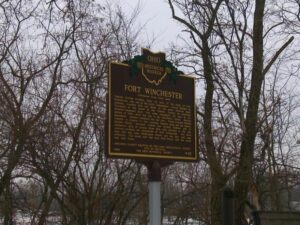
General William Henry Harrison ordered the construction of Fort Winchester at the beginning of October 1812 and it was completed October 15. The fort served as a forward observation post and supply depot for the American army during the War of 1812. Until Fort Meigs was completed in 1813, Fort Winchester was the front line against the British and their Indian allies. During the siege of Fort Meigs, Fort Winchester was a rendezvous point for the troops of General Green Clay and those of Colonel William Dudley. Fort Winchester outlined the shape of a parallelogram, measuring 600 by 300 feet in size. Blockhouses anchored the four corners of the fort and within its stockade were storehouses and a hospital.
, OH
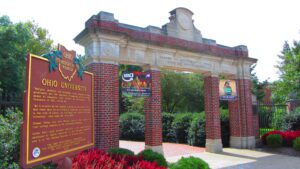
Manasseh Cutler, Rufus Putnam, Winthrop Sargeant, and Benjamin Tupper of the Ohio Company conceived Ohio University, which was encouraged by the Ordinance of 1787 and the Northwest Territorial Legislature in 1799, incorporated as the American Western University in 1802, and chartered by the Ohio State Legislature on February 18, 1804. The university is the first institution of higher learning in the Northwest Territory, second west of the Allegheny Mountains, and the first in the United States to be endowed with land by the government with proceeds used to pay for its operations-revenue from two townships was set aside to support the university. Opened on June 1, 1809, as an academy with three students, Ohio University awarded its first undergraduate degrees in 1815.
, OH
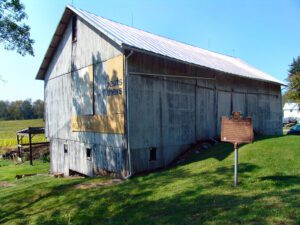
A migration of Indians throughout Ohio began due to unstable conditions created by the American Revolution. The massacre of Christian Indians at the Moravian mission of Gnadenhutten in 1782 and Colonel William Crawford’s expedition against Wyandot and Delaware towns along the Sandusky fueled insecurities. Delaware, including a small group of Mingo Indians, abandoned the village of Helltown, five miles southwest of this site, and settled Greentown as early as 1783. Greentown, situated on an elevation on the Black Fork beyond the clearing behind this site, was presumably named for British loyalist, Thomas Green. John Chapman (Johnny Appleseed) had an amicable relationship with the Delaware, owned land throughout the Black Fork Valley, and was known to visit Greentown on his travels throughout Ohio. Other visitors to the village included the Shawnee Prophet; Munsee Delaware leader, Captain Pipe; and local preacher, James Copus.
, OH
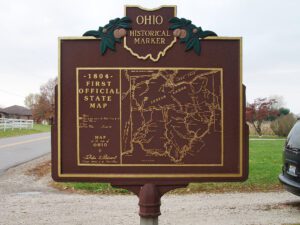
With the signing of the Treaty of Paris in 1783, England lost the American Revolution and ceded to its former colonies land from the Atlantic Ocean to the Mississippi River. By this time, pioneer settlers had reached the eastern bank of the Ohio River, but the Ohio Country, located west and north of the river, was still considered Indian Territory. The Indian tribes desperately defended their hold on this land. On August 20, 1794, United States forces led by Major General Anthony Wayne defeated an Indian alliance at the Battle of Fallen Timbers fought near modern-day Toledo. One year later, on August 3, 1795, the largest assemblage of northwestern Indian representatives at a peace settlement signed the Treaty of Greene Ville, which effectively ceded all land south of the Greene Ville Treaty line to the Americans. The Fort Laurens site was a reference point in the Treaty line. The Ohio Country was then rapidly settled, and in 1808, Tuscarawas County was organized.
, OH
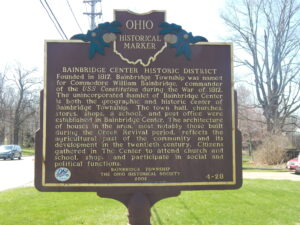
Bainbridge Center Historic District. Founded in 1817, Bainbridge Township was named for Commodore William Bainbridge, commander of the USS Constitution during the War of 1812. The unincorporated hamlet of Bainbridge Center is both the geographic and historic center of Bainbridge Township. The town hall, churches, stores, shops, a school, and post office were established in Bainbridge Center. The architecture of houses in the area, most notably those built during the Greek revival period, reflects the agricultural past of the community and its development in the twentieth century. Citizens gathered in The Center to attend church and school, shop, and participate in social and political functions.
, OH
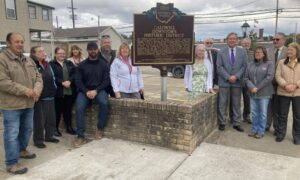
The Caldwell Downtown Historic District is the historic commercial and governmental core of the Village of Caldwell, which was founded in 1857 on farmland owned by Joseph and Samuel Caldwell. Caldwell serves as the county seat of Noble County, the last of Ohio’s 88 counties to be organized. The agricultural community prospered and by 1873 was the second-largest producer of tobacco in Ohio. The Pennsylvania Railroad arrived in 1872, and the development of salt, oil, coal, and natural gas extraction companies followed during the 1880s. Two separate fires in 1897 devastated portions of the north and south quadrants of the district. As a result, Caldwell formed a volunteer fire department and the Village Council introduced legislation prohibiting construction of wood buildings within a block of the public square. (Continued on other side)
, OH
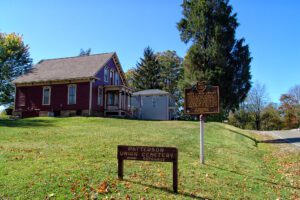
Mary Leonore Jobe was born on January 29, 1878, near Tappan, Harrison County, Ohio. She earned a bachelor’s degree from Scio College and master’s degree from Columbia University. While studying, she began a life-long career of exploration and natural history investigation. She first explored areas of British Columbia, Canada in 1905 and in 1916 started Camp Mystic, a summer camp in Connecticut for girls. She married explorer Carl E. Akeley in 1924 and completed an expedition to Africa when Carl died in the Belgian Congo in 1926. Honors include the naming of Mount Jobe in Canada to recognize her achievements and Belgium awarding her the Cross of the Knight, Order of the Crown, for her work in the Belgian Congo. She is known for her books and contributions to the American Museum of Natural History in New York. She died on July 19, 1966, and is buried in Deersville.
, OH
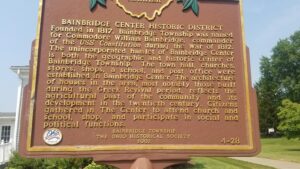
Bainbridge Center Historic District. Founded in 1817, Bainbridge Township was named for Commodore William Bainbridge, commander of the USS Constitution during the War of 1812. The unincorporated hamlet of Bainbridge Center is both the geographic and historic center of Bainbridge Township. The town hall, churches, stores, shops, a school, and post office were established in Bainbridge Center. The architecture of houses in the area, most notably those built during the Greek revival period, reflects the agricultural past of the community and its development in the twentieth century. Citizens gathered in The Center to attend church and school, shop, and participate in social and political functions.