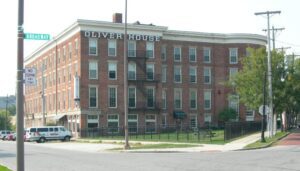
Overlooking the “Middlegrounds,” an early site of railroad, immigration, and commercial activity, the Oliver House opened in 1859 as Toledo’s premier hotel. It was designed by nationally prominent architect Isaiah Rogers, in the Greek Revival style, and built by the family of William Oliver for whom the hotel was named; owner of this land, Oliver was one of Toledo’s earliest real estate investors. (Continued on other side)
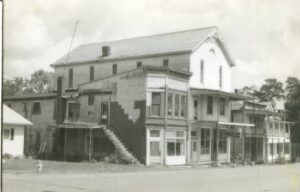
The commercial building that stood at 305 Main Street for over a century was built by Justus S. Law in 1897. On April 1, 1897, Law leased the Odd Fellows and Knights of Pythias joint-use of the third floor, rent-free, for 99 years after they completed its construction and added a slate roof to the building. Although the Pythians purchased the remainder of the building in 1921, they continued to share their “Castle Hall” with the Odd Fellows until 1965. In July 1974, the Pythians assigned their Pleasant City property to the Ohio Knights of Pythias Home in Springfield. From 1974 to 2012 the property exchanged private ownership multiple times until forfeited to the state in 2020. After the dilapidated Victorian building was demolished in 2021 the land was donated to the Village of Pleasant City.
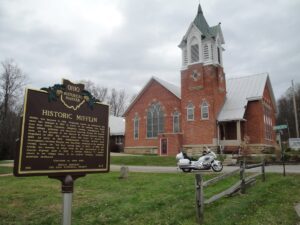
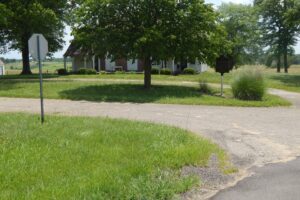
Mifflin was founded in 1816. Originally known as Petersburg, the name was changed in 1827 in honor of the settlers that moved here from Mifflin Township, Allegheny County, Pennsylvania. The first village jailhouse and crossroad watering trough are located here, on the grounds of the historic St. Michael Lutheran Church. Organized in 1835, the church built this house of worship in 1890. As early as 1810, stagecoaches traveled Mifflin’s main thoroughfare between Wooster and Mansfield, stopping at the watering trough, known for “the best spring water in Ohio”. In 1925, the trough was removed to allow room for the construction of the Lincoln Highway built in 1928. A Lincoln Highway “L” marker stands in the village today, in its original location, directing motorists eastbound.
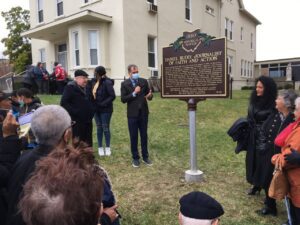
Daniel Arthur Rudd was born into slavery on August 7, 1854, in Bardstown, Kentucky. He became a newspaperman, lecturer, publicist, and tireless advocate for the Roman Catholic Church. After the Civil War Rudd moved to Springfield. Baptized and raised in Catholicism, he joined St. Raphael Parish, where the philosophy of racial equality offered by the church solidified his vision of justice. By 1885 he had established his own weekly newspaper, The Ohio State Tribune. He rebranded it The American Catholic Tribune (ACT) after moving to Cincinnati. Rudd claimed ACT was the only Catholic newspaper owned by an African American. At the height of its popularity in 1892, the publication had a circulation of 10,000. In 1893 Rudd was asked to chair the Afro-American Press Association, representing more than 200 black-owned newspapers.
Agricultural development and cultivation on steep lands led to severe soil erosion in the nation in the 1920s and 1930s. In response, the United States Department of Agriculture established the Soil Conservation Service (SCS) in 1935. The SCS established the North Appalachian Experimental Watershed (NAEW) in the hills of Coshocton County to study and develop methods of conserving soil and water resources. The Federal government and Coshocton County purchased 1,047 acres of land for the program and, in 1936, field research equipment was installed and buildings constructed. The Works Progress Administration (WPA) and Civilian Conservation Corps (CCC) provided labor near the program’s inception, as did the Civilian Public Service Agency during World War II. (Continued on other side)
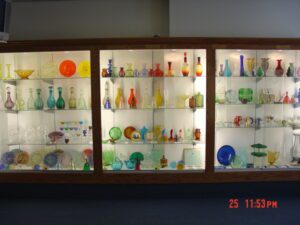
With ready access to raw materials, fuel, skilled labor, and transportation, the Ohio Valley became the center of the American glass industry during the late 1800s. Among dozens of local manufacturers, the Imperial Glass Company, founded in 1901 by river man and financier Edward Muhleman, first made glass in 1904 and distinguished itself for mass production of attractive and affordable pressed glass tableware using continuous-feed melting tanks. One of the largest American handmade glass manufacturers during the 20th century, Imperial also produced blown glass, several lines of art glass, and its trademark “Candlewick” pattern. Bellaire’s glassmaking era ended when the “Big I” closed its doors in 1984, and the building was razed in 1995. Its diverse products remain highly prized by glass collectors.
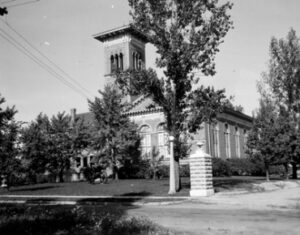
At the turn of the twentieth century, increased enrollment in the Combined Normal and Industrial Department at Wilberforce University (which later became Central State University) spurred construction of new teaching and dormitory facilities. Galloway Hall, which included an auditorium and a tower with chimes and a clock, was completed in 1906. Many famous personalities performed in Galloway Hall’s auditorium, including the renown opera singer Leontyne Price; Robert McFerrin, the first African American male lead with the New York Metropolitan Opera; actors Ruby Dee and Ossie Davis; comedian and civil rights activist Dick Gregory; and composer and conductor Duke Ellington. Noted authors and intellectuals addressed audiences there, including historian John Hope Franklin; writer, poet, actor, and playwright Maya Angelou; Lerone Bennett, author, historian, and editor of EBONY Magazine; and writer and essayist James Baldwin. (continued on other side)
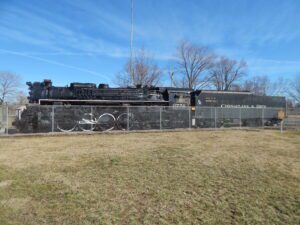
Granville T. Woods was a pivotal African American inventor during the late 19th and early 20th centuries. Woods’ invention of the telegraph device that enabled railway companies to know the location of each of their trains. This new technology greatly enhanced train scheduling and reduced the frequency of fatal collisions throughout the railway industry. From 1878 through 1880 Woods was a railroad locomotive engineer employeed by the Springfield, Jackson and Pomeroy Railroad Company and later by the Dayton and Southeastern Railroad. With frequent stops in Washington Courthouse and extensive leisure time, Woods learned telegraphy from a local telegraph operator. (Continued on other side)