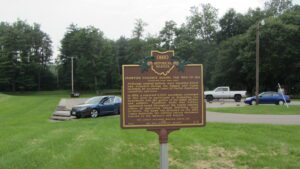
Tensions between Native Americans and Euro-American settlers remained high on the Ohio frontier during the War of 1812. Grievances mounted rapidly following the forced removal of the Greentown Delawares to Piqua in the late summer of 1812. On September 10, British-allied Indians attacked and killed the Frederick Zimmer family and neighbor Martin Ruffner one mile north of here. Five days later, on September 15, Reverend James Copus and three militiamen–George Shipley, John Tedrick, and Robert Warnock–were killed while defending Copus’ family from a raiding party one mile south of this site. (continued on other side)
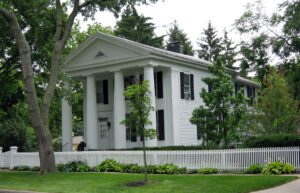
Theodore Dreiser wrote in 1900 his famous novel, Sister Carrie, in this house. It was built in 1835 and altered to Greek Revival Style in 1844. Dreiser acquired it in 1899. The house possesses most of the features typical of the American “classic temple” including four Doric columns rising the full length of the structure. In 1967 the house is owned by the William M. Hankins family.
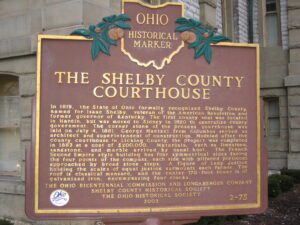
In 1819, the State of Ohio formally recognized Shelby County, named for Isaac Shelby, veteran of the American Revolution and former governor of Kentucky. The first county seat was located in Hardin, but was moved to Sidney in 1820 to centralize county government. The corner stone of the present courthouse was laid on July 4, 1881. George Maetzel from Columbus served as architect and superintendent of construction. Modeled after the county courthouse in Licking County, the project was completed in 1883 at a cost of $200,000. Materials, such as limestone, sandstone, and marble arrived by canal boat. The French Second Empire style building has four symmetrical sides facing the four points of the compass, each side with pillared porticoes approached by broad stone steps. A figure of Lady Justice holding the scales of equal justice surmounts each facade. The roof is classical mansard, and the center170-foot tower is of galvanized iron, encompassing four clocks.
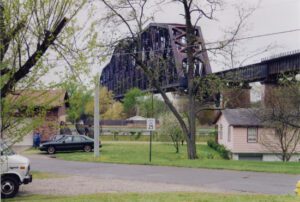
Sciotoville Bridge, 1917, designed and built by two famous American Civil Engineers, Gustav Lindenthal, D.Sc. (1850-1935), the Consulting Engineer (and) David Barnard Steinman, D.Sc. (1887-1960), the designer and stress analyst. A double track railroad bridge of twin spans each 775 feet long, it remained until 1935 the longest continuous truss bridge in the world and stands today as the prototype for continuous structures. Its construction marked a major advance in the art of bridge engineering and was a pioneer achievement in continuous truss analysis. In beauty of design, size and erection techniques it stands as a landmark of progress in man’s mastery of his environment.
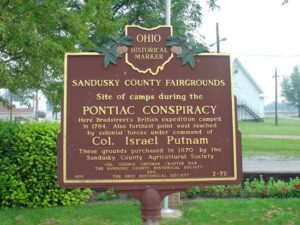
Here Bradstreet’s British expedition camped in 1764. Also farthest point west reached by colonial forces under command of Col. Israel Putnam. These grounds purchased in 1870 by the Sandusky County Agricultural Society.
Described as a Columbus “institution” when he died in 1969, Emerson C. Burkhart was born on a farm in Union Township, Putnam County in 1905. The son of Albert and Nora Burkhart, Emerson graduated from Kalida High School in 1924 and from Ohio Wesleyan University in 1927. After studying art in Provincetown, Massachusetts and in New York City, he settled in Columbus and, in 1937, married Mary Ann Martin, an artists’ model who devoted herself to his career. Burkhart was a prolific painter and completed an estimated 3,000 pictures during his 40-year career, including street scenes, rural landscapes, and more than 250 self-portraits, once noting his face was “cheaper than a model’s and always there.”
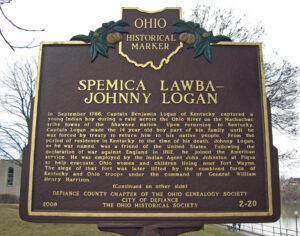
In September 1786, Captain Benjamin Logan of Kentucky captured a young Indian boy during a raid across the Ohio River on the Machachac tribe towns of the Shawnee nation. Upon returning to Kentucky, Captain Logan made the 14 year old boy part of his family until he was forced by treaty to return him to his native people. From the period of residence in Kentucky to the time of his death, Johnny Logan, as he was named, was a friend of the United States. Following the declaration of war against England in 1812, he joined the American service. He was employed by the Indian Agent John Johnston at Piqua to help evacuate Ohio women and children living near Fort Wayne. The siege of that fort was later lifted by the combined force of Kentucky and Ohio troops under the command of General William Henry Harrison. [continued on other side]
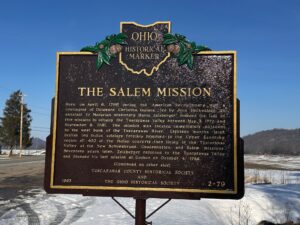
Here, on April 6, 1780 during the American Revolutionary War, a contingent of Delaware Christian Indians, led by John Heckwelder, an assistant to Moravian missionary David Zeisberger, founded the last of five missions to occupy the Tuscarawas Valley between May 3, 1772 and September 8, 1781. The mission was located immediately adjacent to the west bank of the Tuscarawas River. Eighteen months later, British led Indian soldiers forcibly removed to the Upper Sandusky region all 400 of the Indian converts then living in the Tuscarawas Valley at the New Schoenbrunn, Gnadenhutten, and Salem missions. Seventeen years later, Zeisberger returned to the Tuscarawas Valley and founded his last mission at Goshen on October 4, 1798.