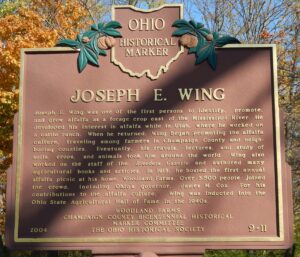
Joseph E. Wing was one of the first persons to identify, promote, and grow alfalfa as a forage crop east of the Mississippi River. He developed his interest in alfalfa while in Utah, where he worked on a cattle ranch. When he returned, Wing began promoting the alfalfa culture, traveling among farmers in Champaign County and neighboring counties. Eventually, his travels, lectures, and study of soils, crops, and animals took him around the world. Wing also worked on the staff of the Breeders Gazette and authored many agricultural books and articles. In 1913, he hosted the first annual alfalfa picnic at his home, Woodland Farms. Over 3,500 people joined the crowd, including Ohio’s governor, James M. Cox. For his contributions to the alfalfa culture, Wing was inducted into the Ohio State Agricultural Hall of Fame in the 1940s.
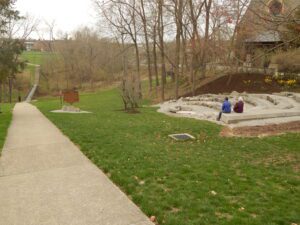
In what was called the “Freedom Summer” of 1964, more than 800 volunteers, most of them college students, gathered at the Western College for Women (now Western Campus of Miami University) to prepare for African-American voter registration in the South. Three of the volunteers – James Chaney of Mississippi, and Andrew Goodman and Michael Schwerner of New York – disappeared on June 21, 1964, in rural Mississippi mere days after leaving Oxford, Ohio. Their bodies were discovered forty-four days later, buried in an earthen dam. Ku Klux Klan members were later convicted on federal conspiracy charges. Erected in 1999, this outdoor amphitheater is a memorial to the slain activists, other volunteers, and ideals of the Freedom Summer movement.
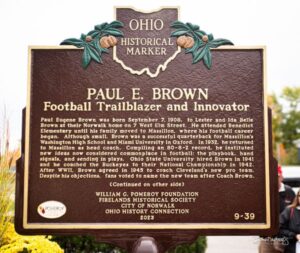
Paul Eugene Brown was born September 7, 1908, to Lester and Ida Belle Brown at their Norwalk home on 7 West Elm Street. He attended Benedict Elementary until his family moved to Massillon, where his football career began. Although small, Brown was a successful quarterback for Massillon’s Washington High School and Miami University in Oxford. In 1932, he returned to Massillon as head coach. Compiling an 80-8-2 record, he instituted new ideas now considered commonplace in football: the playbook, hand signals, and sending in plays. Ohio State University hired Brown in 1941 and he coached the Buckeyes to their National Championship in 1942. After WWII, Brown agreed in 1945 to coach Cleveland’s new pro team. Despite his objections, fans voted to name the new team after Coach Brown. (Continued on other side)
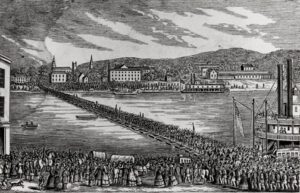
The American Civil War was in its second year, and Confederate forces were advancing in the east and in the west. Confederates led by General Edward Kirby Smith had defeated a Union Force at Richmond, Kentucky on August 30, 1862. Word was received that they were advancing on Cincinnati. Ohio Governor David Tod issued a proclamation to all Ohioans: “Our Southern border is threatened with invasion. I therefore recommend that all the loyal men of your Counties at once form themselves into military companies. Gather up all the arms in the county and furnish yourselves with ammunition for the same. The service will be but for a few days. The soil of Ohio must not be invaded by the enemies of our glorious government.” (continued on other side)
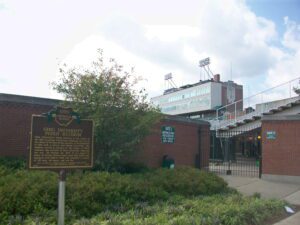
Ohio University’s Peden Stadium is the oldest of the Mid-American Conference stadiums and one of the oldest of its type in the country. It was dedicated in 1929 with a victory over Miami University. The stadium served as housing for the influx of WWII veterans who enrolled at Ohio University following the war. On October 22, 1960, it was named in honor of former Bobcat head coach Don Peden who coached from 1929 to 1946 and compiled a record of 121 wins, 46 losses, and one tie.
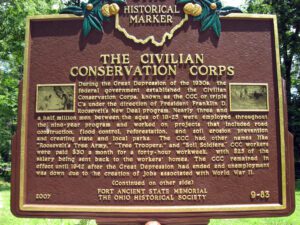
During the Great Depression of the 1930s, the federal government established the Civilian Conservation Corps, known as the CCC or triple C’s under the direction of President Franklin D. Roosevelt’s New Deal program. Nearly three and a half million men between the ages of 18-25 were employed throughout the nine-year program and worked on projects that included road construction, flood control, reforestation, and soil erosion prevention and creating state and local parks. The CCC had other names like “Roosevelt’s Tree Army,” “Tree Troopers,” and “Soil Soldiers.” CCC workers were paid $30 a month for a forty-hour workweek, with $25 of the salary being sent back to the workers’ homes. The CCC remained in effect until 1942 after the Great Depression had ended and unemployment was down due to the creation of jobs associated with World War II.
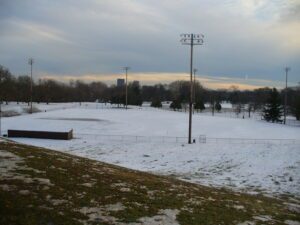
On October 3, 1920 the first game matching two professional teams of the American Professional Football Association, a league that would become the National Football League (NFL), was held on this field within Triangle Park. In that game, the Dayton Triangles defeated the Columbus Panhandles 14-0. The Triangle’s Lou Partlow scored the first touchdown and George “Hobby” Kinderdine kicked the first extra point. Three factories founded by Dayton businessmen Edward Deeds and Charles Kettering sponsored the Dayton Triangles team. The factories were the Dayton Engineering Laboratories Company (DELCO), Dayton Metal Products Company (D.M.P.Co.), and Domestic Engineering Company (DECO), later call Delco-Light. They formed an industrial triangle of plants in downtown Dayton.
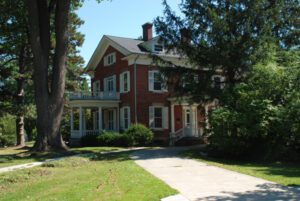
Jabez Lyman Burrell (1806-1900), originally from Massachusetts, built this house in 1852. Burrell made his living as a cattleman and farmer, but devoted much of his time serving the cause of abolitionism, helping slaves, who had escaped the South, get to Sheffield and from there to Lorain and across Lake Erie to Canada. He was also devoted to equal education for all, providing funding to a freedmen’s school in Selma, Alabama, and serving as a trustee of the Oberlin Collegiate Institute, well known for educating African Americans and women. From 1884 to 1934, this was the home of Henry Churchill King (1858-1934), who was the president of Oberlin College from 1902-1927. The Kings added the porches and rear wing and made their home a social center for the college and community. The house is listed on the National Register of Historic Places and is a City of Oberlin Historic Landmark.