

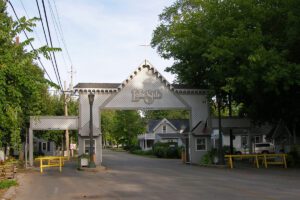
, OH
Established in 1873, Lakeside is a pioneer of the American Chautauqua Movement, one of the greatest revival movements in United States history which flourished in the late nineteenth and early twentieth centuries. Founded by the Methodist Church, Lakeside is one of the few existing Chautauqua communities that remain and thrive today. Each summer, the late-Victorian community provides spiritual, cultural, intellectual, and recreational programs designed to nurture the mind, body, and spirit. It draws visitors from across the country and around the world for its Chautauqua program. Lakeside is recognized on the National Register of Historic Places.
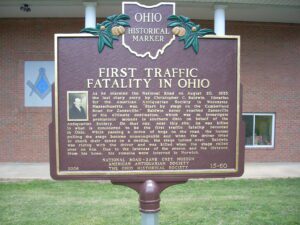
, OH
As he traveled the National Road on August 20, 1835, the last diary entry by Christopher C. Baldwin, librarian for the American Antiquarian Society in Worcester, Massachusetts, was, “Start by stage on the Cumberland Road for Zanesville.” Baldwin never reached Zanesville or his ultimate destination, which was to investigate prehistoric mounds in southern Ohio on behalf of the Antiquarian Society. On that day, near this site, he was killed in what is considered to be the first traffic fatality recorded in Ohio. While passing a drove of hogs on the road, the horses pulling the stage became unmanageable and when the driver tried to check their speed on a decline, the stage turned over. Baldwin was riding with the driver and was killed when the stage rolled over on him. Due to the lateness of the season and the distance from his home, his remains were interred in Norwich.
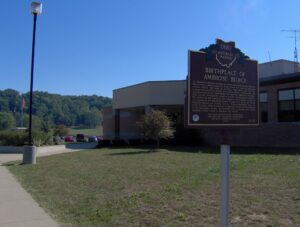
, OH
An influential American journalist of the late nineteenth century, Ambrose Bierce (1842 – c. 1914) was born in Meigs County and reared in Kosciusko County, Indiana. He fought in the Union Army during the Civil War, a formative experience related in his short stories “Chickamauga” and “An Occurrence at Owl Creek Bridge.” Moving to San Francisco in the years after the war, he began his career as a writer and newspaper columnist. His cynical wit and elaborate puns reached a wide audience during the last quarter of the nineteenth century through such papers as William Randolph Hearst’s San Francisco Examiner. Bierce’s best-known book, the Devil’s Dictionary (1911), is a lexicon of humorous definitions first published in his newspaper columns. In December 1913 or January 1914, Bierce vanished during travels in rebellion-torn Mexico.
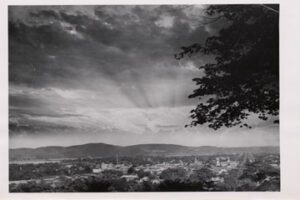
, OH
The hills before you were inspiration for the design of The Great Seal of the State of Ohio. The seal, first depicted in 1803, was often reconfigured until the present image was sanctioned by the Ohio General Assembly in 1967 and modified in 1996. In 1803 the law prescribed the sheaf of wheat to represent Ohio’s agricultural roots and the bundle of seventeen arrows to symbolize Ohio’s place as the seventeenth state in the Union. In the background is a range of hills, including Mount Logan, as viewed from Thomas Worthington’s estate, Adena, now a state memorial. (continued from other side)
, OH
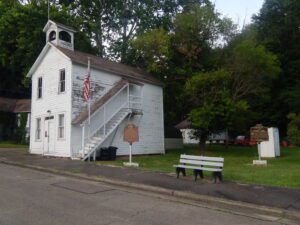
“I say white brother, because I believe that to be the proper phrase, inasmuch as I believe in the principle of the fatherhood of God and the brotherhood of all mankind no matter what the color of his skin may be.” Richard L. Davis championed the cause of racial equality throughout the eastern coalfields, calling for an end to the color line and for all miners to unite against wage slavery. He was born in Roanoke County, Virginia in 1862 and arrived in racially integrated Rendville in 1882, where he became an organizer for the Knights of Labor. In 1886, a year after the Great Hocking Valley Strike, Davis wrote his first letters to the editor of the National Labor Tribune, establishing himself as voice for miners in the labor movement. (Continued on other side)
, OH
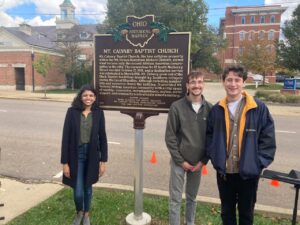
Mt. Calvary Baptist Church, the lone religious property within the Mt. Vernon Downtown Historic District, served what became only the second African American congregation in the city. The cornerstone for 13 South Mulberry Street was laid October 17, 1915, and a dedication service was celebrated in March 1916. Mt. Calvary grew out of the Black Baptist traditions brought by Southern refugees during the Great Migration. Although dwindling membership and resources closed the building, it provided Mt. Vernon’s African American community with a vital space of worship, communion, mutual assistance, asylum, social support, and community celebration for almost a century.
, OH
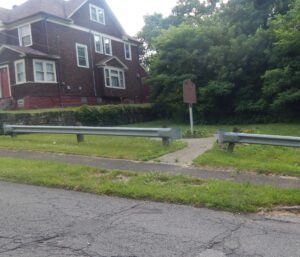
Oscar D. Boggess (1832-1907) was born in Virginia, the son of a slave and her master. He and his family were granted freedom in the will of his father and master. The will was contested up to the United States Supreme Court, which upheld Boggess’ freedom. Boggess moved to Pennsylvania at age 20, and during the Civil War, joined the 43rd United States Colored Troops. He earned the Butler Medal of Honor for bravery at the Battle of the Crater near Petersburg, Virginia, in July 1864. Boggess moved to Youngstown after the war, and worked as a stonemason. He was a charter member of Tod Post 29, Grand Army of the Republic, in Youngstown, and a co-founder of the Oak Hill Avenue African Methodist Episcopal Church, the city’s first African American religious congregation. The Boggess home, formerly located near this site, hosted the church’s first meetings in 1870.
, OH
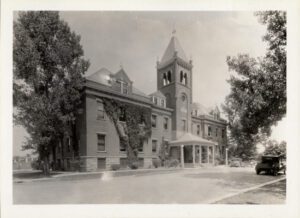
Central State University originated on March 19, 1887, when the Ohio General Assembly passed an act establishing a Combined Normal and Industrial (CN&I) Department at Wilberforce University. Through various transitional changes, it emerged as an independent, state university. In 1941, the General Assembly expanded the CN&I, which offered two-year courses, into the College of Education and Industrial Arts, with four-year programs. In 1947, it separated from Wilberforce University. The history of Central State University tells the history of higher education and advancement for African Americans in Ohio. It is within the walls of these structures, and others unfortunately demolished or destroyed by the 1974 tornado, that thousands of African Americans received valuable training for successful and rewarding careers. Thus, many of the contributions of African Americans to the promotion and betterment of education, medicine, law, social justice, technology, and the arts in Ohio have their roots here on the campus of Central State University.