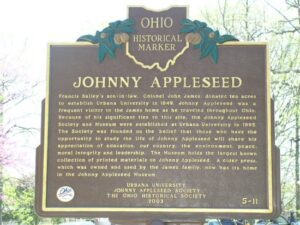
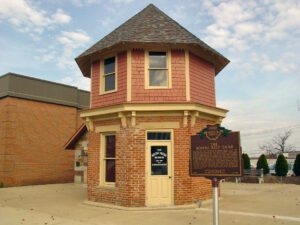
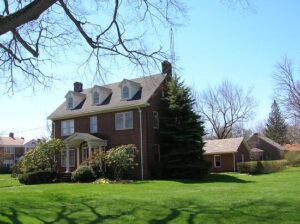
Urbana University was established by the Swedenborgian Church in 1850. Bailey Hall (1853), named after Francis Bailey (1735-1815), was designed by W. Russell West, architect of the Statehouse of Ohio. Bailey was an American Revolutionary War hero, official printer of the Continental Congress and printer of The Freeman’s Journal or the North American Intelligencer. He also printed The True Christian Religion papers. John (Johnny Appleseed) Chapman (1774-1845) distributed The True Christian Religion papers along with his famous apple trees throughout Ohio as a missionary for the Swedenborgian Church. Barclay Hall (1883) was named after Hester Barclay, a ward of Francis Bailey. It was Hester Barclay’s brother-in-law, John Young, who converted Chapman to the Swedenborg faith. Francis Bailey and Hester Barclay were the first male and female Swedenborgian converts in North America. Both Bailey and Barclay halls appear on the National Register of Historic Places.
The Scioto Salts Licks, located in and around Jackson, is an area where naturally occurring salt water, known as brine, flowed to the surface as a salt-water spring. It is known that the spring existed since the Pleistocene Ice Age because numerous bones, probably including those of mammoth and ground sloth, were excavated there. Native Americans obtained salt here for at least 8,000 years and did so until 1795 when the Treaty of Greenville separated the Native American and European populations. Early pioneer settlers utilized the licks in the second half of the eighteenth and first half of the nineteenth centuries, constructing salt furnaces that extended for four miles up and down Salt Lick Creek. Salt was a precious and necessary commodity, and the early settlers in the area profited from its trade.
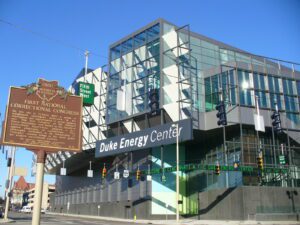
On this site in October of 1870 met a group of enlightened individuals dedicated to the reformation and improvement of penal systems. This first Congress of the National Prison Association, now known as the American Correctional Association, adopted a far-sighted philosophy of corrections. This philosophy, embodied in its Declaration of Principles, remains today as the basic guide for modern correctional systems.
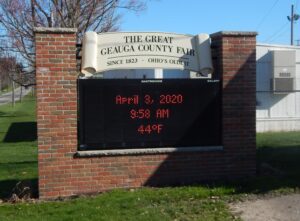
The Great Geauga County Fair is the longest continuously operating county fair in Ohio. The fair is a major county gathering event each year, pulling together people from the whole county. Geauga’s settlers imported the idea of the county fair with them from New England. The fair’s parent organization, the Geauga County Agricultural and Manufacturing Society, began holding fairs on Chardon Square in 1823. Since then, the Geauga County Fair has served as a gathering place and form of education to promote local agriculture and introduce farmers to new farming developments and each other. Controversy arose between 1840 and 1854 after Lake County ceded and Chardon, Claridon, and Burton vied for the permanent fair grounds. Burton’s proposal was accepted, improvements began immediately, and the fair grew quickly. The Great Geauga County Fair continues as a time-honored tradition.
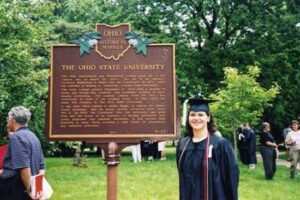
The Ohio Agricultural and Mechanical College grew out of the Cannon Act of March 22, 1870. “But let it be started,” Governor Rutherford B. Hayes told the Legislature in 1873, “with the intention of making it a great State University.” The little college opened September 17, 1873 with a faculty of seven and twenty-four students. One academic building at first housed everything. The campus, remote from the city, was surrounded by some of the original forest. In May, 1878 the name was changed to The Ohio State University. It was after 1900 before it really began to realize its educational potential, and its major growth occurred after World War II. By 1970, the Centennial Year, the university had more then met the hopes of its founders. A leading university with great manpower and physical resources, it had earned high standing in many fields covering a wide range of educational and research activities.
Administration Building built in 1931. Chapter House built in 1962. Commemorating American Red Cross Centennial, 1881-1981.
Early Western Reserve burial grounds, 1804-1848. Grave sites of 12 Revolutionary War veterans and Mary Chesney, member of pioneer Warren family and for whom local D.A.R. chapter was named.
On this site stood the Main Gatehouse of the Anna Dean Farm, estate of Barberton town founder and industrialist Ohio C. Barber. The Anna Dean Farm was not only a lavish estate but also a farming showcase built to promote and develop scientific agricultural practices in the United States.
This historic village was a hub for early Ohio industry and travel. The natural geography of the area provided ideal conditions for the establishment of a variety of mills. Col. Robert Patterson, an ancestor of the founder of National Cash Register in Dayton, John Patterson, chose Clifton for the site of a woolen mill, which furnished material for the American army during the War of 1812. Davis Mill, established in 1802 and in operation today as Clifton Mill, produced meal and flour for Civil War troops. A major stop on the stagecoach trail, “The Accommodation Line,” which ran from Springfield to Cincinnati from 1827 to 1840, the village bustled with the commotion of travelers. The once flourishing industry of Clifton faded as railroad traffic bypassed the village and manufacturers left the area.