When inventor and entrepreneur Garrett Augustus Morgan sold his Traffic Signal patent to General Electric in 1923, he used the $40,000 to purchase a 121-acre farm in Huron County in 1924. Advertising “a village of our own,” Morgan established the Wakeman Country Club — one of Ohio’s early African American recreation clubs — and offered 247 lots for $60 each in “Wakeman Heights.” Located near the intersection of State Route 60 and Chenango Road, the development provided country pleasures to Blacks excluded from the Country Club lifestyle. Club membership, included in the purchase of a lot, offered fishing, hunting, swimming, and horseback riding. A restaurant, dance hall, and amphitheater provided cultural and boxing events. The club waned during World War II and no buildings from the once-thriving Wakeman Country Club remain.
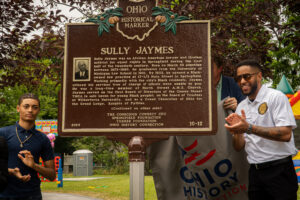
Sully Jaymes was an African American lawyer and tireless activist for equal rights in Springfield during the first half of the twentieth century. Born on March 30 sometime between 1875-1880, he graduated from the University of Michigan Law School in 1901. By 1903, he opened a Black-owned law practice at 17-1/2 Main Street in Springfield. Working primarily with the city’s Black residents, Jaymes offered his services free of charge if clients were unable to pay. He was a long-time member of North Street A.M.E. Church. Jaymes served on the first Board of Directors of the Center Street YMCA (a safe-haven for young Black people), on the Board of Trustees at Wilberforce University, and as a Grand Chancellor of Ohio for the Grand Lodge, Knights of Pythias. (Continued on other side)
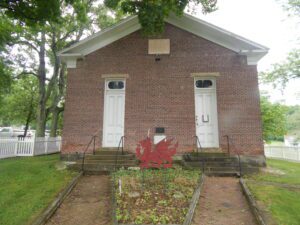
In 1972 a group of Welsh-Americans chartered the Welsh-American Heritage Museum to preserve Welsh history and culture, and to preserve the Welsh Congregational Church. The old brick church was where songs of praises rang, as the Welsh gathered and sang beloved hymns of their homeland in four-part harmony. The church is a link in a long, unbroken chain of memories and still serves the community as a center of Welsh-American activities and a keeper of the community’s heritage. The red dragon and daffodil are symbols of Wales.
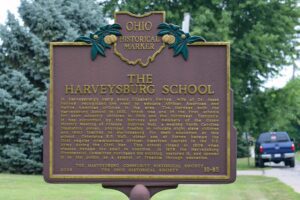
The Quaker village of Harveysburg was founded in 1829 on land originally a part of Colonel Abraham Buford’s Revolutionary War Land Grant. Levi Lukens, a Virginia Quaker, purchased the 1000 – acre survey in 1812 and sold a portion to Rhoden Ham in 1815. Ham then sold a portion of his holdings to William Harvey, a Quaker originally from North Carolina, who developed 47 lots for a village which thrived from its beginnings. Early businesses included grist mills, a tin shop, hardware store, blacksmith shop, a large pork packing plant, a bank, and a dry goods store owned by William Harvey. Its first post office opened in 1839. Harveysburg was incorporated in 1844. The village received its name from a merchant in Cincinnati who told William Harvey that he should add burg to his name and call the place Harveysburg.
In 1918, Charles Young made a desperate attempt to convince the U.S. Army that he was fit for duty. The Army’s highest-ranking Black officer, he had been medically retired and not given a command during World War I. To demonstrate his fitness, he rode 497 miles from his home in Wilberforce, Ohio, to Washington, D.C. Leaving on June 6 he made the journey in 17 days, 16 on horseback and 1 resting. Averaging 31 miles each day, he rode 45 minutes and walked 15 minutes every hour. Upon his arrival, Young met with Secretary of War Newton Baker. Pressured by the Black press and the White House, Baker hedged. He recalled Young to active duty a year later and assigned him to Camp Grant, Illinois, just five days before the end of the war.
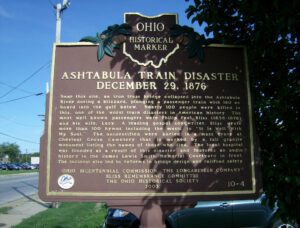
Near this site, an iron truss bridge collapsed into the Ashtabula River during a blizzard, plunging a passenger train with 160 on board into the gulf below. Nearly 100 people were killed in this, one of the worst train disasters in American history. The most well known passengers were Philip Paul Bliss (1838-1876) and his wife, Lucy. A leading gospel songwriter, Bliss wrote more than 100 hymns including the music to “It Is Well With My Soul.” The unidentified were buried in a mass grave at Chestnut Grove Cemetery that is marked by a tall granite monument listing the names of those who died. The local hospital was founded as a result of this disaster and features an audio history in the James Lewis Smith Memorial Courtyard in front. The incident also led to reforms in bridge design and railroad safety.
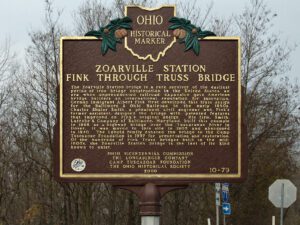
The Zoarville Station Bridge is a rare survivor of the earliest period of iron bridge construction in the United States, an era when unprecedented railroad expansion gave American bridge builders an international reputation for innovation. German immigrant Albert Fink first developed this truss design for the Baltimore & Ohio Railroad in the early 1850s. Charles Shaler Smith, a prominent civil engineer and Fink’s former assistant, designed the bridge with patented features that improved on Fink’s original design. His firm, Smith, Latrobe & Company of Baltimore, Maryland, built this example in 1868 as a highway bridge over the Tuscarawas River in Dover. It was moved to this site in 1905 and abandoned in 1940. The Lebold family donated the bridge to the Camp Tuscazoar Foundation in 1997 for preservation and restoration. Of the hundreds of Fink Truss bridges built in the mid-1800s, the Zoarville Station Bridge is the last of its kind known to exist.
Surgeon and songwriter Brewster Higley VI was born in Rutland in 1823, the grandson of Brewster Higley IV, a veteran of the American Revolution and founder of Rutland. Higley began studying medicine at age 18 and opened his first practice in Pomeroy, moving to Indiana and then to Kansas in 1871. The following year he penned the words to the famous Western song, “Home on the Range.” This perennial favorite became the state song of Kansas in 1947. Oh, give me a home where the buffalo roam, And the deer and the antelope play, Where seldom is heard a discouraging word, And the skies are not cloudy all day.