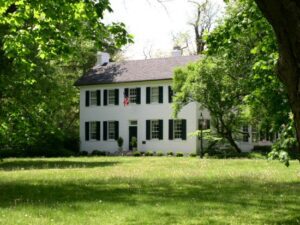
John Anderson Ward had this Federal style house constructed from 1823-1825 on land inherited from his father, Urbana’s founder Colonel William Ward. The Colonel’s will stipulated that a local mason use 26,500 bricks to build the house and be paid $80.00. The original house is thought to have had four rooms, two rooms each on the first and second floors and both divided by central hallways. John and his wife Eleanor Ward reared seven children in the house, two of whom became nationally recognized artists, John Quincy Adams Ward and Edgar Melville Ward. The farmstead, consisting of 172 acres, was also the site of a huge feast held in honor of General William Henry Harrison’s visit to Champaign County during his 1840 presidential campaign. Twelve 300 foot-long tables were spread across the lawn where thousands of people from the surrounding countryside dined on barbecued beef and lamb and drank barrels of cider.
The house of Ebenezer Zane was built here in 1805. The structure was the meeting place for the First Methodist Quarterly Conference in 1819 where over 300 settlers in the area and about sixty members of the Wyandot tribe came together. Although the cabin was reconstructed in 1997, it is a symbol of harmonious relations between American settlers and the Wyandot in the years before the latter’s removal from Ohio in 1842.
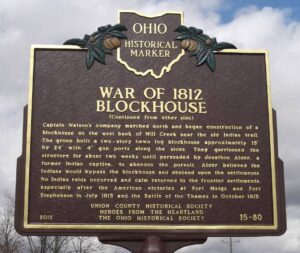
Following the American surrender of Fort Detroit in August 1812, panic spread along the Ohio frontier in fear of possible Indian attacks. The boundary of the Indian territory lay approximately 14 miles to the north at the Greenville Treaty line. Ohio Governor Return Jonathan Meigs, Jr. called out the Ohio Militia to defend the frontier and to construct blockhouses to guard against Indian attacks. A local militia company of 70 men was raised in present Union and Madison Counties to protect the settlements along Big Darby Creek. David Watson served as captain with Frederick Lloyd as first lieutenant.
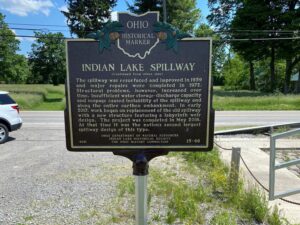
Indian Lake Dam was built 1851-1860 to create a feeder lake, known as the Lewistown Reservoir, for the Miami and Erie Canal. The dam included a 700-foot long concrete ogee weir spillway that discharged water from the lake into the Great Miami River. In 1898, the Ohio General Assembly designated the lake as a public recreation area and renamed it Indian Lake. The lake and dam structure have been owned and operated by the Ohio Department of Natural Resources since the creation of ODNR in 1949. (Continued on other side)
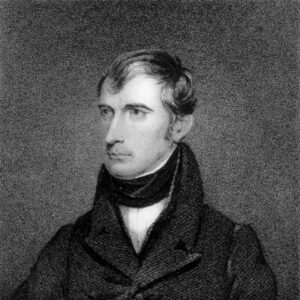
During the War of 1812, Northwestern Army Commander General William Henry Harrison led troops through northwest Ohio on the way to Detroit and Ft. Malden in Michigan. After the decimation of General James Winchester’s division at Frenchtown (Monroe, Michigan) by British and Indian forces, Harrison retreated and led his troops southward to the Portage River. Near this site, now the William Henry Harrison Park, Harrison’s men waited for supplies and reinforcements, which were delayed due to heavy rains and flooding in the Black Swamp. With the addition of General Leftwich’s brigade at the end of January 1813, Harrison’s forces reached approximately 1,700. The troops endured the harsh, wet weather and several soldiers died of exposure and were buried at the camp. Once the winter freeze set in, Harrison led the remaining troops to the rapids of the Maumee River where construction of Fort Meigs began.
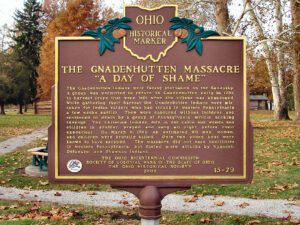
The Moravian Church in America began missionary work among the Delaware and Mohican tribes of North America in the mid-18th century. David Zeisberger, one of the best-known Moravian missionaries, came to the Ohio country with Delaware converts from a mission in western Pennsylvania and founded Schoenbrunn in the Tuscarawas Valley on May 3, 1772. Josua, a Mohican convert and missionary leader, led Mohican and Munsee Christians downriver and settled Gnadenhutten (“Tents of Grace”) on October 9, 1772. Zeisberger served as lead missionary at both villages. By 1775, there was an estimated 200 inhabitants in the village. The British, along with Wyandot and Delaware allies, suspected the Christian Indians of aiding the Americans. To ensure their allegiance to the British, the inhabitants of Gnadenhutten were forcibly removed in 1781 and taken to Captives’ Town on the Sandusky River.
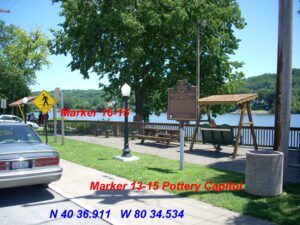
Fawcettstown, later to become East Liverpool, marked the first Ohio community to be encountered by early river travelers as they headed toward new challenges and new lives in the expanding nation. Indian canoes, flatboats, and steamboats carried increasing traffic, both passenger and freight, along these Ohio “Gateway” shores. Many of these early craft were built locally and local residents served as crewmen. Products from farms and ceramics from this city’s pioneer potteries were shipped from this site. The wharf area also served as a landing place for many of the early English potters who came here to ply their trades and, in the process, create a defining industry. The river continues to play an important role in industrial and recreational capacities.
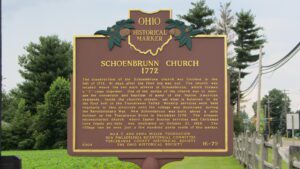
In December 1772, Brother David Zeisberger and his followers began the construction of Schoenbrunn schoolhouse. The school was built in the Tuscarawas Valley on land given to Zeisberger in the spring of 1771 by the Delaware Native Americans as a Moravian mission to the Delaware. With the land, Zeisberger laid out the town of Schoenbrunn or “Beautiful Spring.” The school served Delaware Indian children, who were taught from special textbooks prepared in the Delaware and German languages by Zeisberger. John Heckewelder, who taught at the school, is recognized as the first schoolteacher in Tuscarawas County. The present reconstructed schoolhouse was dedicated on July 29, 1928 on the 155th anniversary of the completion of the school’s construction. The village can be seen just a few hundred yards south of this marker.