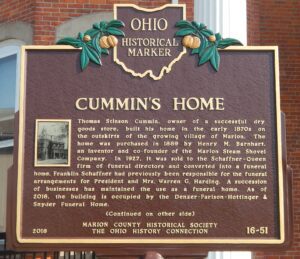
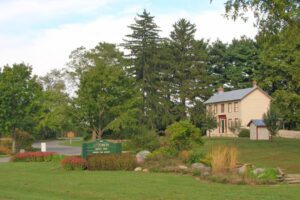
Thomas Stinson Cummin, owner of a successful dry goods store, built his home in the early 1870s on the outskirts of the growing village of Marion. The home was purchased in 1889 by Henry M. Barnhart, an inventor and co-founder of the Marion Steam Shovel Company. In 1927, it was sold to the Schaffner- Queen firm of funeral directors and converted into a funeral home. Franklin Schaffner had previously been responsible for the funeral arrangements for President and Mrs. Warren G. Harding. A succession of businesses has maintained the use as a funeral home. As of 2016, the building is occupied by the Denzer-Farison-Hottinger & Snyder Funeral Home. (Continued on other side)
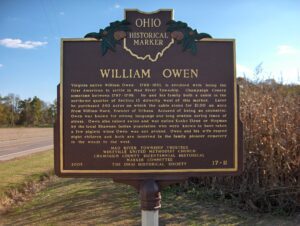
Virginia native William Owen, 1769-1821, is credited with being the first American to settle in Mad River Township, Champaign County sometime between 1797-1799. He and his family built a cabin in the northeast quarter of Section 15 directly west of this marker. Later he purchased 240 acres on which the cabin stood for $1.00 an acre from William Ward, founder of Urbana. Accused of being an eccentric, Owen was known for strong language and long oration during times of stress. Owen also raised swine and was called Kosko Elene or Hogman by the local Shawnee Indian population who were known to have taken a few piglets when Owen was not around. Owen and his wife reared eight children and both are interred in the family pioneer cemetery in the woods to the west.
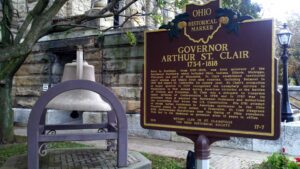
Born in Scotland. From 1787-1802, was first governor of the Northwest Territory, which included Ohio, Indiana, Illinois, Michigan, Wisconsin and part of Minnesota. St. Clair established territorial court system and Ohio’s first nine counties, including Belmont in 1801 and named St. Clairsville its county seat. St. Clair’s promotion to major general in 1777 recognized his exemplary service to Washington in New Jersey during American victories at the battles of Trenton and Princeton. St. Clair was a delegate to Congress under Articles of Confederation in 1786 and in 1787 was its president when it adopted the Northwest Ordinance and authorized the convention that wrote the U.S. Constitution. His 1791 attempt to break Indian resistance to American settlement in the Ohio Country ended in bitter defeat. A Federalist, St. Clair disagreed with Jeffersonian-Republicans over the timing of Ohio statehood. This led to his dismissal as governor after 15 years in office.
The 17th Infantry, created by Congress in 1812 and formed with personnel from western states, was the only Regular Army regiment in General James Winchester’s column of the Army of the Northwest’s campaign to regain Detroit. During the War of 1812, the 17th fought at Frenchtown, Fort Meigs, Fort Stephenson, and Thames River. In 1815, the 17th was consolidated with the 5th, 19th, and 28th Infantry to form the 3rd Infantry. In May 1861, the 17th Infantry was again organized as a Regular Army regiment and has since served continuously with distinction.
This area of western Hancock County is a part of the Maumee River Watershed known as “Indian Green.” Wyandot Indians chose this area for hunting and ceremonial grounds along the Blanchard River in the 1700s because it was next to the river, yet high enough to avoid frequent flooding. One-half mile east of this location is a Liberty Township cemetery. It is located upon a sand ridge once used as a burial ground by Indians, hence the name “Indian Green.”
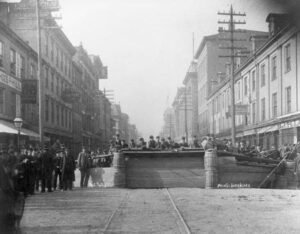
In March 1884, public confidence of Cincinnati law enforcement was extremely low. The public believed that murderers and other serious offenders were not brought to justice promptly or received little punishment. Civil unrest was brought to a boil when a seventeen-year-old was sentenced to only twenty years for manslaughter after brutally murdering his employer. On March 28, thousands of citizens stormed the county jail and courthouse. The riots lasted three days requiring forces from the Sheriff’s Office, city police, and local and state militia to restore order. Fifty-four people were killed and more than 200 wounded. The courthouse and jail suffered enormous damage, and valuable records were destroyed from the assault and fire. The riot gained international notoriety and helped pave the way for removal of political favoritism and a larger police force.
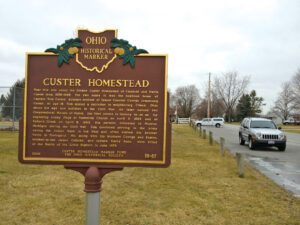
Near this site stood the former Custer Homestead of Emanuel and Maria Custer from 1856-1865. For two years it was the boyhood home of Captain Tom Custer, younger brother of famed General George Armstrong Custer. At age 16, Tom misled a recruiter in neighboring Gilead, Ohio about his age and enlisted in the Civil War. He later earned two Congressional Medals of Honor, the first person in history to do so, for capturing enemy flags at Namozine Church on April 3, 1865 and at Sailor’s Creek on April 6, 1865. His parents relocated to Monroe, Michigan during the Civil War. Tom continued serving in the Army during the Indian Wars in the West and often visited his brother Nevin in Tontogany. He, along with his brothers George and Boston, brother-in-law James Calhoun, and nephew Harry Reed, were killed at the Battle of the Little Bighorn in June 1876.
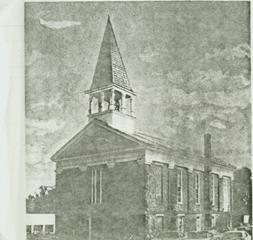
This site has long served the religious, education, and public interests of the residents of Mechanicsburg. A local Methodist congregation built its first church here in 1820, and the townspeople also used the structure as its village school. The Methodists replaced their original structure in 1837, using brick as the main building material. As the Methodist congregation grew, however, it was determined that a larger, more permanent structure was needed. As a result, the Mechanicsburg First Methodist Church was built here in 1858, and it served the congregation until 1894 when an African American based Second Baptist congregation purchased the building at a cost of $2,850. Besides religion and education, the site was also used as Mechanicsburg’s first cemetery. That cemetery lasted until the Maple Grove Cemetery was established and burials at this site were relocated there. [continued on other side]