In the early 1770s, Chief White Eyes (Koquechagachton) of the Delaware tribe founded White Eyes Town approximately two miles southeast of this marker on a plain near present day West Lafayette. A friend of the Moravian leader David Zeisberger, White Eyes was an ardent supporter of Moravian missionary efforts and kept the Delawares neutral during the American Revolutionary War. White Eyes’s dream was to bring his people under the influence of Christianity. He also hoped to establish a fourteenth state for the Indian nations, which would join the other thirteen. White Eyes died at the height of his career in November 1778 near Pittsburgh. The cause of his death remains open to question.
In the mid-1700s, France found its influence waning among midwestern tribes as it contested for Native American trade and military alliances with Great Britain. Shortly after Miami chief Memeskia (also known as Old Britain or La Demoiselle) moved his village to Pickawillany, British traders were given permission to establish a small post in the village, which was deep in the territory claimed by France. When French demands to evacuate the post failed, Charles Langlade led a party of 250 Ottawa and Ojibwe warriors and French Canadians in a surprise attack on the Miami village on June 21, 1752. The trading post was destroyed, British traders were taken to Detroit as prisoners, and Memeskia was executed. Pickawillany was completely abandoned soon after. As a prelude to the French and Indian War, the Battle of Pickawillany fueled land claim and trading right conflicts between France and Britain.
In 1817 the United States government signed a treaty with a number of Native American tribes in northern Ohio, including the Seneca Indians. The Fort Meigs or Maumee Rapids Treaty bound the Seneca tribe to cede all claims to land north of the Greenville Treaty line, and in return they received a 40,000 acre reservation at Lower Sandusky (Fremont) and a $500 annuity to be paid each year in perpetuity. The reservation’s boundary began 1.5 miles north of here and extended 6.5 miles to the south. The width of the reservation was 8 miles with the western boundary at the Sandusky River. Beginning in 1830, with a policy of Indian removal developed by the administration of Andrew Jackson, tribes east of the Mississippi River were pressured to move to reservations in the West. The Seneca Indians moved to northeast Oklahoma in 1831.
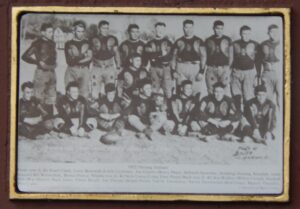
The Oorang Indian football team was founded by LaRue native Walter Lingo (1890-1966), owner of the Oorang Airedale Dog Kennels. The team, comprised of Native American Indians, played in the National Football League (NFL) in 1922-23. The star player and coach was Jim Thorpe (1887-1953), a Sac and Fox Indian. Thorpe gained international fame as a two-time gold medal winner (decathlon and pentathlon) in the 1912 Olympics and was acclaimed as the “World’s Greatest Athlete.” The team gave LaRue the distinction of being the smallest community ever to have an NFL franchise.
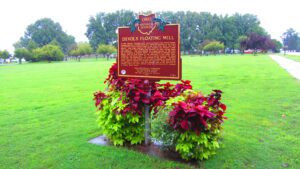
In 1791, Captain Jonathan Devol, upon a proposal from Griffin Greene, designed and built a floating grain mill, which was erected on two boats and anchored within several yards of the Ohio River shore near this marker. Oak planks fastened the boats together and formed a deck, upon which sat a frame building that enclosed the mill’s running gears and millstones. The mill’s position in a rapid portion of the river and its proximity to Farmer’s Castle, a fortification of thirteen blockhouses, built by local farmers at the beginning of the Indian Wars, shielded it from Indian raids. The river’s current revolved the wheel of the mill, and depending on the strength of the current, between twenty-five and fifty bushels of grain were processed in twenty-four hours. Devol’s floating mill replaced the hand mill, which had become too laborious to operate. The mill supplied meal to the garrison at Farmer’s Castle and other settlers along the Ohio River for a distance of nearly thirty miles.
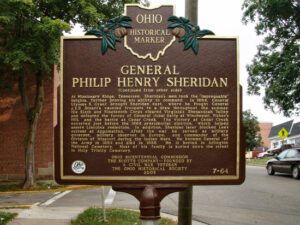
Philip Sheridan was most likely born in County Cavan, Ireland in 1831, but records do not indicate his actual birthplace. His family moved to Somerset when Philip was a child and lived down the avenue from this site. His family later owned the house across the street. His military interest was inspired by “Muster” day and frequent visits from a young West Pointer named William T. Sherman. Sheridan graduated from the United States Military Academy in 1853 and served on the Western Frontier Indian campaigns prior to the Civil War. In 1862, Sheridan became Colonel of the Second Michigan Calvary. At Stones River, Tennessee, he commanded a Division of the Twentieth Corps and stubbornly held General William S. Rosecrans’ right flank, distinguishing himself in battle. (continued on other side)
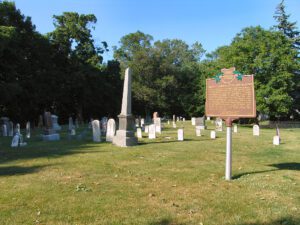
Israel Harrington (1779-1841) established a tavern at Lower Sandusky (now Fremont) shortly after the War of 1812. As a judge and land speculator, Harrington influenced the organization of much of northwestern Ohio. In 1824 he traded the tavern for land a short distance from this site, where an Indian trail crossed the Portage River. Elmore grew from this settlement. Harrington and his father (also Israel Harrington, a veteran of the American Revolution) are interred here, along with many of the pioneers who transformed this section of the Black Swamp into productive farmland.
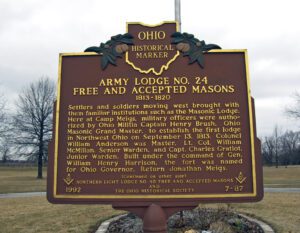
Settlers and soldiers moving west brought with them familiar institutions such as the Masonic Lodge. Here at Camp Meigs, military officers were authorized by Ohio Militia Captain Henry Brush, Ohio Masonic Grand Master, to establish the first lodge in Northwest Ohio on September 13, 1813. Colonel William Anderson was Master, Lt. Col. William McMillan, Senior Warden, and Capt. Charles Gratiot, Junior Warden. Built under the command of Gen. William Henry Harrison, the fort was named for Ohio Governor, Return Jonathan Meigs.