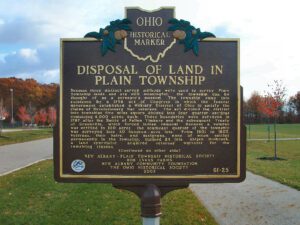
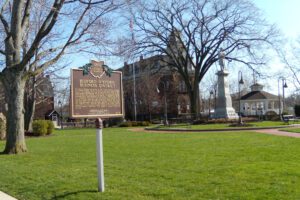
Because three distinct survey methods were used to survey Plain Township lands and are still meaningful, the township can be thought of as a surveyor’s museum. The township came into existence by a 1796 act of Congress in which the federal government established a Military District of Ohio to satisfy the claims of Revolutionary War veterans. The act divided the district into townships five miles square divided into four quarter-sections containing 4,000 acres each. These boundaries were surveyed in 1797 after the Battle of Fallen Timbers and the subsequent Treaty of Greenville, which forced Indian removal. Because a veteran was entitled to 100 acres, the southeast quarter of the township was surveyed into 40 hundred-acre lots. From 1801 to 1805, veterans, their heirs, and assignees, none of whom settled permanently in the township, claimed 24 lots. Abijah Holbrook, a land speculator, acquired veterans’ warrants for the remaining sixteen. (continued on other side)
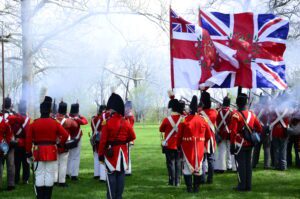
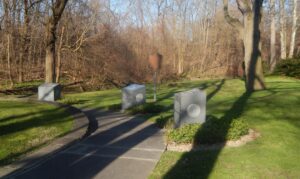
Near this site, in the War of 1812, stood the British encampment during the First Siege of Fort Meigs from May 1-9, 1813. This marker honors members of the 41st Regiment of Foot who died during the engagement. Killed in action on May 5, 1813 were Privates James Barkley, Richard Booth, William Carpmail, Samuel Cartledge, John Cox, Benjamin Dorman, John Dyer, Edward Graves, and Patrick Russell. Private Edward Billing died of wounds from battle May 6 and Private John Chamberlane expired May 20.
In 1962, Asian Indian students of Case Western Reserve University started India Association of Cleveland (IAC). In 1967, IAC started a newspaper “LOTUS,” regarded as the first such Asian Indian community newspapers in the United States. In 1978, IAC started a community center to be owned and managed by a new organization: India Community Center (ICC), the first such facility established by Asian Indians in Ohio. In 1980, IAC and ICC merged and formed the Federation of India Community Associations (FICA). Other associations representing the various states and interests in India became Federation members.
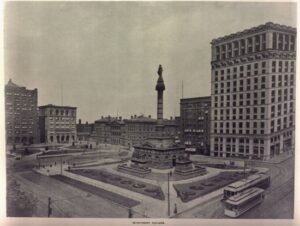
This monument, dedicated July 4, 1894, honors Cuyahoga County men and women, who performed military and patriotic duties during the Civil War (1861-1865). William J. Gleason (1846-1905), army veteran and local businessman, proposed its creation in 1879. Captain Levi Tucker Scofield (1842-1917), Cleveland architect and sculptor, designed the structure and supervised its 19-month construction by contractors, A. McAllister and Andrew Dall. George T. Brewster of Boston and George Wagner of New York, professional artists, assisted Scofield as sculptors. A 12-member Monument Commission, appointed by Governor Joseph B. Foraker in 1888, oversaw the project, which included the removal of William Walcutt’s 1860 marble statue of Commodore Oliver Hazard Perry from the site. The monument’s cost of $280,000 was raised by a countywide property tax levy. An 11-member commission maintains the monument funded by the county. (continued on other side)
The town of Bedford was settled in 1837. Early residents, Hezekiah and Clarissa Dunham donated the land that serves as Bedford Public Square. The Dunhams built one of the area’s first homes in 1832, which stands at 729 Broadway with the letters H & D above the doorway. Early settlers were attracted to the area by the abundance of natural resources and a large waterfall for mill sites. Bedford also served as a stagecoach stop on the route from Cleveland to Pittsburgh. The road or Turnpike Road as it was called was originally part of the Mahoning Indian Trail. By 1895 the road was renamed Main Street (and later Broadway) when the Akron, Bedford, and Cleveland Railway Company (ABC) traversed the middle of the street carrying passengers. The interurban is called “America’s first high speed long distance electric interurban” with speeds in excess of 60 miles per hour. [continued on other side]
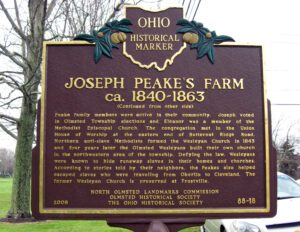
Joseph Peake was born in Pennsylvania in 1792 and came to Ohio in 1809 with his parents and brother. They were the first African Americans to settle permanently in the Cleveland area. He was the son of George Peake, a runaway slave from Maryland, who fought on the British side at the Battle of Quebec in 1759 during the French and Indian War. A man with some means and talent, George Peake invented a stone hand mill for grinding corn, a labor-saving device that endeared the Peakes to their neighbors in western Cuyahoga County. Joseph Peake and his wife Eleanor, an African American from Delaware, bought land in the 1840s on the Mastick Plank Road and built a home near this marker. [Continued on other side]
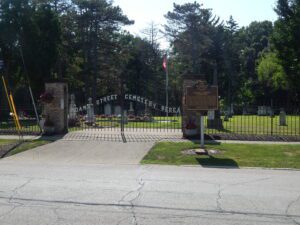
Known as the “Village Cemetery,” this was Berea’s main burial ground from 1834 to the 1880s. However, in 1886, the Cleveland Stone Co. purchased quarries adjacent to the cemetery, where Coe Lake is today. Quarrying had already caused flooding and landslides in the area. Local stories say that the company operated too near to the edge of cemetery, causing a landslide in the northwest corner that exposed some graves. Worried families moved their loved ones’ remains to other cemeteries, including those of five Civil War veterans. Pioneering families, 16 Civil War veterans, 3 mayors of Berea, several quarry owners, and many ordinary people still rest here. Of the original 589 burials, 40% were children. (Continued on other side)
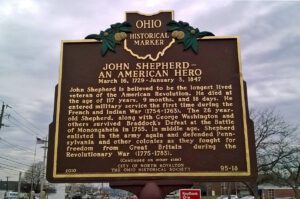
John Shepherd is believed to be the longest lived veteran of the American Revolution. He died at the age of 117 years, 9 months, and 18 days. He entered military service the first time during the French and Indian War (1754-1763). The 26 year-old Shepherd, along with George Washington and others survived Braddock’s Defeat at the Battle of Monongahela in 1755. In middle age, Shepherd enlisted in the army again and defended Pennsylvania and other colonies as they fought for freedom from Great Britain during the Revolutionary War (1775-1783). (Continued other side)