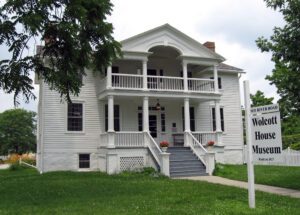
This federal style house was built in 1827 by James A. Wolcott who migrated to Ohio in 1818 from Connecticut. Of distinguished parentage, Wolcott was a leading merchant, shipbuilder, judge and politician. Here he and his wife, Mary Wells, daughter of scout William Wells and Sweet Breeze, Indian Chief Little Turtle’s daughter, made their home a center of frontier activity. This house stands as a tangible symbol of this Maumee pioneer, a Registered National Historic Place.
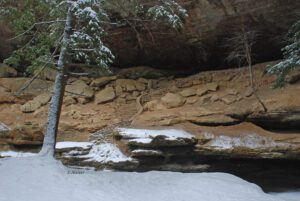
This recess cave was named for the “old man” Richard Rowe, a recluse who made the cave his home in the 1800s and is a part of scenic Hocking Hills State Park. Hocking comes from the Wyandot Indian word “hockinghocking,” referring to the Hocking River’s bottle-shaped gorge near Lancaster. Streams and percolating groundwater carved the hollows and caves in this area from layers of sandstone bedrock that vary in hardness. The hollow’s moist, cool climate preserves more typically northern tree species such as eastern hemlock trees and Canada yew, which have persisted since the glaciers retreated 15,000 years ago.
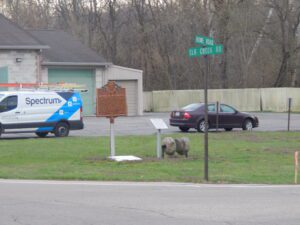
4401 Elk Creek Road (intersection of Howe & Elk Roads)
Middletown
, OH
The village of Miltonville, located along the banks of Elk Creek, was platted in 1816 by George Bennett, Theophilus Eaglesfield, and Richard V. V. Crane. The creek served two grist mills, one built around 1804 and operated by a free black, Bambo Harris, and the second was built by George Bennett in 1815. An Indian burial ground was located on the east bank of Elk Creek near the site of Huff’s Ferry. Eagle Tavern, the area’s first three-story brick inn, was a stopover for stagecoach lines traveling the Miltonville-Trenton Turnpike. The village was known for pottery factories, vineyards and wineries, and Frisch’s brickyard, established in 1880. The United Brethren Church, organized in 1811, and Miltonville Cemetery were the sites of church conferences and celebrations. The Miltonville School operated from the 1800s to 1936, and the local post office was in service during the years 1889-1904.
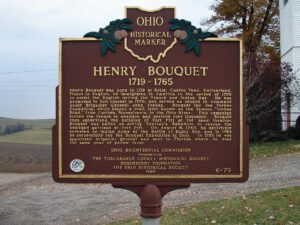
Desperately trying to protect their homeland, the Delaware Indian Nation who lived here in the Tuscarawas Valley, joined the French against the English during the French and Indian War, 1754-1763. After the French defeat, the Delawares, dissatisfied with the treaty terms, joined an Indian Confederacy to attack the English in early 1763. Known as Pontiac’s Rebellion, the uprising was lead by Ottawa chief Pontiac. In response, the English commander, General Jeffrey Amherst, ordered Colonel Henry Bouquet to mount a 1,500-man expedition to subdue the Confederacy in Ohio. The Army arrived at this location on October 13, 1764. The camp, known as Camp 14, was located in this valley between the two small streams on the side of the hill. Proceeding on to the Delaware town of modern-day Coshocton, Bouquet negotiated a surrender with the Delaware, Shawnee, and Wyandot who then relinquished over two hundred white prisoners.
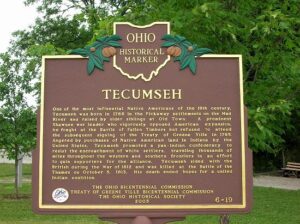
One of the most influential Native Americans of the 19th century, Tecumseh was born in 1768 in the Pickaway settlements on the Mad River and raised by older siblings at Old Town. A prominent Shawnee war leader who vigorously opposed American expansion, he fought at the Battle of Fallen Timbers but refused to attend the subsequent signing of the Treaty of Greene Ville in 1795. Angered by purchases of Native American land in Indiana by the United States, Tecumseh promoted a pan-Indian confederacy to resist the encroachment of white settlers, traveling thousands of miles throughout the western and southern frontiers in an effort to gain supporters for the alliance. Tecumseh sided with the British during the War of 1812 and was killed at the Battle of the Thames on October 5, 1813. His death ended hopes for a united Indian coalition.
Clinton County was a major center of activity for the Shawnee, Miami, and Delaware Indians. Early traces and trails developed as Indians traveled from village to village; gathered flint, salt and gold; traded furs, mica, and feldspar; and hunted bear, deer, otters, raccoons, foxes, wild cats, turkeys, and other wildlife. Trails throughout the county connected to other trails and villages in Ohio such as Lower Shawnee Town (now Portsmouth), Hurricane Tom’s Town (now Piketon), Chillicothe, Old Town (near Xenia), and Miami Town (now Dayton). Major trails or traces in Clinton County included the Bullskin, Wayne, Chillicothe, Delaware, Fort Ancient, Kanawha, Kenton and Todds Fork Traces. These routes were the avenues the first white settlers followed. (continued on other side)
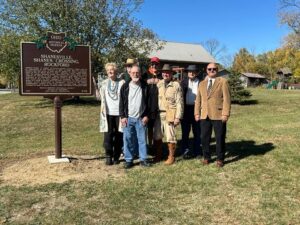
John Chapman (1774 – 1845) leased these three acres to the north and west from William Botts Hedges on April 29, 1828. He paid Hedges by cultivating 1,000 apple trees on the site over the next ten years. Apples provided an important food source. Cut and dried for sauces in the winter, they could be pressed into cider or “apple jack” at a time when water often carried disease. The Hedges Nursery profited the Shanesville area by shipping apples to the major trading posts at Piqua and Ft. Wayne. During his lifetime, Chapman proved an able businessman who established profitable orchards in Ohio, Pennsylvania, and Indiana. In 2009, American Forests, the Johnny Appleseed Foundation, the Museum at Urbana University, and the Village of Rockford planted two “Rambo” apple trees at the Hedges Nursery site.
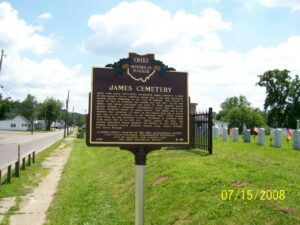
Major John James (1772-1854) established James Cemetery in 1828 on and around a Native American mound that is the only significant ancient mound remaining in the city of Jackson. The mound is about 70 feet in diameter and nearly six feet tall. In the late 1800s, this mound comprised one point of three ancient mound groups forming a triangular configuration along East Broadway Street, formerly known as James Street. One group was a few hundred feet northeast of here on the Watson farm and a second was just to the northwest on the Warnicke farm. These mounds were built by the Hopewell Culture, prominent in southern Ohio from about 100 BC to 400 AD. Major James, his wife, and several immediate family members are buried on the mound including Jackson County pioneers Andrew Long, Daniel Hoffman, and David Mitchell.