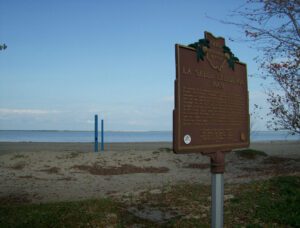
In search of a westward-flowing river, French explorer and trader Rene-Robert Cavelier, Sieur de La Salle (1643-1687) mounted an inland expedition from the south shore of Lake Erie at the mouth of the Grand River in the fall of 1669. Thought to be the first European to see the Ohio River, La Salle journeyed up the Grand River and portaged to a tributary of the Ohio; from there he descended as far as the falls at Louisville, Kentucky. La Salle’s explorations both expanded the fur trade and helped to consolidate French claims to the Mississippi River valley. French dominance in Ohio ended following British victory in the French and Indian War (1754-1763).
Frances Dana (Barker) Gage was born on October 12, 1808, in Marietta. She married James L. Gage in 1829 and they raised eight children, including four sons who served with Union forces during the Civil War. Throughout much of her life, Frances was deeply involved with the Temperance and Anti-Slavery movements and Women’s Rights issues. Presiding over the Women’s Rights Convention in Akron in 1851, she invited Sojourner Truth to give her famous “Ain’t I a Woman” speech. The Gage family moved in 1853 to St. Louis, the western extension of the Mason-Dixon Line, where her life was threatened whenever she spoke out against slavery. During the Civil War, she traveled south to aid Union soldiers and teach freed slaves. Though crippled and permanently disabled by a stroke, she continued to lecture on social issues until 1867. Frances Dana Gage died on November 10, 1884, in Greenwich, Connecticut.
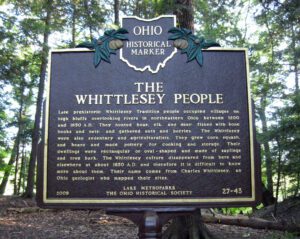
The Indian Point Site contains the remains of a prehistoric Native American earthen enclosure, officially known as the Lyman site, named after a former property owner. The site contains two earthen walls that are bordered by ditches. Steep cliffs provide natural barriers on two sides of the enclosure. Archaeological digs have uncovered many artifacts here, including pottery sherds, tools, pipes, and beads. There is evidence that the walls were built around 140 B.C., and the site was occupied again around 1500 A.D. by the Whittlesey Tradition people. It is uncertain if the site was a village or was used as a ceremonial center. After 1650 A.D., the area became a neutral hunting ground for various historic tribes.
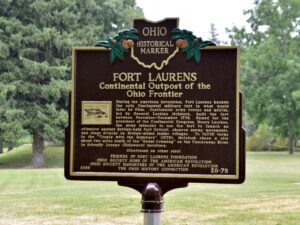
During the American Revolution, Fort Laurens became the only Continental military fort in what would later be Ohio. Continental army troops and militia, led by General Lachlan McIntosh, built the fort between November-December 1778. Named for the president of the Continental Congress, Henry Laurens, the army intended to use the fort to launch an offensive against British-held Fort Detroit, observe enemy movements, and stage attacks on British-allied Indian villages. To fulfill terms in the “Treaty with the Delaware” (1778), McIntosh chose a site about two miles south of the “Great Crossing” on the Tuscarawas River in friendly Lenape (Delaware) territory. (Continued on other side)
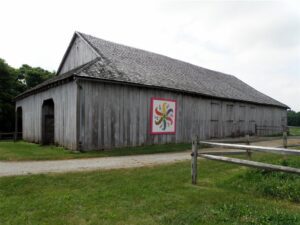
With the intention of becoming a “gentleman farmer,” John Johnston began development of his Upper Piqua farm in 1808 with a two-story log cabin and this double pen log barn. The surrounding outer sheds were built to protect the log pens from the weather. One of the oldest structures of its kind in Ohio, the barn is built around two hand-hewn log pens, each sixty-foot square. The barn served the family’s farming activities and was a storage facility for trade goods Johnston needed when the farm was the Piqua Indian Agency, 1811-1829.
Thomas Burk Sr. purchased a quarter section of federal land here in 1804. A school house was erected on this purchase in 1809. That same year, a road from Williams’ Mill (Millville) was blazed and a saw mill was built on Indian Creek west of this marker. Obadiah Welliver opened a tavern on his purchase in 1812. Burk sold his grist mill in 1818 and it is thought that the hamlet around this mill was called Dogtown because of a vicious dogfight there. In 1825, Reily Post Office was established at Welliver’s Tavern. That year a woolen mill with textile production machinery was built by Elias Sayres, near the saw mill. Multi-millionaire Elias Jackson (“Lucky”) Baldwin (1828-1909), the founder of Santa Anita Racetrack near Los Angeles, was born here.
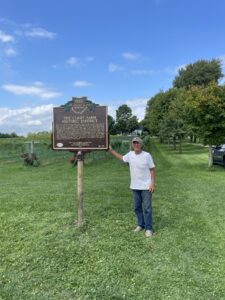
George Curry (1819-1885) was one of seven children born to a tenant sheepherder in the Cheviot Hills of Scotland. He immigrated to Ohio during the 1840s and married Scottish immigrant Agnes Milligan (1830-1893) in 1855. The couple moved to Licking County in 1865, and purchased 160-acres of farmland in 1873 to establish a sheep farm. They soon became known for their fine Spanish Merino herd. In the late nineteenth century, Ohio was a leader in the wool trade, with Licking County leading the state’s wool production by 1870. At the time of his death, George Curry was “a well-known stock dealer, and was greatly esteemed” in the community. Five generations of George and Agnes Curry’s family lived and farmed their Licking County land, until it was divided into parcels and sold in 1979.
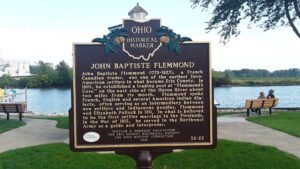
John Baptiste Flemmond (1770-1827), a French Canadian trader, was one of the earliest Euro-American settlers in what became Erie County. In 1805, he established a trading post at “Flemmond’s Cove” on the east side of the Huron River about two miles from its mouth. Flemmond spoke French, English and several American Indian dialects, often serving as an intermediary between new settlers and indigenous peoples. Flemmond wed Elizabeth Pollock in 1811, in what is believed to be the first settler marriage in the Firelands. In the War of 1812, he served in the Northwest Army as a guide and interpreter.