

, OH
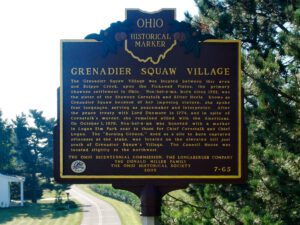
The Grenadier Squaw Village was located between this area and Scippo Creek, upon the Pickaway Plains, the primary Shawnee settlement in Ohio. Non-hel-e-ma, born circa 1722, was the sister of the Shawnee Cornstalk and Silver Heels. Known as Grenadier Squaw because of her imposing stature, she spoke four languages, serving as peacemaker and interpreter. After the peace treaty with Lord Dunmore in 1774, and in spite of Cornstalk’s murder, she remained allied with the Americans. On October 1, 1978, Non-hel-e-ma was honored with a marker in Logan Elm Park near to those for Chief Cornstalk and Chief Logan. The “Burning Ground,” used as a site to burn captured prisoners at the stake, was located on the elevated hill just south of Grenadier Squaw’s Village. The Council House was located slightly to the northwest.
, OH
The Wyandot called the Grand Reserve home nearly a century before Ohio statehood. They built houses, cultivated the land, and grew bountiful groves of fruit trees. They governed from the nearby Wyandot Council House and operated a productive saw and grist mill. Many sent their children to school and worshiped at the limestone church, built in 1824, and recognized as the first Methodist mission in the country. But Ohioans set their sights on Wyandot lands in the fertile Sandusky River Valley. State and federal governments were unwilling to allow the Wyandot to remain on their chosen homelands, despite their participation in American society and friendly relations with neighboring settlers. Following the Indian Removal Act of 1830, the Wyandot were the last tribe removed from the State of Ohio in 1843.
, OH
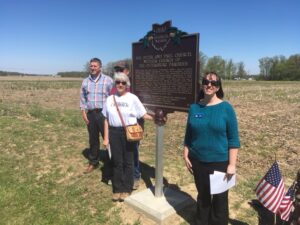
Saints Peter and Paul Church, Petersburg (1835), was the mother church for St. Joseph, Wapakoneta; St. John the Evangelist, Fryburg; St. Lawrence, Rhine; and Our Lady of the Immaculate Conception, Botkins. All were founded by German-Catholic immigrants to west-central Ohio. After the removal of the Wapakoneta Shawnee in 1832, the land became available for purchase. The 1830s and ’40s saw a wave of devout German settlers who wished to practice their faith in their new home, a desire served by missionary priests such as Father Wilhelm Horstman. Father Horstman first visited the settlement at Petersburg on May 8, 1835, presiding at Mass, baptizing, and blessing a marriage. In April 1836, immigrants John and Anna Mary Ruppert sold 40 acres of land in Pusheta Township to the trustees of the Catholic Church and a log church was built at the Petersburg site. (Continued on other side
, OH
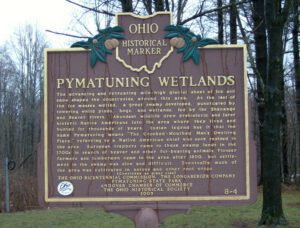
The advancing and retreating mile-high glacial sheet of ice and snow shaped the countryside around this area. As the last of the ice masses melted, a great swamp developed, punctuated by towering white pines, bogs, and wetlands, fed by the Shenango and Beaver rivers. Abundant wildlife drew prehistoric and later historic Native Americans into the area where they lived and hunted for thousands of years. Indian legend has it that the name Pymatuning means “The Crooked-Mouthed Man’s Dwelling Place,” referring to a Native American chief who once resided in the area. European trappers came to these swamp lands in the 1700s in search of beaver and other fur-bearing animals. Pioneer farmers and lumbermen came to the area after 1800, but settlement in the swamp was slow and difficult. Eventually much of the area was cultivated in onions and other root crops. (continued on other side)
, OH
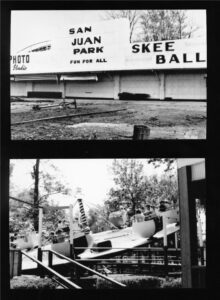
Nicknamed “Ohio’s Million Dollar Playground” or “Atlantic City of the Midwest,” Sandy Beach Amusement Park opened here on May 29, 1924. The park at Indian Lake featured a 2,000-foot long roller coaster and other popular rides, a boardwalk, and the Minnewawa Dance Hall. The Minnewawa and its succeeding dance pavilions hosted the greatest names of the Big Band era, and thousands of people came from all over Ohio to listen and dance to these popular entertainers. Societal turmoil and rioting in the 1960s affected the popularity of the park. Diminishing crowds, plus competition from larger theme parks such as Cedar Point and Kings Island, led to the park closing in the early 1970s. The lone remnant of the park is the steel arch bridge that spans the harbor.
, OH
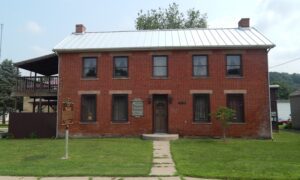
Named for General Zebulon Pike, killed in the War of 1812, Pike County was organized in February 1815. Commissioners were charged with establishing a county seat and on May 12, 1815 accepted a conveyance of 40 acres from Elisha Fitch. The new seat was named “Piketon.” In 1816, the commissioners let a contract for the construction of a courthouse and jail. A fine two story courthouse with brick laid in Flemish bond was finished in 1819. A fire destroyed some country courthouse offices on October 9, 1844. The repaired courthouse was the seat of county government until 1861 and is part of the Piketon Historic District, which was listed on the National Register of Historic Places in 1974. Limestone headers above the windows have the names of the county government offices.
, OH
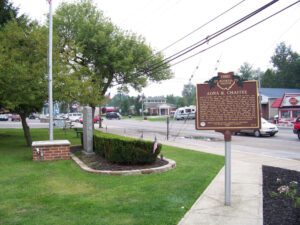
Adna R. Chaffee was born in Orwell on April 14, 1842, and grew up on the family farm. He left home in 1861 to pursue a career in the military, enlisting first in the 6th U.S. Cavalry for service in the Civil War. Distinguishing himself in many battles, including Gettysburg, Chaffee rose to the rank of 1st Lieutenant. He then fought in the Indian Wars of the West from 1867-1888, assisting in the capture of Geronimo and being promoted to the rank of Major. He also saw action in the Spanish American War, the Boxer Rebellion in China, and the Philippine Insurrection. On January 9, 1904, Chaffee was promoted to Lt. General and became Chief of Staff of the U.S. Army, the first to achieve this office without attending West Point. He retired in 1906. He died in 1914 and was buried in Arlington National Cemetery with the highest military honors.
, OH
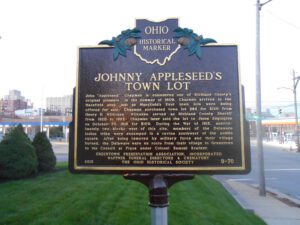
John “Appleseed” Chapman is considered one of Richland County’s original pioneers. In the summer of 1809, Chapman arrived in the Mansfield area just as Mansfield’s first town lots were being offered for sale. Chapman purchased town lot 265 for $120 from Henry H. Wilcoxen. Wilcoxen served as Richland County Sheriff from 1820 to 1825. Chapman later sold the lot to Jesse Edgington on October 30, 1818 for $100. During the War of 1812, approximately two blocks west of this site, members of the Delaware Indian tribe were encamped in a ravine southwest of the public square. After being removed by military force and their village burned, the Delaware were en route from their village in Greentown to the Council at Piqua under Colonel Samuel Kratzer.