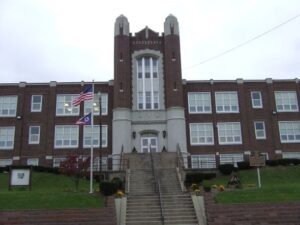
An October 23, 1927, ceremony was held for the laying of the cornerstone for the Dennison High School Building. It opened in the fall of 1928 and was called “Angel’s Castle” in honor of school superintendent William Hiram Angel. The building was designed by J.K. Griffin, an architect from Canton, Ohio, in a style that has the elements of Collegiate Gothic that was popular for school and college buildings during the early twentieth century. The distinguishing architectural features of the entrance towers enhance the school’s prominent location above the street level. Dennison High School is an important visual landmark in the community, as its towers are visible from the downtown area and surrounding neighborhoods. It has retained its integrity of location, materials, design, and association and conveys the early twentieth century ideals of education that the original design of the building was intended to inspire. (Continued on other side)
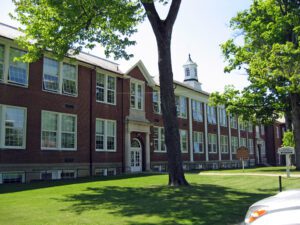
Poland Academy, an elite private school, was established on this site in 1830 and in 1859 graduated its most notable student William McKinley, who became the 25th president of the United States. In 1862, the school changed its name to Poland Seminary and was one of the first schools in northeast Ohio to admit girls on an equal basis. Ida Tarbell, who became a prominent national journalist and author was Preceptress of the Seminary from 1880-1882. William Calhoun graduated from the Seminary and became the U.S. Ambassador to China from 1910-1913. The school became a public institution in 1909 when it became the Poland Seminary High School. In 1972 it was the site of Poland Junior High School and Poland Middle School in 1985.
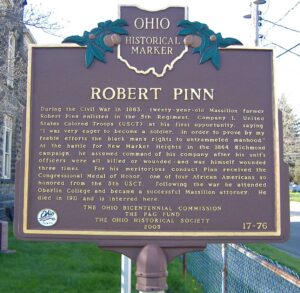
During the Civil War in 1863, twenty-year-old Massillon farmer Robert Pinn enlisted in the 5th Regiment, Company I, United States Colored Troops (USCT) at his first opportunity, saying, “I was very eager to become a soldier, in order to prove by my feeble efforts the black man’s rights to untrammeled manhood.” At the battle for New Market Heights in the 1864 Richmond campaign, he assumed command of his company after his unit’s officers were all killed or wounded – and was himself wounded three times. For his meritorious conduct Pinn received the Congressional Medal of Honor, one of four African Americans so honored from the 5th USCT. Following the war he attended Oberlin College and became a successful Massillon attorney. He died in 1911 and is interred here.
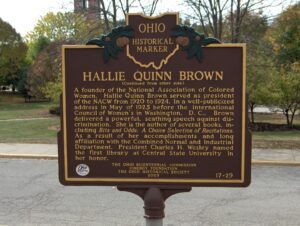
Hallie Quinn Brown (c. 1850) was born in Pittsburgh, Pennsylvania to former slaves. She and her family moved to Wilberforce, Ohio in 1870, where she received a Bachelor of Science degree from Wilberforce University in 1873. Brown taught school in the South until her appointment as professor of elocution at Wilberforce University in 1893. A gifted elocutionist and author, Brown received national and international acclaim not only for her recitals and written works, but also for her passionate belief in civil rights and African American culture. (Continued on other side)
Near this location stood the settlement of African American families known as “The Lett Settlement.” The Lett Settlement was a self-sustaining community of mixed race families, including the Caliman, Guy, and Lett families. The families had formed ties through marriage and common background during the mid-1700s in Virginia and Maryland. These early African American pioneer families came to Ohio as “free people of color,” and began acquiring land in Meigs Township, Muskingum County, and surrounding townships in adjacent counties during the 1820s. They were soon joined by the Brown, Clifford, Earley, Simpson, Tate, and Pointer families. The families of the Lett Settlement were land owners and tax payers in Ohio before the Civil War and challenged the State of Ohio for the right to vote and for access to education during the 1840s, 1850s, and 1860s. (Continued on other side)
In April 1784, the Continental Congress adopted the Report of Government for the Western Territory, a broad plan drafted primarily by Thomas Jefferson for organizing the United States’ new western lands that were ceded by the states and purchased from Native Americans. One of the most far-reaching legislative acts in American history, the resulting Land Ordinance of 1785, passed on May 20th, established the public land system by which all federal land was surveyed and distributed. The Ordinance established a rectilinear survey system that divided land into townships of six miles square aligned by north-south and east-west baselines, and set aside certain lands for Revolutionary War veterans and for public schools.
James Edwin Campbell was born on September 28, 1867, in the Kerr’s Run area of Pomeroy to James and Letha Campbell. He graduated from Pomeroy High School with the class of 1884. After graduation, Campbell taught in various parts of Meigs County. Campbell achieved notoriety as an African American poet, editor, author of short stories, and educator. He began his writing in 1887 with the work Driftings and Gleanings. During the 1880s and 1890s, he wrote regularly for daily newspapers in Chicago and was employed on the literary staff of the Chicago Times-Herald. His dialect poetry attracted wide-spread popularity and he published a collection of his best works, Echoes From the Cabin and Elsewhere. Campbell was installed as the first president of the West Virginia Colored Institute (West Virginia State University), serving in the capacity from 1891 to 1894. James Edwin Campbell died in Pomeroy on January 26, 1896.
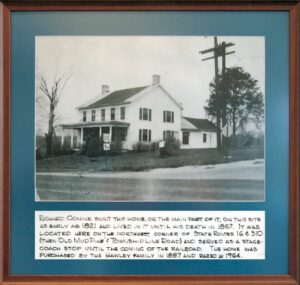
Born in New Jersey, Richard and Sarah Conine, the founders of the village of Pataskala, moved to Lima Township and lived on this site as early as 1821 when Richard established a grist mill nearby. Their homestead also served as a stagecoach stop on the mud pike between Columbus and Newark prior to the coming of the railroad. Richard platted “Conine Town” south and west of here in 1851, and the town was renamed Pataskala soon after. The public-spirited Conines contributed to the building of several area schools and churches and donated land for the Pataskala Cemetery. After their deaths, Sarah’s nephew Jacob Van Dorn inherited the property. John Hawley purchased the home in 1887 and for many years it was known as “The Hawley House.” It was demolished in 1964 to make way for commercial development.