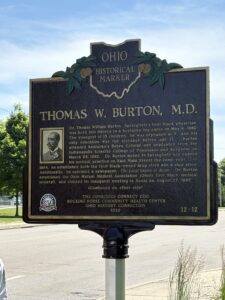
Dr. Thomas William Burton, Springfield’s first Black physician, was born into slavery in a Kentucky log cabin on May 4, 1860. The youngest of 15 children, he was orphaned at 9, and his only education was the alphabet before age 21. Burton attended Kentucky’s Berea College and graduated from the Indianapolis Eclectic College of Physicians and Surgeons on March 24, 1892. Dr. Burton moved to Springfield and opened his medical practice on East Main Street the same year. In 1894, he established both the first Black-owned drug store and a shoe store. Additionally, he operated a newspaper, The Loyal Legion of Honor. Dr. Burton established the Ohio Mutual Medical Association (Ohio’s first Black medical society), and chaired its inaugural meeting in Xenia on August 27, 1897. (Continued on other side)
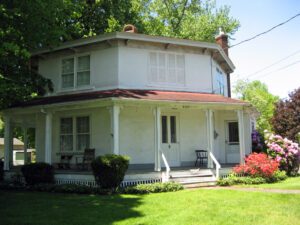
This eight-sided house reflects a widespread pre-Civil War architectural fad. Promoted by phrenologist Orson S. Fowler in his 1848 book A Home for All as a way to “bring comfortable homes within the reach of the poorer classes,” the octagon made efficient use of interior space and natural ventilation. More than thirty octagonal houses are known to have been built in Ohio, and at least twenty-five survive. This example was built circa 1854 and purchased by cabinetmaker Amirus Darrow in 1864. The exterior walls are constructed of chestnut beams between layers of concrete. It was added to the National Register of Historic Places in 1971.
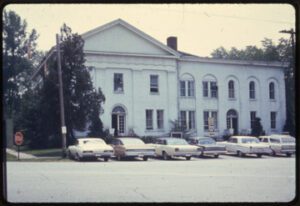
Mahoning County was created in 1846 by combining townships from southern Trumbull and northern Columbiana counties. Canfield engaged in competition with several surrounding communities for the new county seat, and its success was attributed to its central location along with the state and local political influence of Judge Eben Newton and Elisha Whittlesey, Esq., Comptroller of the United States Treasury from 1849-1857. To become the county seat, the State of Ohio required “a suitable lot and $5,000 toward public buildings” Judge Newton donated the land and spearheaded the subscription of the state required bond. Once attained, construction progressed rapidly on the Classical Revival style courthouse, completed in June 1848. The Italianate style West wing was added in 1862, but its government status was challenged when in the early 1870s, Youngstown, by now a city, resumed its earlier challenge for the county seat. (continued on other side)
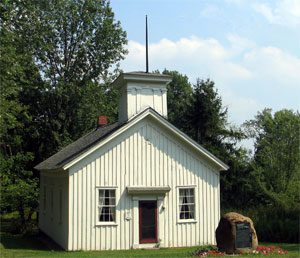
Called the “Cradle of Equal Suffrage” and “Free Speech Chapel,” Union Chapel was to be “…open and free for all denominations, but to be monopolized by no one or to the exclusion of anyone.” Built in 1858 or 1859 on land donated by Anson Matthews, the chapel reputedly exists in response to incident triggered by James A. Garfield, then principal of the Western Reserve Eclectic Institute (now Hiram College) and later president of the United States. He was scheduled to speak at the Congregationists’ “Brick Church” in December 1857. Because of the supposed controversial nature of Garfield’s speech, however, the invitation was withdrawn. (Continued on other side)
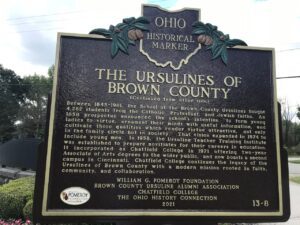
On July 21, 1845, eleven Ursuline sisters from Boulogne-sur-Mer and Beaulieu, France, arrived in St. Martin, Brown County, Ohio. A Catholic order of sisters known for providing quality education to young women, the Ursulines were invited by Cincinnati Archbishop John Baptist Purcell (1800-1883) to establish a school in the diocese and granted approximately 400 acres in St. Martin for that purpose. Led by Mother Julia Chatfield (1808-1878), the sisters quickly established their convent, a day school, and, within the year, admitted their first boarders. Originally known as The Saint Ursula Literary Institute, the school operated for the next 136 years. The Ursulines educated local students from their adopted Brown County as well as many who came from across the U.S. and farther abroad to board on campus. (Continued on other side)
Toledo High School opened in 1854 on the site of the city’s first log schoolhouse. After an 1895 fire, it was rebuilt and named Central High School. The facility closed in 1914 with the opening of Scott and Waite high schools. It reopened as Woodward Technical School and later became Vocational High. The building was razed in 1938 for construction of the Toledo Public Library.
A school has stood on this site almost continuously since the late 1840s. The first school here was the Newell School, a white-frame, one-room school in use from approximately 1847 to 1939. The building was a part of the Newell Rural School District, which extended from the north border of Greenhills to present-day Interstate 275. Area schools consolidated in 1939 and the Newell district was absorbed into the Science Hall Rural School District and then into the Greenhills Rural School District (later renamed the Greenhills/Forest Park School District). The site of the old Newell School is now a part of the Winton Woods City Schools. The building directly behind this marker opened in 1968 as Forest Park High School and later became Winton Woods High School.
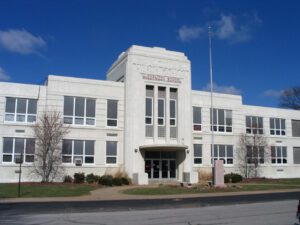
Ohio’s oldest continuing summer theatre, the Huron Playhouse has been housed at McCormick Middle School for its entire history. Dr. Frederick G. Walsh (1915-1999) of the Bowling Green State University (BGSU) Speech Department founded the theatre in 1949. Huron met Walsh’s expectations for an attractive site for the playhouse, and Huron Schools Superintendent R.L. McCormick (1904-1978) offered the use of this school. The curtain opened on the first Huron Playhouse production, Norman Krasna’s hit Broadway comedy John Loves Mary, on June 29, 1949. With persisting support from BGSU, actors and alumni, and the local community, the acclaimed Playhouse has provided theatrical experience for thousands of students and entertainment for generations of Huron residents.