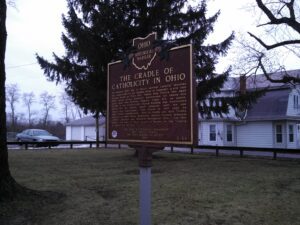
In April 1830 four Dominican sisters from St. Catherine’s, Kentucky, founded St. Mary’s Academy, the first Catholic school in Perry County. Bishop Edward Fenwick, first Bishop of Ohio, donated a small brick house and attached building situated on an acre of land for the school’s use. Classes began with forty students. The following year the sisters built a three-story structure with a dormitory for boarders; by the end of the Civil War, enrollment had increased to 134 students, and St. Mary’s gained recognition as one of the finest schools in Ohio. An 1866 fire destroyed the academy, and in 1885 the Dominican sisters reestablished the academy as a parish school. The present Holy Trinity School building dates to 1968.
Intersection of S. Sandusky Street & Olentangy Avenue
Delaware
, OH
Near this site, the Union army established two camps on either side of the Olentangy River during the Civil War. Both were known as Camp Delaware. The first camp, situated on the west side of the river in the summer of 1862, was where the white recruits of the 96th and 121st regiments of Ohio Volunteer Infantry were mustered into service. A second camp, on the east side of the Olentangy, was established in the summer of 1863 and became the rendezvous point for most African-American Ohioans joining the army. The 127th Regiment of Ohio Volunteer Infantry-later renamed the 5th Regiment United States Colored Troops, the 27th U.S. Colored Troops, and members of other African-American units were mustered into service at Camp Delaware.
A. B. Graham, superintendent of Springfield Township Rural schools in Clark County, established the Boys and Girls Agricultural Experiment Club, which revolutionized agricultural education and non-formal youth development methods. The first meeting of the club, said to be the nation’s first farm club for young people, was held at this site on January 15, 1902 in the basement of the Clark County Courthouse. This was the start of what would be called a 4-H Club a few years later. Through the years, the overall objective of A.B. Graham and 4-H has remained the same: the development of youth as individuals and as responsible and productive citizens.
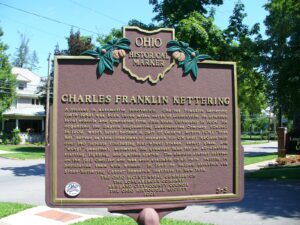
A pioneer in automotive innovation, Charles Franklin Kettering (1876-1958) was born three miles north of Loudonville. He attended local schools and graduated from Ohio State University in 1904. He organized the Dayton Engineering Laboratories Company (Delco) in 1909, which later became a part of General Motors (GM). “Boss Ket” served as vice-president of research for GM until 1920 and held over 140 patents (including four-wheel brakes, safety glass, and “ethyl” gasoline), achieving his greatest fame for an all-electric starting, lighting, and ignition system. The electric starter debuted on the 1912 Cadillac and was soon available on all cars, helping to popularize them with women. In 1945 he helped establish the Sloan-Kettering Cancer Research Institute in New York.
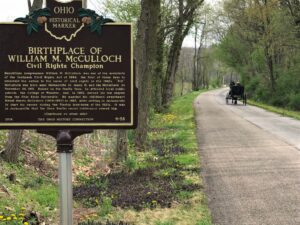
Republican congressman William M. McCulloch was one of the architects of the landmark Civil Rights Act of 1964, the first of three laws to recommit the nation to the cause of civil rights in the 1960s. “Bill” McCulloch was born near Holmesville to James H. and Ida McCulloch on November 24, 1901. Raised on the family farm, he attended local public schools, the College of Wooster, and, in 1925, earned his law degree from the Ohio State University. He married his childhood sweetheart Mabel Harris McCulloch (1904-1990) in 1927, after settling in Jacksonville to start his career during the Florida land-boom of the 1920s. It was in Jacksonville that the Deep South’s racial intolerance seared him. (Continued on other side)
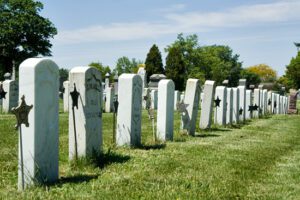
In 1884 the Ohio General Assembly authorized “the burial of the body of any honorably discharged union soldier, sailor or marine of this state who shall hereafter die without leaving means sufficient to defray funeral expenses.” Permanent government-issued headstones have been provided to veterans since the late 19th century. Between 1884 and the 1930s, Washington Cemetery buried 47 white soldiers (including 15 unknown) and 35 African-American soldiers. These veterans served in the Civil War, the Spanish-American War, and WWI. They are remembered for the sacrifices they made. In the fall of 2001, the cemetery underwent significant renovations, in which students of the Washington Senior High School Research History program aided in identifying the buried soldiers and restoring and replacing the gravestones. Here in Soldiers’ Row, the words of local United States Colored Troops veteran, Albert Bird, echo centuries later: “We have suffered to save the country; we ought to be remembered.”
Frances Rappaport Horwich was born in Ottawa on July 16, 1907, the daughter of Sam Rappaport, an Austrian immigrant who operated a general store, and Rosa Gratz Rappaport, a Russian immigrant. The youngest of six children, she attended the Ottawa elementary school and graduated from Ottawa High School in 1924. After high school, she attended the University of Chicago where she earned a bachelor’s degree in philosophy and taught first grade for three years. “Miss Frances,” as she was called, then earned a master’s degree from Columbia University in 1933 and a Ph.D. in 1942 from Northwestern University. From 1942 to 1952, she was involved in teaching and education development. The basic education she received in the Ottawa schools enabled her to achieve great skills and abilities. [continued on other side]
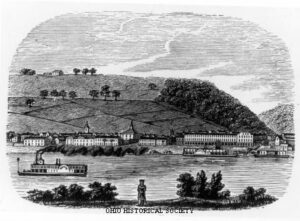
Ripley was incorporated as the village of Staunton in 1812. Its name was changed in 1816 to honor General Eleazer Wheelock Ripley, a hero of the War of 1812. In the years before railroads, Ripley was a principal Ohio River shipping center. Also important were its extensive boat-building, tobacco, pork, and timber industries. Ripley too was the home of saw and planing mills, iron foundries, and a piano factory. Such varied commerce enabled Ripley to remain vibrant throughout the nineteenth century. Although noted as a port, Ripley is best remembered as an abolitionist stronghold. Many of its citizens, including Rev. John Rankin and John P. Parker, served as conductors on the famed “Underground Railroad.” The notoriety of Ripley’s anti-slavery network perhaps eclipsed that of nearby Cincinnati, earning the town a reputation as the “Black Hole of Abolitionism.” (Continued on side two)