

, OH
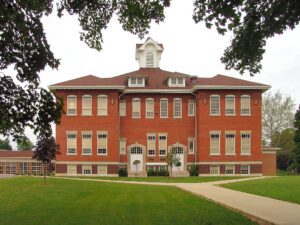
The first school in what is now Pataskala was a “subscription school” operated by Amariah Cubberly on the nearby banks of the South Fork of the Licking River in the 1820s. Subscription schools, which charged fees, were the forerunners of rural public schools in many parts of Ohio. By the 1830s several one-room public schools served the children of the area, but in 1870 the civic minded citizens of Pataskala provided a centralized building for grades one through twelve on Main Street, where the old Town Hall now stands. This school was moved to the new building on this site in 1908. When the Southwest Licking Local School District was established in 1953, Pataskala Elementary School continued in the building. Additions in 1968 and 2000 enhanced its educational capabilities. This 1908 Queen Anne architectural style building was listed on the National Register of Historical Places in 1983.
, OH
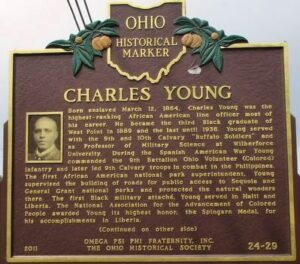
Born enslaved March 12, 1864, Charles Young was the highest-ranking African American line officer most of his career. He became the third Black graduate of West Point in 1889 and the last until 1936. Young served with the 9th and 10th Calvary “Buffalo Soldiers” and as Professor of Military Science at Wilberforce University. During the Spanish American War Young commanded the 9th Battalion Ohio Volunteer (Colored) Infantry and later led 9th Calvary troops in combat in the Philippines. The first African American national park superintendent, Young supervised the building of roads for public access to Sequoia and General Grant national parks and protected the natural wonders there. The first Black military attache, Young served in Haiti and Liberia. The National Association for the Advancement of Colored People awarded Young its highest honor, the Spingarn Medal, for his accomplishments in Liberia. (continued on other side)
, OH
“The future doesn’t belong to the fainthearted; it belongs to the brave. The Challenger crew was pulling us into the future and we’ll continue to follow…” President Ronald Reagan
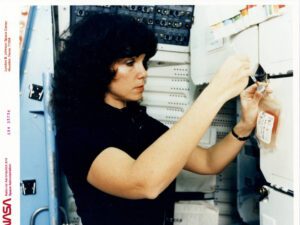
As the second American woman in space, Judith Resnik (1949-1986) paved the way for the future of women in space exploration. A gifted science and music student and valedictorian of Firestone High School’s class of 1966, she earned a doctorate in Electrical Engineering from the University of Maryland in 1977 and was accepted by the National Aeronautics and Space Administration (NASA) as an astronaut candidate in 1978. Her first flight was on the inaugural mission of the Space Shuttle Discovery in 1984. Resnik was aboard the Space Shuttle Challenger as a mission specialist on January 28, 1986, when it exploded just 73 seconds after lift-off from the Kennedy Space Center in Florida. All seven crewmembers died in the explosion.
, OH
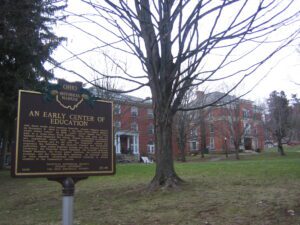
Just three weeks after reaching Granville, pioneer villagers decided on December 9, 1805 to build a log cabin where eighty children would attend school. By 1820, public school classes were being held in a three-story brick building. When rail lines and the National Road bypassed the village, dreams of becoming an industrial and commercial center were dashed. Educational institutions, however, thrived and by the Civil War Granville’s citizens had organized the following: the Granville Literary and Theological Institution, later called Granville College and then renamed Denison University; the Granville Female Seminary, the Granville Episcopal Female Seminary, the Young Ladies’ Institute, the Granville Female Academy, and the Granville Male Academy. As Granville enters its third century, educational excellence continues to attract students to the community’s schools.
, OH
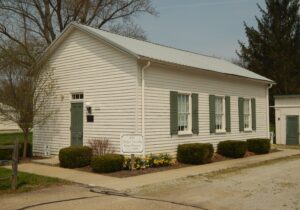
On April 20, 1857, the trustees of Morgan Township met in Okeana to obtain a lot for the township house. From a quarter mill tax levy, $850 was budgeted for a house and lot. Money expended on the project included $50 for the lot, $650 for the construction of the building, $41 for fencing, $12.60 for twelve chairs, and $10.25 for a table. Since its completion in 1858, this meeting house has been used for trustee meetings, a voting precinct, village singing schools and concerts, public school, bank, and township garage. The trustees moved to a new building across the street in 1972 and into their Chapel Road complex in 2000.
, OH
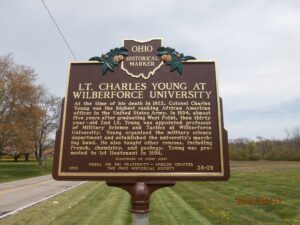
At the time of his death in 1922, Colonel Charles Young was the highest ranking African American officer in the United States Army. In 1894, almost five years after graduating West Point, then thirty year-old 2nd Lt. Young was appointed professor of Military Science and Tactics at Wilberforce University. Young organized the military science department and established the university’s marching band. He also taught other courses, including French, chemistry, and geology. Young was promoted to 1st lieutenant in 1896. (Continued other side)
, OH
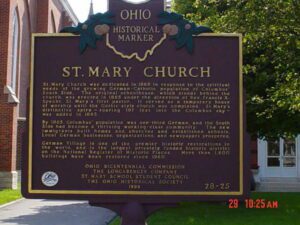
St. Mary Church was dedicated in 1868 in response to the spiritual needs of the growing German-Catholic population of Columbus’ South Side. The original schoolhouse, which stands behind the church, was erected in 1865 under the direction of Rev. Francis X. Specht, St. Mary’s first pastor. It served as a temporary house of worship until the Gothic-style church was completed. St. Mary’s distinctive spire – soaring 197 feet into the Columbus sky – was added in 1893. By 1865, Columbus’ population was one-third German, and the South Side had become a thriving working-class community. The new immigrants built homes and churches and established schools. Local German businesses, organizations, and newspapers prospered. German Village is one of the premier historic restorations in the world, and is the largest privately funded historic district on the National Register of Historic Places. More than 1,600 buildings have been restored since 1960.
, OH
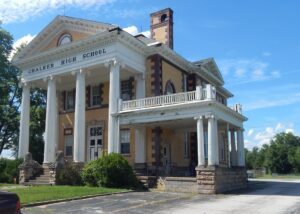
Southington native Newton Chalker built, furnished, and donated Chalker High School to his community in 1907. Chalker was born in 1842 in Southington Township and lived there until adulthood. He later built a prosperous law and real estate practice in Akron. Chalker’s dedication to improve educational opportunities in the township likely originated with his personal struggle to complete high school, which was repeatedly interrupted by financial concerns and family obligations. The Chalker High School building was designed in the Neo-Classical Revival architectural style which was favored for public buildings, churches and schools early in the twentieth century. The building exhibits Classical influences through the use of fluted columns that support a pedimented gable, resembling a Greek temple. Chalker High School and the Civil War Monument were listed in the National Register of Historic Places in 2010. (Continued on other side)