

, OH
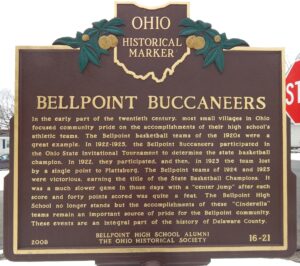
In the early part of the twentieth century, most small villages in Ohio focused community pride on the accomplishments of their high school’s athletic teams. The Bellpoint basketball teams of the 1920s were a great example. In 1922-1925, the Bellpoint Buccaneers participated in the Ohio State Invitational Tournament to determine the state basketball champion. In 1922, they participated, and then, in 1923 the team lost by a single point to Plattsburg. The Bellpoint teams of 1924 and 1925 were victorious, earning the title of the State Basketball Champions. It was a much slower game in those days with a “center jump” after each score and forty points scored was quite a feat. The Bellpoint High School no longer stands but the accomplishments of these “Cinderella” teams remain an important source of pride for the Bellpoint community. These events are an integral part of the history of Delaware County.
, OH
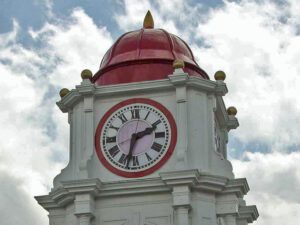
The Bellaire High School Clock Tower was erected in 1925 as the second town clock to be mounted on Bellaire’s public schools. C.W. Bates of Wheeling designed this tower, built by C.D. Keyser & Co. of Bellaire. The school building stretches 256 feet along 35th Street, and the tower rises 40 feet above the 3rd floor parapet of the roof. The clock faces are 6 feet, 7 inches in diameter. At the exterior corners of the bell room are 11 foot columns. The tower dome is painted red. E. Howard & Co. of Boston made the clock works and the McShane Bell Foundry of Baltimore cast the bell in August 1888. The BHS Alumni Association lighted the tower in 1998 to honor all “faithful and true-hearted” graduates of the school.
, OH
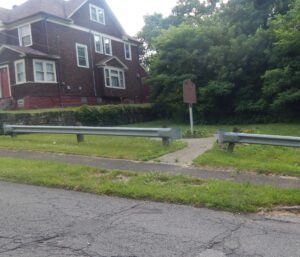
Oscar D. Boggess (1832-1907) was born in Virginia, the son of a slave and her master. He and his family were granted freedom in the will of his father and master. The will was contested up to the United States Supreme Court, which upheld Boggess’ freedom. Boggess moved to Pennsylvania at age 20, and during the Civil War, joined the 43rd United States Colored Troops. He earned the Butler Medal of Honor for bravery at the Battle of the Crater near Petersburg, Virginia, in July 1864. Boggess moved to Youngstown after the war, and worked as a stonemason. He was a charter member of Tod Post 29, Grand Army of the Republic, in Youngstown, and a co-founder of the Oak Hill Avenue African Methodist Episcopal Church, the city’s first African American religious congregation. The Boggess home, formerly located near this site, hosted the church’s first meetings in 1870.
, OH
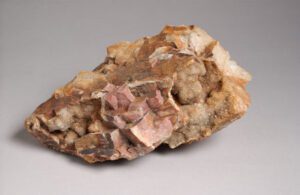
For more than 10,000 years, Flint Ridge was one of the most important flint quarries in eastern North America. The flint formed at the bottom of a shallow ocean 300 million years ago. The softer rocks surrounding the flint have washed away, leaving the hard flint exposed near the surface. Prehistoric people came here to quarry the flint, which they crafted into a variety of stone tools. Hundreds of quarry pits and workshops are scattered for miles along this ridge. The beautiful rainbow-colored flint was especially prized by the Hopewell culture that built the nearby Newark Earthworks. Artifacts crafted from Flint Ridge flint may be found throughout eastern North America. In more recent times, local industries quarried the flint for use as grindstones.
, OH
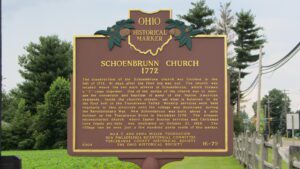
In December 1772, Brother David Zeisberger and his followers began the construction of Schoenbrunn schoolhouse. The school was built in the Tuscarawas Valley on land given to Zeisberger in the spring of 1771 by the Delaware Native Americans as a Moravian mission to the Delaware. With the land, Zeisberger laid out the town of Schoenbrunn or “Beautiful Spring.” The school served Delaware Indian children, who were taught from special textbooks prepared in the Delaware and German languages by Zeisberger. John Heckewelder, who taught at the school, is recognized as the first schoolteacher in Tuscarawas County. The present reconstructed schoolhouse was dedicated on July 29, 1928 on the 155th anniversary of the completion of the school’s construction. The village can be seen just a few hundred yards south of this marker.
, OH
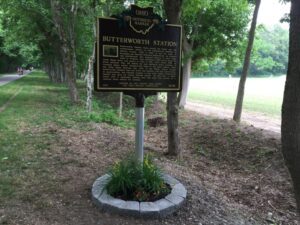
Butterworth Station (seen across the field) was the southernmost station on the Underground Railroad in Warren County. Built in 1820, it was the home of Benjamin and Rachael Moorman Butterworth. As Quakers and abolitionists who opposed slavery in their home state of Virginia, they purchased 1,500 acres along the Little Miami River and moved to Ohio in 1812. Until nearly 1850, at great personal risk, the family fed and sheltered large numbers of runaway slaves before transporting them to the next station. When the Little Miami Railroad was built in the 1840s, Henry Thomas Butterworth donated land and water and assisted with the construction. In appreciation, the railroad created a stop here called Butterworth Station and gave his family lifetime passes. On this site, a water tower with a passenger waiting area was built that served as a railroad water station for decades.
, OH
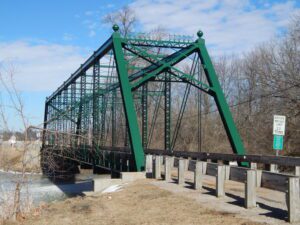
The Bridgeport Iron Bridge, often called the Streng Road Iron Bridge, was built in 1914. It replaced a wooden covered bridge built in 1869 by Reuben L. Partridge (1823-1900) and Isaac J. Grummons (1828-1921), which was damaged by the flood of 1913. The 200′ steel superstructure uses a pin-connected Pratt Through truss design and was constructed by the Central Concrete & Construction Company, Canton, Ohio, at a cost of $8,987. The original substructure abutments were constructed by John A. Maugans (1861-1933) for $3,248, but have since been replaced. In 1992 and 1993, the bridge was renovated under the leadership of County Engineer Steve A. Stolte and Assistant Engineer Jeff Stauch.
, OH
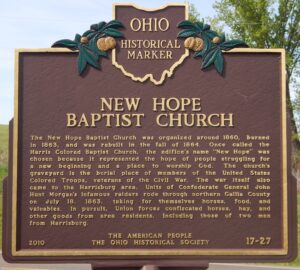
The New Hope Baptist Church was organized around 1860, burned in 1863, and was rebuilt in the fall of 1864. Once called the Harris Colored Baptist Church, the edifice’s name “New Hope” was chosen because it represented the hope of people struggling for a new beginning and a place to worship God. The church’s graveyard is the burial place of members of the United States Colored Troops, veterans of the Civil War. The war itself also came to the Harrisburg area. Units of Confederate general John Hunt Morgan’s infamous raiders rode through northern Gallia County on July 18, 1863, taking for themselves horses, food, and valuables. In pursuit, Union forces confiscated horses, hay, and other goods from area residents, including those of two men from Harrisburg.