

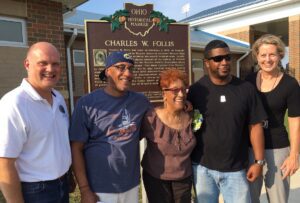
, OH
Charles W. Follis was born on February 3, 1879, in Virginia. His family moved to Wooster where he attended Wooster High School and helped establish the school’s football team. In 1901, Follis enrolled and played baseball at the College of Wooster and played football for the Wooster Athletic Association where he earned the nickname “The Black Cyclone from Wooster.” In 1904, Follis signed a contract to play football with Shelby Athletic Club, making him the first African-American professional football player. Follis faced discrimination on and off the field leading to many injuries. After a career-ending injury in 1906, Follis played baseball for the Cuban Giants of Long Island. He died of pneumonia in 1910 at the age of 31 and is buried in Wooster Cemetery.
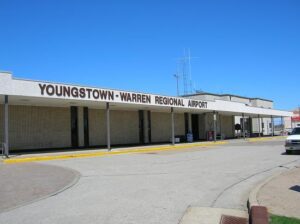
, OH
Born on April 18, 1913, in Barrea, Province L’Aquila Abruzzi, Italy to Salvatore and Maria (Lombardozzi) Campana, Mary Ann Campana immigrated to the United States with her parents at age eight. Raised in Youngstown and educated in the Youngstown Public Schools and Youngstown College, Ms. Campana was a pioneer in Ohio, National, and international aviation. In 1932, at age eighteen, she achieved the distinction of being the first licensed woman pilot in Ohio. On June 4, 1933, with only 44 hours of prior flying time, Mary Ann established the world’s endurance record in the Light plane class for a non-refueled flight. Flying above Youngstown in a 500-pound Taylor Cub Plane with a 40-horsepower engine and loaded with 40 gallons of gasoline, she flew for 12 hours and 27 minutes without a parachute, breaking the old record by one hour and ten minutes before electrical storms forced her down. (Continued on other side)
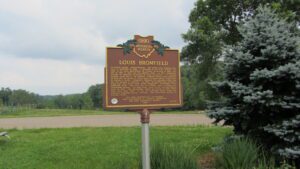
, OH
Acclaimed author, conservationist, and farmer Louis Bromfield was born in Mansfield in 1896. A graduate of the city’s schools, he went on to study agriculture at Cornell University in 1914, but left in 1915 to help run his family’s farm. In 1916, Bromfield enrolled in Columbia University to study journalism. As America entered World War I, he enlisted in United States Army Ambulance Service and saw action in seven major European battles. Determined to become a writer, Bromfield finished his education after the war and became a reporter. In 1921, he married Mary Appleton Wood and they would have three daughters. Bromfield’s first published novel, the Green Bay Tree (1924), was a critical and commercial success; his third novel, Early Autumn, won the Pulitzer Prize in 1927. The Bromfields moved to France in 1925 where they lived until 1938. In all, he published thirty books and authored numerous stories, articles, and screenplays during his writing career.
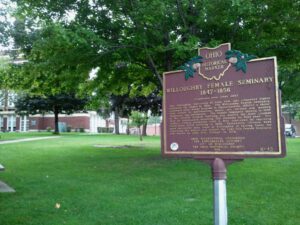
, OH
The village of Chagrin, founded in 1798, changed its name in 1834 to honor Dr. Westel Willoughby, a pioneer medical educator. That same year, the Willoughby University of Lake Erie was chartered, and the Willoughby Medical College opened its doors, signaling the beginning of medical education in northern Ohio. The Medical College trained 160 doctors, educated in contemporary methods of medicine, anatomy, chemistry, and surgery. Financial struggles and public outcry against grave-robbing — which supplied cadavers for anatomy classes — hampered the college’s development. The movement of faculty to Cleveland and the transfer of the state charter to Columbus hastened the demise of the Medical College in 1847, and laid the foundation for the establishment of the medical schools of Case Western and Ohio State universities. (Continued on side two)
, OH
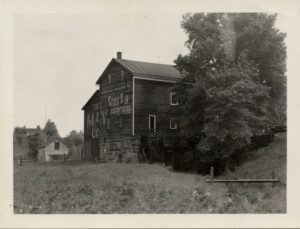
Fowlers Mill (originally Fowler’s Mills) developed around a group of mills built in the 1830s on the Chagrin River. Opportunities from these mills led to Fowlers Mill becoming the commercial center of Munson Township. From the 1830s into the twentieth century, the community expanded with construction of churches, a post office, township hall, stores, hotel, blacksmith shop, schools, and houses built in such styles as Federal, Greek Revival, Italianate, and Queen Anne. This type of community center was common in rural, nineteenth century America, but rarely survives with so much original fabric intact. On Mayfield Road, the Disciple Church was built in 1842. East of the church, the brick central school built in 1913 replaced earlier one-room schoolhouses. The gristmill is the only mill standing in Geauga County. The cemetery contains burials dating from the 1830s. The Fowler’s Mills Historic District was placed on the National Register of Historic Places in 2002.
, OH
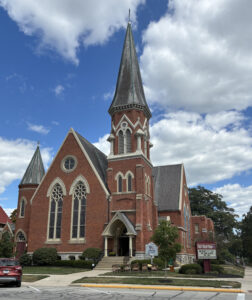
Sidney’s First Presbyterian Church formally organized on September 4, 1825, under the guidance of Reverend Joseph Stevenson, who traveled from Bellefontaine for that purpose. The original eight-member congregation worshipped outdoors or in the Shelby County Courthouse until able to finance their own building in 1834. First Presbyterian’s small frame chapel was constructed on the half-acre parcel that became their permanent home. Two centuries later, the congregation continues to worship at the corner of Miami Avenue and North Street on Lot 109, set aside for religious use in Charles Starrett’s 1819-1820 agreements platting Sidney’s original 70-acre tract. (Continued on other side)

, OH
Archibald Worthington (1818-1895) was a freed slave from Virginia, a Civil War veteran, and prominent landowner in Highland Township. Census records indicate he was manumitted prior to 1850, and by 1860 owned land in northwest Ohio. Worthington also farmed, boarded freed slaves, and owned apple orchards and livestock. April 1866 township records show that he supported the local school for Black families. He and his wife Elizabeth raised three children: Henry, Mathilda, and James. Henry enlisted in the Massachusetts 54th Volunteer infantry, one of the first Black regiments formed in the Civil War. He died January 8, 1865, in a prison camp and is buried in North Carolina’s Salisbury National Cemetery. Mathilda and James both met partners and married, had children, and left the area. Archibald Worthington died in 1895 and is buried in Wilmington’s Sugar Grove Cemetery.
, OH
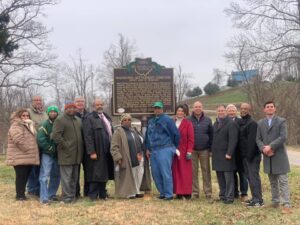
Macedonia Cemetery (circa 1840) belongs to Macedonia Church, Ohio’s first Black Church. Those buried include settlers of the Macedonia Free Black Settlement, built by free people who assisted freedom seekers along the Underground Railroad. Also interred are soldiers of the Civil War’s United States Colored Troops (USCT), most of whom served in the 5th Regiment, Ohio’s first Black Regiment (1863). The Polley family also rest here. Emancipated slaves, the family continued their freedom struggle when their children were kidnapped from Ohio and unlawfully sold into slavery. Macedonia’s extant burial grounds include this sacred site and another 1/2 mile north.