

, OH
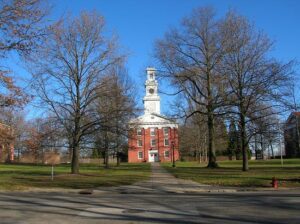
With the help of town founder, David Hudson, Western Reserve College and its Academy were founded in 1826. Often called “The Yale of the West,” the college saw success initially as all of its professors and college presidents were Yale College graduates. Nationally, Western Reserve College became involved with the Underground Railroad and anti-slavery movement 28 years before the Civil War began. Moreover, Western Reserve College established the Loomis observatory, named for Elias Loomis, a Yale tutor and WRC professor, which is now the second oldest observatory in the United States. The Western Reserve College moved to Cleveland in 1882 and eventually became Case Western Reserve University while the Academy remained in Hudson. Today, the Western Reserve Academy is one of the nation’s oldest and most respected independent college preparatory schools.
, OH
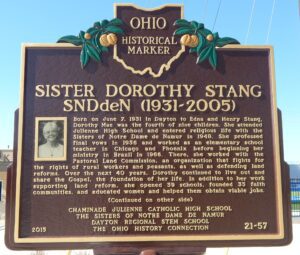
Born on June 7, 1931 in Dayton to Edna and Henry Stang, Dorothy Mae was the fourth of nine children. She attended Julienne High School and entered religious life with the Sisters of Notre Dame de Namur in 1948. She professed final vows in 1956 and worked as an elementary school teacher in Chicago and Phoenix before beginning her ministry in Brazil in 1966. There, she worked with the Pastoral Land Commission, an organization that fights for the rights of rural workers and peasants, as well as defending land reforms. Over the next 40 years, Dorothy continued to live out and share the Gospel, the foundation of her life. In addition to her work supporting land reform, she opened 39 schools, founded 35 faith communities and educated women and helped them obtain viable jobs. (Continued on other side)
, OH
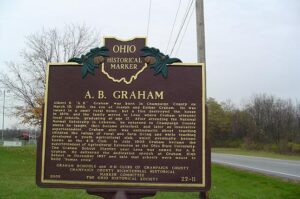
Albert B. “A.B.” Graham was born in Champaign County on March 13, 1868, the son of Joseph and Esther Graham. He was raised in a small rural home, but a fire destroyed the house in 1879, and the family moved to Lena where Graham attended local schools, graduating at age 17. After attending the National Normal University in Lebanon, he returned to Champaign County where he taught, then became principal, and later an innovative superintendent. Graham also was enthusiastic about teaching children the values of rural and farm living and while teaching developed a youth agricultural club, which eventually became known as the 4-H Club. In July 1905 Graham became the superintendent of Agricultural Extension at the Ohio State University. The Graham School District near Lena was named for A.B. Graham. He delivered the dedication speech at Graham High School in December 1957 and said that schools were meant to build “human souls.”
, OH
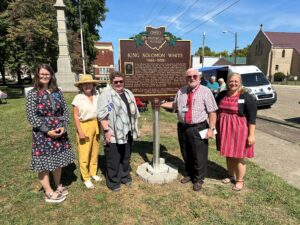
King Solomon “Sol” White was born in Bellaire on June 12, 1868. A Baseball legend, he was an all-around player, manager, and organizer in the Pre-Negro Leagues (1887-1912) and the Negro Leagues (1920-1926). White first played with integrated baseball clubs the Bellaire Globes (1884-1886) and Wheeling Green Stockings (1887). After 1887-1888 color barriers were imposed on baseball, White played on segregated minor league teams. They included: the Pittsburgh Keystones, Cuban Giants, York Colored Monarchs, Cuban X-Giants, Page Fence Giants, and Chicago Columbia Giants. As a coach, he helped organize and lead the powerhouse Philadelphia Giants to their 1904-1907 championships. White died on August 26, 1955, and was buried in an unmarked grave in Staten Island’s Frederick Douglas Memorial Cemetery. In 2006, “Sol” White was posthumously inducted into the Baseball Hall of Fame.
, OH
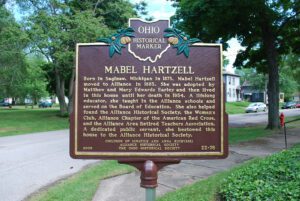
Born in Saginaw, Michigan in 1875, Mabel Hartzell moved to Alliance in 1883. She was adopted by Matthew and Mary Edwards Earley and then lived in this house until her death in 1954. A lifelong educator, she taught in the Alliance schools and served on the Board of Education. She also helped found the Alliance Historical Society, the Woman’s Club, Alliance Chapter of the American Red Cross, and the Alliance Area Retired Teachers Association. A dedicated public servant, she bestowed this house to the Alliance Historical Society.
, OH
The Black community of Gallipolis pooled their resources and expertise to open Gallipolis Union Colored School in 1868. Located on the northwest corner of Third Avenue and Olive Street, the public school offered primary education until, around 1877, a high school curriculum was added. In 1882, the first four students to graduate high school were W.H. Haskins, Minnie Battles, Idella Black, and Mary Nease. By 1890, the school had been renamed for President Abraham Lincoln. Valuing their public education, many Lincoln School graduates became teachers; of 33 high school graduates in the first 8 classes, 11 would become schoolteachers. Dr. Edward Alexander Bouchet (Principal 1908-1913) added an intellectual rigor to Lincoln’s curriculum. The nation’s first Black Ph.D., Bouchet earned a doctorate in physics from Yale University in 1876. (Continued on other side)
, OH
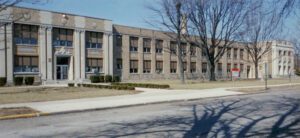
The North Baltimore Elementary and High School stood at 124 S. Second St. and was dedicated November 11, 1927. The tan and brown brick building replaced a school (built 1884) that a fire destroyed on January 26, 1926. The new school building, for children in grades 1-12, also included classrooms for home economics and business courses, as well as a 900-seat auditorium (including balcony), second floor cafeteria, gymnasium, administrative offices, and a public library. E.E. Leidy was the school’s superintendent and R. Vern Northup was the high school principal. The members of the board of education were Dr. E.A. Powell, President, D.B. Bushey, Vice President, C.G. Nigh, Clerk, and Nellie Roberts and R.E. Simon. Previously known as the “Independents,” the school’s sports teams became the “Tigers” in 1931. (Continued on other side)
, OH
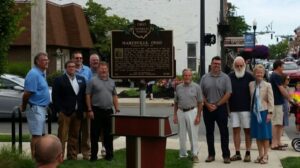
Marysville, Ohio. On August 10, 1819, Samuel W. Culbertson (1780-1840), a Zanesville lawyer, established Marysville at the convergence of Mill Creek and the road connecting Delaware to Urbana. Culbertson purchased 450 acres of land on July 10, 1817 and authorized Charles Roberts to survey the village, which originally contained 96 lots. Culbertson named the village in honor of his daughter, Mary Ellen (1810-1853), who later married US Congressman, Joshua Mathiot (1800-1849). The village was originally in Delaware County, located in part of the Virginia Military District. It was land given as bounties to soldiers from Virginia after the Revolutionary War. Union County, which included Marysville, was created in 1820, and Marysville became the county seat in 1822. (Continued on other side)