

, OH
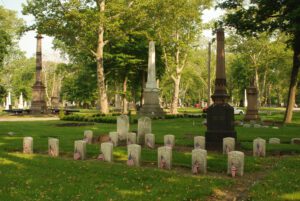
Howard Daniels, who lived from 1815-1863, was a noted architect and landscape gardener. Over the course of his life, he designed six Ohio and New York cemeteries, including Woodland that began in 1852 when he laid out 20 of its 60 acres into fashionable “rural cemetery” style. Later acreage in the cemetery adapted his curvilinear design. “As beautifully prepared for a burial place as fancy and taste could desire,” Woodland was dedicated on June 14, 1853, and became Cleveland’s primary cemetery. An ornate gatehouse, chapel, and fountains came later. Generations of Clevelanders, pioneering and prominent, as well as veterans onward from the War of 1812, are buried here. For more than a century, Woodland, in its original and newly platted sections, has embraced people from every race, the rich and poor, natives and immigrants, and the famous and obscure. It has truly become a community cemetery. [continued on other side]
, OH
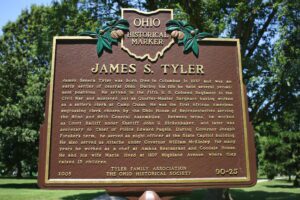
James Seneca Tyler was born free in Columbus in 1837 and was an early settler of central Ohio. During his life he held several prominent positions. He served in the Fifth U.S. Colored Regiment in the Civil War and mustered out as Quarter-Master Sergeant having worked as a sutler’s clerk at Camp Chase. He was the first African American engrossing clerk chosen by the Ohio House of Representatives serving the 62nd and 66th General Assemblies. Between terms, he worked as Court Bailiff under Sheriff John U. Rickenbaker, and later was secretary to Chief of Police Edward Pagels. During Governor Joseph Foraker’s term, he served as night officer at the State Capitol building. He also served as Attache under Governor William McKinley. For many years he worked as a chef at Ambos Restaurant and Goodale House. He and his wife Maria lived at 1107 Highland Avenue where they raised 13 children.
, OH
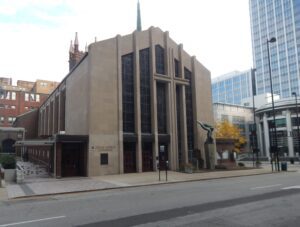
In 1817 twenty-two men, including future President William Henry Harrison, chartered Cincinnati’s first Episcopal parish, Christ Church. In 1835 members erected a Gothic Revival-style church on this site. The neighborhood evolved as the city grew with the influx of immigrants. Parish women raised funds to teach, feed, clothe, and shelter tenement families, and alleviate suffering during floods and disease outbreaks. In 1883 the women helped establish what became Cincinnati Children’s Hospital. In 1909 members opened the Late Gothic-style Parish House, a community center with kitchen, classrooms, library, auditorium, clinic, gymnasium, and bowling alley. By the parish’s centennial in 1917, music had expanded beyond worship to public concerts. In 1940 the annual Boar’s Head Festival of music and pageantry began. Since the 1960s, members have collaborated with local agencies to advocate for social and economic justice, a mission continuing into the 21st century. (Continued on other side)
, OH
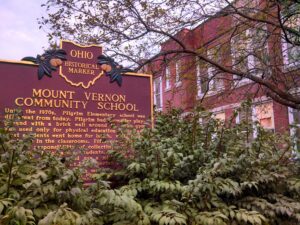
Pilgrim Elementary School, now East Pilgrim, was the community school for the Mount Vernon area and was a focal point for community activities. The Parent Teacher Association was active with members of the community and the school was used as a meeting place. The 1977 Ohio Supreme Court case of Penick v. The Columbus School Board ended the segregation of schools in Columbus. Students from Pilgrim were bussed to other schools in the district.
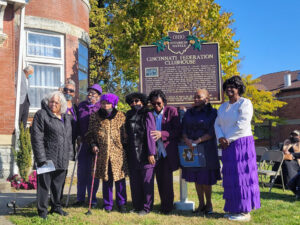
, OH
“Lifting As We Climb”: The Cincinnati Federation of Colored Women’s Clubs (CFCWC) was organized May 6, 1904, during a meeting called by Mary Fletcher Ross at the Allen Temple A.M.E. Church. Gathering together eight existing African-American women’s clubs, the CFCWC sought to unite in their work promoting “the betterment of the community.” At a time when both government and private philanthropies overlooked the needs of Black Americans, CFCWC members helped to organize the city’s first kindergartens for Black children, taught in Cincinnati African-American public schools –including the Walnut Hills Douglass and Stowe schools—and raised money for the Home of Aged Colored Women. Since 1904, the Cincinnati Federation of Colored Women’s Clubs has ensured the civic and constitutional rights of all African Americans while meeting the needs of their city.
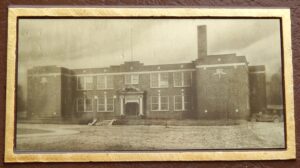
, OH
A bond issue passed by the voters of Parma and Parma Heights Township in 1919 funded the construction of Parma’s first high school. It was located at this site on Ridge Road, south of Ridgewood Drive (then Bean Road) and was dedicated in October 1921. Charles W. Bates designed the school as a single story building, but two years later a second story was added. The first graduating class in 1922 consisted of six students, two boys and four girls. In 1928, the land behind the school became the football field. The Parma High School building became a junior high in 1937 and then in the 1950s, Ridge Road Elementary. From 1962 to 2006 the old high school was the Parma City Schools’ Board of Education. The building was demolished in October 2010.
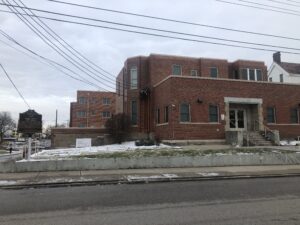
, OH
Walnut Hills has been home to a significant middle- and working-class Black community since the 1850s. In 1931, African American entrepreneur Horace Sudduth bought 1004 Chapel Street and then the row of buildings across Monfort, naming them the Manse Hotel and Annex. Throughout the 1940s, hotel dinner parties could move to the Federation of Colored Women’s Clubs house next door for dancing. A large addition to the Manse in 1950 created its own ballroom, 24-hour coffee shop, upgraded Sweetbriar Restaurant, and more guest rooms. It appeared in the Negro Motorist’s Green Book between 1940-1963, providing local, transient, and residential guests both catered meetings and top entertainment during the last decades of segregation. It closed in the late 1960s when the economic need for a first-class segregated hotel disappeared in the age of Black Power.
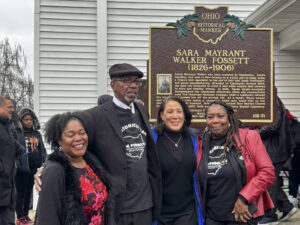
, OH
Sarah Mayrant Walker was born enslaved in Charleston, South Carolina, and sent to New Orleans as a young girl to study under a French hair specialist in the art of hair and scalp treatment, and goods manufacturing. Brought to Cincinnati around 1840, she used her networks to build a hair salon empire that catered to elite and wealthy women. In 1859, Sarah single-handedly desegregated the Cincinnati streetcars when she successfully sued The Passenger Railroad Company after a conductor refused her passage and pushed her off the moving car. As a result, Black women and children could ride inside a streetcar while men could ride on the platform. She and her husband, Peter Fossett, founded First Baptist Church of Cumminsville circa 1870. Both are buried in the Union Baptist Cemetery.