

, OH
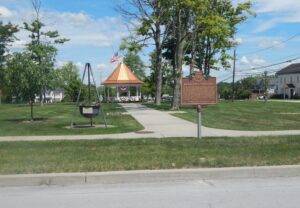
In 1798, Judge Samuel Hinckley of Northampton, Massachusetts, drew the 72nd draft in the land lottery held by the Connecticut Land Company and received 15,305 acres in Township 4, Range 1, for which he paid $12,903.23, less than one dollar per acre. The area had been inhabited for many years by trappers, missionaries, and Native Americans. One of the earliest settlers was James McMullen, who acquired the first 160-acre parcel from Hinckley in 1801. Brookfield Township became the crown jewel of Hinckley’s holdings. Hinckley named Brookfield after a city in England and set aside land for the village green and the cemetery stating that they were for public use forever. During the mid-1820s the Overland Stage Line had a run through Brookfield, linking it to Salem, Warren, and Youngstown in Ohio and Erie, Pennsylvania and Dunkirk, New York. (Continued on other side)
, OH
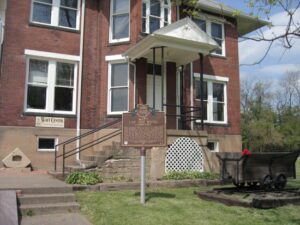
Joseph Watt and son James H. started a small foundry in 1862 making plow points, window sash weights, and heating stoves. Later, brothers Stewart, Ross, and John W. joined and the name became J.H. Watt and Brothers. Securing a patent for a self-oiling mine car wheel, the business expanded to this 27-acre site. In 1891, Ohio gubernatorial candidate, and later U.S. president, William McKinley, dedicated the buildings. By 1901, over 135 were employed by Watt Mining Car Wheel Company producing mine and rail cars for U.S. and foreign markets. The Watt Car and Wheel Company was sold in 1966 to German interests and closed in 1996, ending an era of employment for generations of local people.
, OH
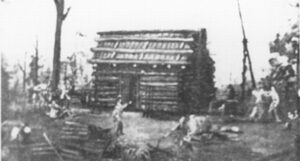
In the late 1790s General Benjamin Whiteman built near this site one of the first log cabins in Alpha, the first settlement in what would become Beavercreek Township of Greene County. The cabin, later owned by Whiteman’s father-in-law, Owen Davis, and leased for use as a tavern to Peter Borders, became the first courthouse of Greene County. Twenty-five feet square, it had one room below and a chamber above, serving as the family sleeping quarters. A small ladder through a hole in the ceiling reached the upper level. The building was constructed of burr oak logs with a roof made of clapboards held in place by long poles laid across them. Considered to be one of the finest houses in that part of the county, the cabin had one door, one window, and a huge fireplace with an outside chimney built of sticks, stones, and clay. (Continued on other side)
, OH
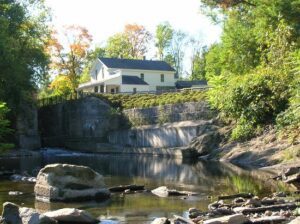
The Mustill house and store are survivors of Akron’s canal era and date to the 1840s. Joseph and Sarah Mustill moved their family from England to Akron in 1833 and owned the store and Greek Revival house at Lock 15 on the Ohio & Erie Canal. Three generations of Mustills lived and worked the grocery business at Lock 15, first Joseph and Sarah, then their son Fred with his wife Emma, and their children Maria, Frederick, Edwin and Franklin. A popular place to buy or barter goods, the store served canallers, farmers, craftsmen, and neighbors for many years.
, OH
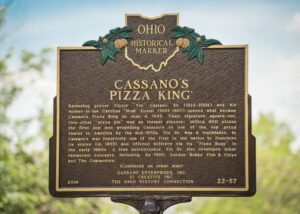
Kettering grocer Victor “Vic” Cassano, Sr. (1922-2002) and his mother-in-law Caroline “Mom” Donisi (1893-1987) opened what became Cassano’s Pizza King on June 4, 1953. Their signature square-cut, thin-crust “pizza pie” was an instant success; selling 400 pizzas the first day and propelling Cassano’s to one of the top pizza chains in America by the mid-1970s. Vic Sr. was a trailblazer, as Cassano’s was reportedly one of the first in the nation to franchise its stores (in 1955) and offered delivery via its “Pizza Bugs” in the early 1960s. A true entrepreneur, Vic Sr. also developed other restaurant concepts, including, by 1980, London Bobby Fish & Chips and The Commodore. (Continued on other side)
, OH
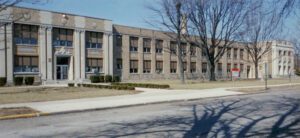
The North Baltimore Elementary and High School stood at 124 S. Second St. and was dedicated November 11, 1927. The tan and brown brick building replaced a school (built 1884) that a fire destroyed on January 26, 1926. The new school building, for children in grades 1-12, also included classrooms for home economics and business courses, as well as a 900-seat auditorium (including balcony), second floor cafeteria, gymnasium, administrative offices, and a public library. E.E. Leidy was the school’s superintendent and R. Vern Northup was the high school principal. The members of the board of education were Dr. E.A. Powell, President, D.B. Bushey, Vice President, C.G. Nigh, Clerk, and Nellie Roberts and R.E. Simon. Previously known as the “Independents,” the school’s sports teams became the “Tigers” in 1931. (Continued on other side)
, OH
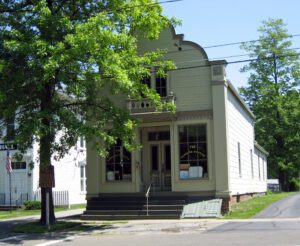
For ninety-one years, The Mahoning Dispatch served Canfield and the surrounding communities, earning the distinction of being the oldest continuously published newspaper owned by a single family in Mahoning County. The first edition of the weekly journal was published May 4, 1877, with a yearly subscription price of $1.50, to be paid in advance. Founded by Canfield native and Civil War veteran Henry Manning Fowler, The Mahoning Dispatch was originally located on the corner of East Main and Broad streets. In 1893, the business was moved to this location, which was built by Pierpont Edwards in 1866 to serve as a grocery store. The journal was one of the first printers in the area to purchase a linotype composing machine, which replaced the method of hand setting type. Published by three generations of the Fowler family, the newspaper was discontinued in 1968, maintaining its “country” paper characteristics to the end.
, OH
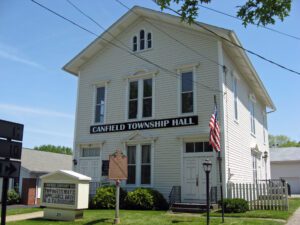
The Canfield Township Hall was erected in 1884. It served as the first public building in which the Canfield citizens could conduct town business, elections, and public meetings. An example of Renaissance Revival or “Italianate” architecture, the building is typical of late Victorian commercial buildings, but constructed of wood rather than of the customary brick. Drafted by Colonel S. Kinney, it was originally constructed for the sum of $2,389 by G.W. Strock at the corner of South Broad and East Main streets, on a lot purchased for $500. In 1936, R.J. Neff moved the hall several hundred feet south to its present location. In addition to official township meetings, the second floor has been used for a variety of activities, including social meetings, lectures, contests, dances, and roller-skating. The building served as an early home of the Canfield Historical Society and operated continuously for over one hundred and twenty-five years.