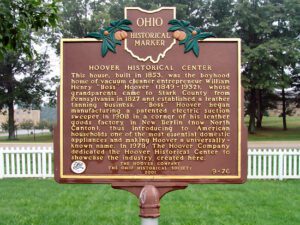
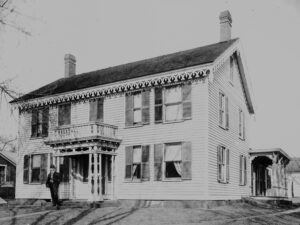
This house, built in 1853, was the boyhood home of vacuum cleaner entrepreneur William Henry “Boss” Hoover (1849-1932), whose grandparents came to Stark County from Pennsylvania in 1827 and established a leather tanning business. “Boss” Hoover began manufacturing a patented electric suction sweeper in 1908 in a corner of his leather goods factory in New Berlin (now North Canton), thus introducing to American households one of the most essential domestic appliances and making Hoover a universally-known name. In 1978, The Hoover Company dedicated the Hoover Historical Center to showcase the industry created here.
Intersection of State Route 554 and Depot Road, Springfield Township
Bidwell
, OH
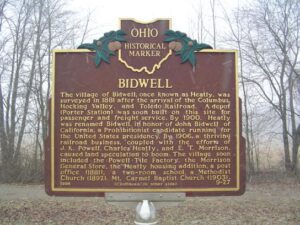
The village of Bidwell, once known as Heatly, was surveyed in 1881 after the arrival of the Columbus, Hocking Valley, and Toledo Railroad. A depot (Porter Station) was soon built on this site for passenger and freight service. By 1900, Heatly was renamed Bidwell, in honor of John Bidwell of California, a Prohibitionist candidate running for the United States presidency. By 1906, a thriving railroad business, coupled with the efforts of J.K. Powell, Charles Heatly, and E.T. Morrison, caused land speculation to boom. The village soon included the Powell Tile Factory, the Morrison General Store, the Heatly housing addition, a post office (1881), a two-room school, a Methodist Church (1892), Mt. Carmel Baptist Church (1903), (Continued)
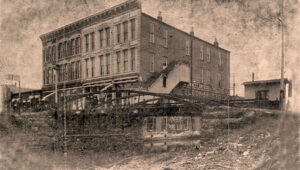
Emmitt-Greenbaum Building, 200 North Market Street, was built around 1878 by businessman and politician James Emmitt (1806-1893) to replace his 1837 wooden warehouse. The brick three-story Italianate building featured five vertical cast iron belts of simulated stone, a projecting cornice, reeded pilasters, and a “fortress-like fourteen bay front.” A covered wooden stairway on the building’s south side originally projected over the canal. Charles Louis Greenbaum (1871-1935) purchased the building in 1912 and opened his department store advertising it as “The Store with The Goods!” Over 140 years, the Emmitt-Greenbaum building was occupied by Jas. Emmitt Dry Goods, Hoffman’s, Greenbaum’s, Armbruster and Armbruster, Waverly Drugs, and the Bee Hive Tavern. A structural collapse after decades of deterioration condemned the building and the southwestern half was razed in 2021.
corner of South Michigan Avenue and East Indiana Street
Edgerton
, OH
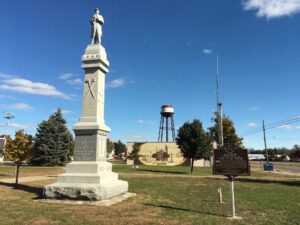
Edgerton was settled beside the St. Joseph River when the Lake Shore & Michigan Southern railroad was completed in 1854. The village was incorporated on December 4, 1865, and named for Alfred P. Edgerton, who donated the land for the park. He was an agent for Hicks & Company, a land speculation business. The firm of Von Behren & Shaffer built the town hall and opera house in 1884 for $7,998. The building and park became a hub of local activity. The park’s bandstand showcased the Edgerton Village Band and citizens gathered for picnics and festivities. (Continued on other side)
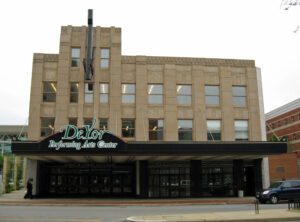
The Warner Brothers – Harry, Albert, Sam, and Jack – were members of a Jewish immigrant family from Poland that settled in Youngstown in the mid-1890s. The brothers attended local schools and worked in their father’s shoe repair shop and meat market before entering the motion picture business. They purchased a projector and opened the first of several theaters in the Mahoning Valley in 1905. The brothers left Youngstown for New York and Hollywood as their company developed into an industry leader. Warner Brothers Pictures, founded in 1923, released Don Juan in 1926, the first “talking picture” using Vitaphone technology. On May 14, 1931, the family gathered in Youngstown to dedicate a luxurious new Warner Theater to the people of the city where it all started, and to memorialize Sam, who died in 1927.
The Johnson House was built in 1852 and its first owner was Henry J. Traver (1827-1911), owner of Traver & Company carriage factory across the street. From 1877 until 1994 the house was the residence and office of four doctors who maintained their practices there. The first was Dr. Daniel Cranz (1854 — 1914); followed by Dr. Thomas Ritter (1855—1928). In 1900, Dr. Robert Johnson (1878 — 1952) purchased the house. His daughter Dr. Myra Johnson (1909 — 1994) took over the practice after he died and until she retired in 1976. After her death, the house was converted into a museum. It is operated by the Wadsworth Area Historical Society and owned by the City of Wadsworth. (Continued on other side)
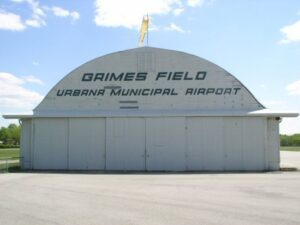
Raised in an Ohio orphanage, Warren G. Grimes (1898-1975) ran away after finishing the ninth grade and at age 16 went to work for the Ford Motor Company in Detroit. He later became a partner in an electrical business where he was instrumental in designing and developing the first lights for the Ford Tri-Motor airplane. In 1930 Grimes moved to Urbana and founded a small lighting fixture plant, Grimes Manufacturing. The inventor of the familiar red, green, and white navigation lights found on the wing tips and tails of aircraft, Grimes, known as the “Father of the Aircraft Lighting Industry,” also developed other aircraft fixtures, including landing, instrumental, and interior lights. Every American-made airplane flown during World War II was equipped with Grimes lights. Grimes served as mayor of Urbana and chairman of the State of Ohio Aviation Board.
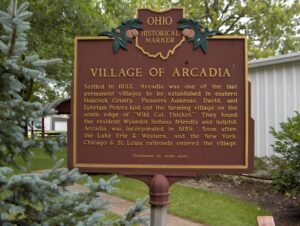
Settled in 1833, Arcadia was one of the last permanent villages to be established in eastern Hancock County. Pioneers Ambrose, David, and Ephriam Peters laid out the farming village on the south edge of “Wild Cat Thicket.” They found the resident Wyandot Indians friendly and helpful. Arcadia was incorporated in 1859. Soon after, the Lake Erie & Western, and the New York Chicago & St. Louis railroads entered the village. (Continued on other side)