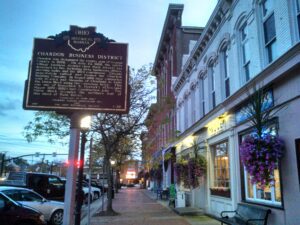
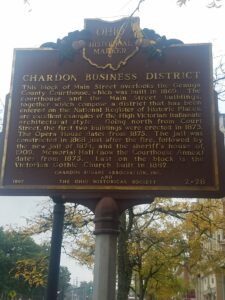
Chardon was designated the county seat of Geauga County in 1808. On July 25, 1868, the entire village business district (now Main Street) was destroyed by fire, including forty businesses, offices, meeting halls, and the 1824 courthouse. Citizens immediately rallied and formed the Chardon Building Company. In August 1868 they contracted with Herrick and Simmons of Cleveland to build the Union Block using fire-resistant brick. This was one of Rensselaer R. Herrick’s (Cleveland Mayor 1879-1882) last construction jobs. The Union Block occupies the northern half of this block of Main Street. (Continued on other side)
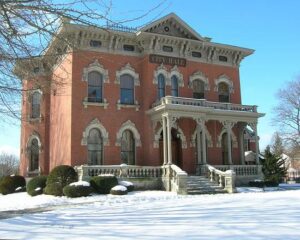
This ornate Victorian/Italianate house was constructed in 1871 as the home of Henry Bishop Perkins, Sr., a civic, business, and political leader of the Western Reserve. During the 19th and early 20th century political figures such as U.S. Grant, James A. Garfield, Rutherford B. Hayes, Benjamin Harrison and William McKinley were visitors to this house.
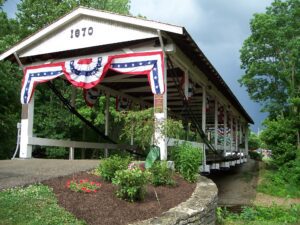
Restored in 1963, the Germantown Covered Bridge on East Center Street, spanning Little Twin Creek, was 93 years old and is reputed to be the only existing covered bridge of its kind in the world. For 41 years this unique inverted bow string truss covered bridge spanned Little Twin Creek on the Dayton Pike in Germantown, Ohio. In 1911 it was removed to its present location where it has been restored and beautified as a link with Ohio’s early history. It is a symbol of individual initiative in America’s early history.
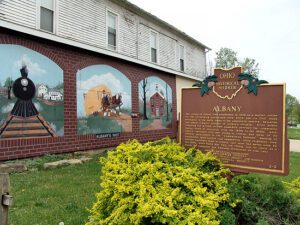
The village of Albany was established in 1838 as a market center for the surrounding agricultural area, which saw its first white settlement in the early years of the nineteenth century. Education was always a major concern of Albany’s citizens. Since public schooling was minimal, private academies provided the community various levels of education from the 1840s to the 1880s. Anti-slavery sentiment also was strong in Albany, and many of its citizens participated in the “Underground Railroad.” Because of educational opportunities and sympathetic white neighbors, free African-Americans came to Albany, but most had moved away by the 1930s. After World War Two, the village lost its status as a center for commerce and business.
This block of Main Street overlooks the Geauga County Courthouse, which was built in 1869. The courthouse and the Main Street buildings, together which compose a district that has been entered on the National Register of Historic Places, are excellent examples of the High Victorian Italianate architectural style. Going north from Court Street, the first two buildings were erected in 1873. The Opera House dates from 1875. The jail was constructed in 1868 just after the fire, followed by the new jail of 1874, and the sheriff’s house of 1909. Memorial Hall (now the Courthouse Annex) dates from 1875. Last on the block is the Victorian Gothic Church built in 1882.
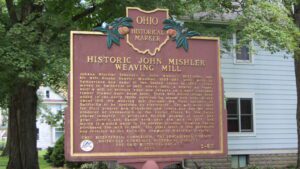
Johann Mischler (changed to John Mishler), 1852-1930, and his wife Rosina Beyeler Mischler, 1852-1927, were born in Switzerland and came to the United States in 1882. They moved to Smithville in 1887 where John, a weaver by trade, built a mill to produce rugs and carpets on a hand operated timber framed barn beam loom. Three belt driven looms were added in the early 1900s powered by steam and later diesel. About 1915, the weaving mill became the first business in Smithville to be operated by electricity. The mill wove cloth for fruit presses and dishcloths and towels and was the only producer of cheesecloth in the United States for the Swiss cheese industry. It produced 40,000 pounds of cloth per year. John’s son Daniel took over the mill in 1930 and moved it a block away to its present location. Charles Norris purchased the mill in 1983. Ten years later, it was purchased and restored by the Smithville Community Historical Society.
Henry Simon Winzeler, founder of The Ohio Art Company, was born in 1876 in the Winzeler family home just north of this site in Burlington. As a young man, he opened a dental practice in 1900 in the Murbach Building in Archbold on the corner of North Defiance and East Holland streets. Making a dramatic career change eight years later, Winzeler, inspired by an oval mirror in his aunt’s clothing store, started a company to manufacture picture frames. Calling it The Ohio Art Company, venture capital came from Winzeler’s Hub Grocery that he opened in August 1908 located on North Defiance Street. His picture frame company was opened in the Spoerle and Baer Building, a few doors down on the same street. [Continued on other side]
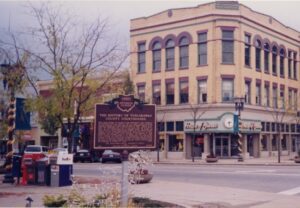
When David Knisely, the founder of New Philadelphia, first arrived in the Tuscarawas Valley on August 27, 1803, he found a sparsely populated, pristine wilderness. Five years later the state legislature approved a bill organizing Tuscarawas County effective March 15, 1808. Shortly thereafter, New Philadelphia was chosen as the county seat, and on April 16, 1808, the first commissioners met at Leininger’s tavern. By August, the tavern proved to be an inappropriate location for the county’s official business, and the commissioners approved the construction of a two-story, combination jail and county office building on land donated by John Knisely on the northeast corner of the square. By 1818 a new, larger brick courthouse was authorized by the commissioners. This building was occupied in 1825 and served as the courthouse until 1882 when the present structure was approved. Occupied in 1888, the building continues to be the center of the county’s business. The beautiful, state-of-the-art annex was dedicated on October 27, 1990.