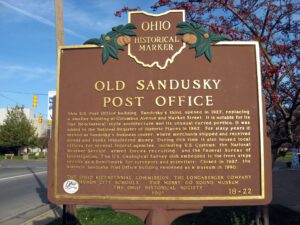
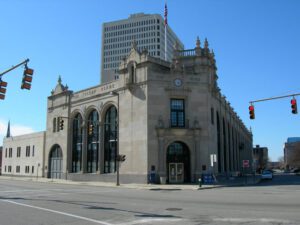
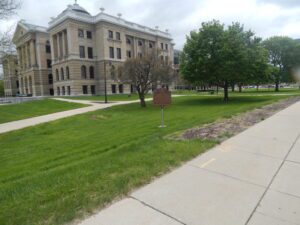
This U.S. Post Office building, Sandusky’s third, opened in 1927, replacing a smaller building at Columbus Avenue and Market Street. It is notable for its fine Neoclassical-style architecture and its unusual curved portico. It was added to the National Register of Historic Places in 1982. For sixty years it served as Sandusky’s business center, where merchants shipped and received goods and banks transferred money. During this time it also housed local offices for several federal agencies, including U.S. Customs, the National Weather Service, armed forces recruiting, and the Federal Bureau of Investigation. The U.S. Geological Survey disk embedded in the front steps serves as a benchmark for surveyors and scientists. Closed in 1987, the historic Sandusky Post Office building reopened as a museum in 1990.
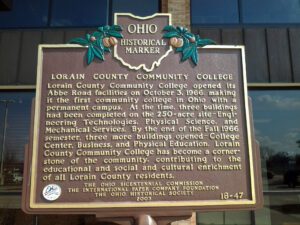
Lorain County Community College opened its Abbe Road facilities on October 3, 1966, making it the first community college in Ohio with a permanent campus. At the time, three buildings had been completed on the 250-acre site-Engineering Technologies, Physical Science, and Mechanical Services. By the end of the Fall 1966 semester, three more buildings opened-College Center, Business, and Physical Education. Lorain County Community College has become a cornerstone of the community, contributing to the educational and social and cultural enrichment of all Lorain County residents.
The Toledo Blade is the city’s oldest continuing business. The newspaper was first published on December 19, 1835, during the Ohio-Michigan boundary dispute known as the “Toledo War.” The name is derived from that conflict and the famous swords of Toledo, Spain. A copy of the first edition and two gift swords from that Spanish city are displayed inside the Blade Building.
201 Martin Luther King Drive (formerly: 201 Cass Avenue)
Marion
, OH
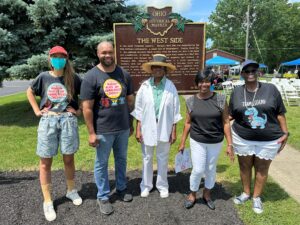
In the early twentieth century, Marion’s West Side was dominated by the Erie Railroad switchyards, a major hub of employment. During World War I, the railroad recruited Black workers from the South for jobs in its yards and roundhouses. In Marion, these workers made their homes in a West Side encampment that became the target of white suspicion and violence. In February 1919, following the unsolved murder of a white roundhouse worker’s wife and a separate alleged assault, a 300-man lynch mob smashed windows and occupied the West Side. All Black residents were ordered to leave the city by 6:00 pm the next day. Despite pleas to Governor Cox, at least 200 Black residents were forced to flee Marion. Marion’s anti-Black violence foreshadowed the nationwide “Red Summer” of 1919.
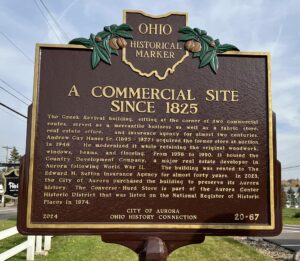
James Willard Converse (1806-1892) opened his store in 1825 at 10 South Chillicothe Road. Serving residents, merchants, and travelers, the store proved central to Aurora’s early commercial development. Converse’s Daybook survives as a glimpse into the habits of early citizens, who, along with household items, regularly purchased whiskey. Surprisingly, such sales surged on George Washington’s February 22 birthday. Converse deeded the business to employee Seth A. Gillett in 1834. Hopson Hurd Sr. (1793-1869) purchased it from Gillett in 1845. Hurd’s store was popular with local farmers who used their home made cheese as legal tender and enjoyed the barrel of whiskey kept in Hurd’s basement for customers who paid their bills. Hurd added a cheese warehouse to his store and, as a major exporter of cheese to Cleveland, Warren, and Pittsburgh, amassed a sizeable fortune.
The first canal boat arrived in Toledo from Indiana in 1843 via the Wabash & Erie Canal. The Miami & Erie Canal from Cincinnati was completed in 1845. It joined the W & E Canal near Defiance and they shared the same course along the Maumee River. The final section of the canal from Toledo’s Swan Creek Side Cut to Manhattan and passed across the present courthouse square.
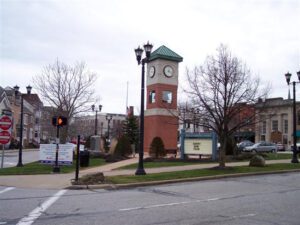
The Triangle, one of the most historic places in Berea, has been the center of the city’s civic life since the mid-19th century. Just beneath lie the solid layers of the famous Berea Sandstone that brought prosperity to Berea during its early years. Quarry owner and Berea Seminary founder John Baldwin obtained much of what is now Berea from Gideon Granger, Postmaster General under President Thomas Jefferson and original owner of Township 6, Range 14 (later Middleburg Township) of the Western Reserve. When the seminary trustees transferred the Triangle tract to the people of Berea in 1847, they designated it by deed as a public promenade. This farsighted stipulation preserved it from commercial development during the 20th century. (continued on other side)
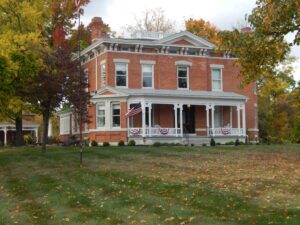
Built of bricks of clay from the Little Miami River, the King Mansion has stood majestically overlooking the town of Kings Mills since 1885. The home of industrialist Ahimaaz King and the first house in Kings Mills, this 12-room, three-story Italianate-style house is crowned with a widow’s walk and features stained-glass windows, distinctive fireplaces, and a tack room. The carriage house included a milking operation for cows on the lower level, stables on the main level, and carriage storage on the upper level. A cast iron fountain in the yard gave the name “Fountain Square” to the area. Occupied by three generations of Kings until 1988, the mansion was added to the National Register of Historic Places in 2008 and is a reminder of Ahimaaz King’s importance to the history of Kings Mills.