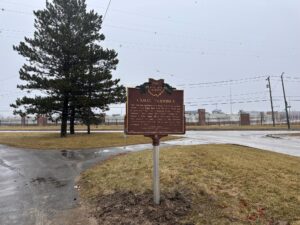
The original northernmost lock in a canal system which linked Lake Erie with the Ohio River was located near the foot of LaSalle Street. Indiana’s Wabash & Erie Canal (1843-1874) joined Ohio’s Miami & Erie Canal (1845-1913) near Defiance and shared the same course to this location. Toledo’s Swan Creek side cut became the northern terminus in 1864.
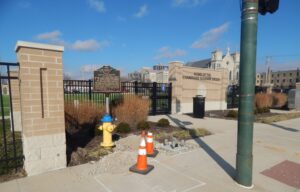
Known by the trade name Henderson’s Printing, the business was a mainstay of Dayton’s African American community for almost 60 years and became a printer of choice for everything from advertising materials, office forms, and a community publications called “housewife savers.” John William Henderson Sr. (1913–1991) purchased his first printing press and founded the business in 1941, bringing to it experience as an instructor of journalism and printing at Wilberforce University. The business’s first location was the family home at 421 Kearney St. After several moves, the business settled at 301 Washington Street in 1958.
Born in Jefferson, Ohio, Theodore E. Burton graduated from Oberlin College and became a prominent Cleveland attorney. He was elected to Congress in 1888 and served from 1889-91, 1895-1909, and 1921-28. He was elected U.S. Senator in 1908 and 1928 and was a leading contender for the U.S. Presidency in 1916. Due to his work in saving Niagara Falls from development and his opposition to wasteful waterways projects, President Theodore Roosevelt appointed Burton chairman of the Inland Waterways Commission in 1907 and the National Waterways Commission in 1909. Burton is credited with pushing legislation through Congress that authorized the construction of the Panama Canal and negotiating agreements to ensure its neutrality. He lobbied to fight wasteful spending and influence of big business and sponsored the Sherman Anti-Trust Act of 1890. As president of the American Peace Society, Burton hosted the First World Conference on International Justice in Cleveland in 1928, attended by 13,000, including world leaders.
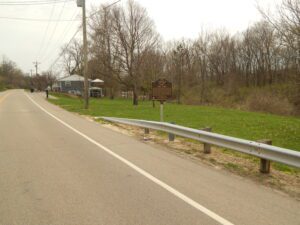
Thomas Burk Sr. purchased a quarter section of federal land here in 1804. A school house was erected on this purchase in 1809. That same year, a road from Williams’ Mill (Millville) was blazed and a saw mill was built on Indian Creek west of this marker. Obadiah Welliver opened a tavern on his purchase in 1812. Burk sold his grist mill in 1818 and it is thought that the hamlet around this mill was called Dogtown because of a vicious dogfight there. In 1825, Reily Post Office was established at Welliver’s Tavern. That year a woolen mill with textile production machinery was built by Elias Sayres, near the saw mill. Multi-millionaire Elias Jackson (“Lucky”) Baldwin (1828-1909), the founder of Santa Anita Racetrack near Los Angeles, was born here.
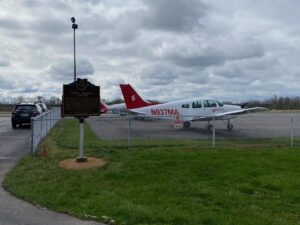
Lewis Albert Jackson (December 29, 1912-January 8, 1994) was an African American aviator remembered for training Tuskegee Airmen during World War II. As a teenager in Indiana, he began flight lessons and soloed in 1932, flying his own Waco 10. Jackson spent 1932-1937 barnstorming to save money for college while earning his Transport Pilot’s License. He re-rated to a Commercial License with Instructor Rating in 1939, and then completed advanced acrobatic training at Coffey School of Aeronautics. In late 1940, he was appointed Director of Training in the Army Air Force 66th Flight Training Detachment at Tuskegee Institute. After the war he moved to Ohio and served as an FAA Flight Examiner from 1947 to 1960. The Lewis A. Jackson Greene County Regional Airport was posthumously renamed to honor this true aviation pioneer.
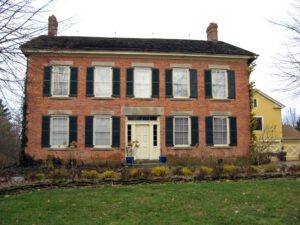
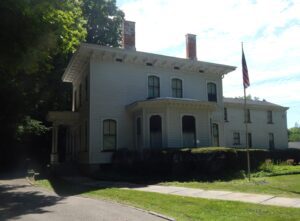
Niles’ industrialist James Ward, Sr. built the house that shares his family’s name in 1862. The house has a low-pitched roof, wide, bracketed eaves, and rounded window and door openings, all characteristics of the Italianate style. John R. Thomas, another industrialist, acquired the house in 1887. His daughter Mary Ann Waddell, wife of Jacob Waddell, lived there until 1969. In 1978, the Thomas family deeded the property to the city of Niles and it became the home of the Niles Historical Society. The house was listed on the National Register of Historic Places in 1984.
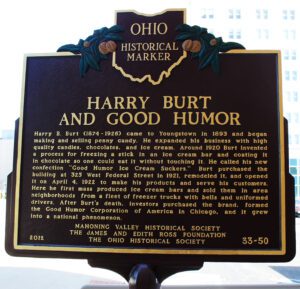
Harry B. Burt (1874-1926) came to Youngstown in 1893 and began making and selling penny candy. He expanded his business with high quality candies, chocolates, and ice cream. Around 1920 Burt invented a process for freezing a stick in an ice cream bar and coating it in chocolate so one could eat it without touching it. He called his new confection “Good Humor Ice Cream Suckers.” Burt purchased the building at 325 West Federal Street in 1921, remodeled it, and opened it on April 4, 1922 to make his products and serve his customers. Here he first mass produced ice cream bars and sold them in area neighborhoods from a fleet of freezer trucks with bells and uniformed drivers. After Burt’s death, investors purchased the brand, formed the Good Humor Corporation of America in Chicago, and it grew into a national phenomenon.
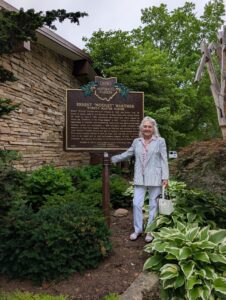
Ernest “Mooney” Warther was born October 30, 1885, near Dover, Ohio. He began to carve, aged 5, and did not set his knife down until shortly before his death on June 8, 1973. Fascinated with trains and steam engines he began his “Evolution of the Steam Engine” in 1913, hoping to convey the importance of invention and engineering. Each model was meticulously hand-sculpted, scaled, and mechanized. A 1923 newspaper article attracted the attention of New York Central Railroad and Warther was invited to tour on their Service Progress Special and later to exhibit at Grand Central Station. This success enabled Warther to quit his local steel mill job and to concentrate on his hobby and his own knife-making business. In 2023, his home, workshop, and museum were listed on the National Register of Historic Places.