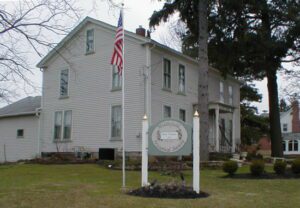
Originally called the James Thompson Inn, named for its builder, the son of Middlefield’s first settler, Isaac Thompson, the Batavia House is Middlefield’s oldest remaining structure. Built in 1818, the two-story wood frame structure was operated continually as an inn by Thompson until his death in 1877. It became the private residence of his daughter, Caroline, until 1907 when again it became an inn, functioning as the Century Inn until 1951. The one-story cement block portion was added circa 1950 to accommodate the weight of the heavy printing presses of the Shetler Printing Company, which occupied the building until 1983.
Behind the Cridersville Fire Department, 100 E. Main Street
Cridersville
, OH
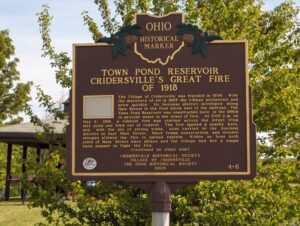
The Village of Cridersville was founded in 1856. With the discovery of oil in 1885 the village prospered and grew quickly. Its business district developed along Main Street in the first block east of the railroad. The Town Pond Reservoir was constructed here in the 1890s to provide water in the event of fire. At 3:00 p.m. on May 2, 1918, a rubbish fire was started across the street from this pond and blew out of control. The fire ignited a nearby barn, and, with the aid of strong winds, soon carried to the business district on East Main Street. Wood frame construction and wooden shingles allowed the fire to spread rapidly. Within an hour both sides of Main Street were ablaze and the village had but a single hand pumper to fight the fire. (continued on other side)
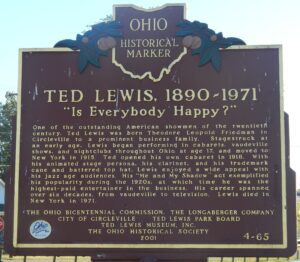
One of the outstanding American showmen of the twentieth century, Ted Lewis was born Theodore Leopold Friedman in Circleville to a prominent business family. Stagestruck at an early age, Lewis began performing in cabarets, vaudeville shows, and nightclubs throughout Ohio at age 17, and moved to New York in 1915. Ted opened his own cabaret in 1918. With his animated stage persona, his clarinet, and his trademark cane and battered top hat, Lewis enjoyed a wide appeal with his jazz age audiences. His “Me and My Shadow” act exemplified his popularity during the 1920s, at which time he was the highest-paid entertainer in the business. His career spanned over six decades, from vaudeville to television. Lewis died in New York in 1971.
Sherwood Anderson (1876-1941), author of 27 works, gave up a successful business career in Elyria, Ohio, to concentrate on writing. Born in Camden, Anderson spent his formative years (1884-1895) in Clyde, and in 1919 he published his most notable book, Winesburg, Ohio. Clyde and small-town Ohio inspired many of its tales. Critics also praised his short story collections, including The Triumph of the Egg (1921) and Death in the Woods (1933). Commercially successful as a writer, Anderson moved to rural Virginia, where in 1927 he purchased and operated two newspapers while continuing his literary career. Through his writings and encouragement he was a major influence to a younger generation of writers, including William Faulkner, Ernest Hemingway, and John Steinbeck. Sherwood Anderson is buried in Marion, Virginia.
Originally known as Hocking Furnace, Haydenville was founded by and named for Columbus industrialist Peter Hayden (1806-1888), who energetically developed the coal, iron, sandstone, and fire clay deposits found in abundance in this area. Here he operated an iron furnace, coal mines and sandstone quarries, shipping products on the Hocking Canal and, later, the Hocking Valley Railroad he helped build. The incorporation of the Haydenville Mining and Manufacturing Company in 1882 initiated the manufacture of brick and ceramic tile from fire clay. Business boomed in the late 19th century as cities paved their streets with brick and fireproof construction became popular in the wake of widely publicized and tragic fires.
Ransom E. Olds was born on this property on June 3, 1864. Olds co-founded the Olds Motor Vehicle Company, forerunner of the Oldsmobile Division of General Motors in Lansing, Michigan, on August 21, 1897. The curved dash model, built from 1900 to 1907, was the first car to carry the name Oldsmobile. With a 66-inch wheelbase, it weighed about 650 pounds, cost $650, and was powered by a one-cylinder, seven-horsepower engine capable of a speed of 20 miles per hour. It was the first commercially successful American-made automobile built using a progressive assembly system that led to modern mass-production methods.
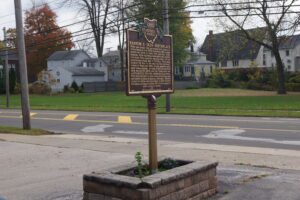
The SW corner of N Market Street and W Emmitt Street/US 23
Waverly
, OH
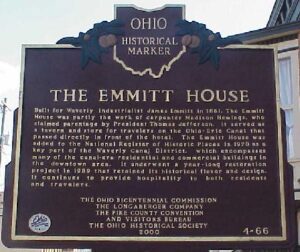
Built for Waverly industrialist James Emmitt in 1861, The Emmitt House was partly the work of carpenter Madison Hemings, who claimed parentage by President Thomas Jefferson. It served as a tavern and store for travelers on the Ohio-Erie Canal that passed directly in front of the hotel. The Emmitt House was added to the National Register of Historic Places in 1978 as a key part of the Waverly Canal District, which encompasses many of the canal-era residential and commercial buildings in the downtown area. It underwent a year-long restoration project in 1989 that retained its historical flavor and design. It continues to provide hospitality to both residents and travelers.
A founder of the Standard Oil Company, Henry Morrison Flagler spent his formative years in Bellevue and began his business career here in 1844, building his home near this site in 1858. He first became associated with John D. Rockefeller as a fellow grain merchant. The two later formed the Standard Oil Company in 1870 with capital partially furnished by members of the local Harkness family. Standard Oil became America’s largest and most powerful corporation in the late 1800s, and Flagler used his wealth to develop the state of Florida. His Florida East Coast Railroad, known as “the railroad over the sea,” extended from Jacksonville to Key West, Florida. The cities of Miami, Palm Beach, Fort Lauderdale, and St. Augustine grew with Flagler’s intensive development efforts.