

, OH
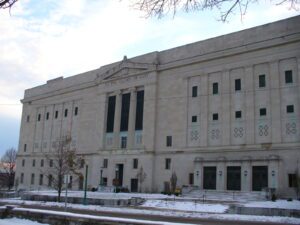
The first Masonic Lodge in Dayton was founded in 1808, located in the first Montgomery County Courthouse. Various other locations were home to Masons in Dayton, but by World War I, rapid growth of the Masonic community called for the creation of a new Lodge building. Masons of the time, including civic and business leaders of Dayton, conceived the idea of a new Masonic Center located on the hill at Belmonte Park North and Riverview Avenue. Ground was broken and construction of the $2.5 million Masonic Temple began on July 20, 1925. Through contributions from the Masonic community, the tremendous task of raising a majority of the building cost, $1.5 million, was accomplished in merely ten days in 1924. It is doubtful that the Temple could be duplicated given the fact that the large quantities of marble and mahogany and cherry woods used in construction would be difficult to procure today.
, OH
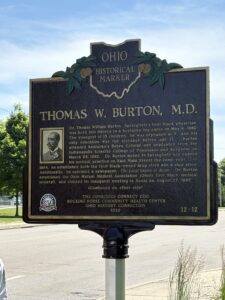
Dr. Thomas William Burton, Springfield’s first Black physician, was born into slavery in a Kentucky log cabin on May 4, 1860. The youngest of 15 children, he was orphaned at 9, and his only education was the alphabet before age 21. Burton attended Kentucky’s Berea College and graduated from the Indianapolis Eclectic College of Physicians and Surgeons on March 24, 1892. Dr. Burton moved to Springfield and opened his medical practice on East Main Street the same year. In 1894, he established both the first Black-owned drug store and a shoe store. Additionally, he operated a newspaper, The Loyal Legion of Honor. Dr. Burton established the Ohio Mutual Medical Association (Ohio’s first Black medical society), and chaired its inaugural meeting in Xenia on August 27, 1897. (Continued on other side)
, OH
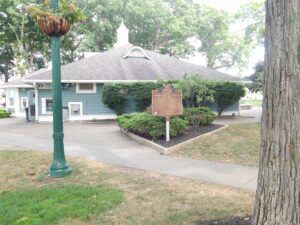
Entrepreneur and philanthropist Joseph (Jose) de Rivera was born in Barcelona, Spain, and built an import business in New York City. In 1854, he bought six Lake Erie Islands and had South Bass Island surveyed and subdivided into ten-acre lots. De Rivera traveled between New York and South Bass Island, initially turning Put-in-Bay into a sheep farm. He encouraged settlement on the island and its wine industry by helping German immigrants purchase land to plant vineyards. He donated five acres for this waterfront park, the site for the first school, and the land for the first church. To promote travel to the island, de Rivera opened the island’s largest cave as a tourist attraction. He is buried in the island’s cemetery, which is on land he donated for that purpose.
, OH
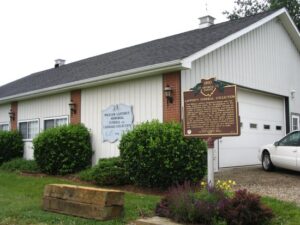
The William Lafferty Memorial Funeral and Carriage Collection shows the development of the funeral business since the mid-1800s through an exhibit of caskets, funeral clothing, and hearses collected and preserved by James William Lafferty (1912 – 1987). William was a member the fourth generation of Laffertys to serve West Union and Adams County. Characteristic of the early history of the profession, William Voris (W.V.) Lafferty (1830-1922) founded the business in 1848 to meet the demand for caskets, which he, as a furniture and cabinetmaker, was often asked to build. (Continued on other side)
, OH
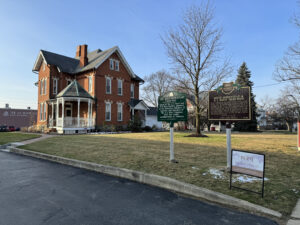
The Root Homestead was built in 1879 by Amos Ives Root, founder of the A. I. Root Company, shortly after he moved his business from the town square. The homestead housed several generations of the Root family until 1953 and was listed on the National Register of Historic Places in 1975. A pioneer of the beekeeping industry, Root helped to standardize such beekeeping equipment and tools as the Langstroth removable frame hive and the centrifugal honey extractor. As a result, beekeepers were able to harvest more honey every season without harming the bees. A prolific author and publisher, Root educated beekeepers across the globe and built a sense of community within the profession. (Continued on other side)
, OH
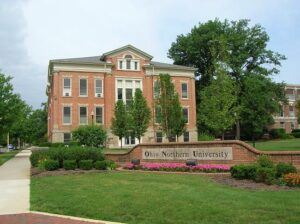
Henry Solomon Lehr founded Ohio Northern University in 1871 as the Northwestern Ohio Normal School. Its purpose was to train teachers and to provide higher education to the people in Northwest Ohio. In 1885, the school became Ohio Normal University. The new name recognized that the institution drew students from all over Ohio and the nation, and offered courses in many disciplines, including literature, music, business, telegraphy, and law, as well as teacher training. Beginning with 131 students, the institution’s enrollment grew rapidly during its first thirty years of existence. Buildings on the early campus included Dukes Memorial (left), built in 1905; the Normal School Building, built in 1871 and demolished in 1915 to make way for Lehr Memorial (center); and Hill building (right) finished in 1879. The Methodist Episcopal Church (predecessor to the United Methodist Church) assumed control in 1899. Ohio Normal University became Ohio Northern University in 1903. On June 3, 1910, President William Howard Taft delivered that year’s commencement address near this spot.
, OH
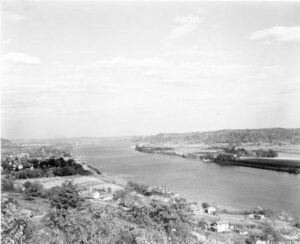
The Ohio River, the southeast border of Gallia County, played a significant role in the development of Gallipolis and Gallia County. One of the state’s first thoroughfares, this waterway enabled pioneers to settle in what was known as the Northwest Territory. On October 17, 1790, approximately 500 French immigrants arrived in Gallipolis, traveling by flatboats from Pittsburgh, and settled in log cabins in what is now City Park, in the heart of Gallipolis. This established the second oldest permanent settlement in the territory. The settlers relied on the River for communication, commerce, and transportation, and the River brought postal service to Gallipolis in 1794. As local business and river trade developed in the 1800s, Gallipolis became a thriving port. The scenic Ohio River is an important inland waterway, providing transportation for many commodities between major cities. The River also provides recreational opportunities for both visitors and residents, including water sports, fishing, and boating.
, OH
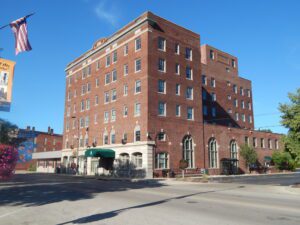
The Hotel Ashtabula was built in 1920 during an economic boom that lasted most of that decade. Architecturally, it represents a combination of Second Renaissance Revival and Georgian Revival styles. The H.L. Stevens and Company of Chicago and New York designed and built the hotel and others like it in Cleveland, Dayton, and Warren, Ohio and throughout the Midwest. The building included a ball room accommodating 300, a dining room that could seat 125, and club meeting and social rooms. A prominent structure of this downtown street, the Hotel Ashtabula was a hub for social activity. (Continued other side)