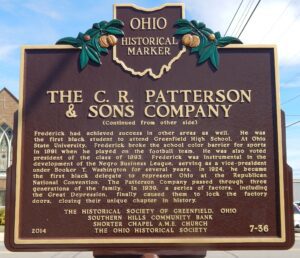
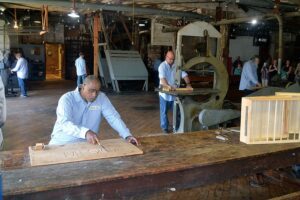
The factory of the C. R. Patterson & Sons Company once stood near here at 138 N. Washington Street. Established in the mid-nineteenth century by the black businessman Charles Richard (C. R.) Patterson and his white partner, J. P. Lowe, the business, originally known as J. P. Lowe & Company, became a successful carriage firm. Patterson became the sole owner in 1893 and changed the name to C. R. Patterson & Sons. After succeeding his father as owner, C. R.’s son, Frederick, became the first known African-American automobile manufacturer. Under his leadership, the company transitioned from building carriages to automobiles, then to trucks and buses to keep up with the changing demands of the transportation industry. (Continued on other side)
In 1847, after completion of the Miami & Erie Canal, 66 residents were recorded in Liberty Township. Construction of Wabash Railway in 1854 encouraged trade at the half way point between Washington Station and Napoleon. Proprietors such as George W. Buchanan, Frank Prey, Alexander Cooper, and Benjamin Penncock began business around 1860. On June 4, 1863, Alphaeus Buchanan registered a plot of 12 lots, which became Liberty Center. On April 9, 1874, the Village of Liberty Center was incorporated and became a prosperous town along the Wabash Railway. (Continued on other side)
In 1888, John Shealy bought a lumber yard from the Stoll Brothers. Ten year later, his son, Charles F. Shealy and partner Edwin F. Stephan formed the Shealy Lumber Company. The business had a “well equipped sash and door factory and an extensive lumber yard” and many area homes contained components made by company craftsmen. The Shealy Lumber Company became the Stephan Lumber Company when Shealy sold his share of the partnership to Stephan in 1911.
New Haven, Ohio, was the mercantile center of southwest Huron County during the first half of the 19th century. Residents described immense wagons, or “land schooners,” lined up for miles on the New Haven-Worthington Road traveling from Columbus to the Lake Erie ports. Organized in 1815, New Haven was one of the early townships formed in Huron County and the Firelands. The village was platted, with streets at right angles around a diamond-shaped town green, after the plan of New Haven, Connecticut. When, in the 1840s, New Haven rejected the railroad’s direct route through the village, the Sandusky & Newark was routed to the west and through Plymouth taking with it the shipping business. Subsequently, New Haven began a steady economic decline into a small crossroads village.
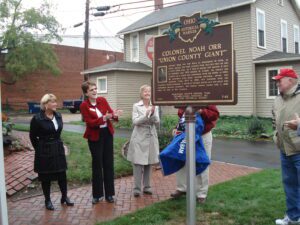
Cyprian Lee (1792-1854) settled in the Union County wilderness in 1820 and purchased the 118 West Sixth Street lot in 1828 for $6. County treasurer, coroner, shoemaker, and anti-slavery activist, Lee lived here in a log cabin until 1832 when this Greek Revival two-story brick house was completed. Other notable citizens to have resided in this oldest brick house in Marysville were showman Noah Orr (1836-1882), also known as the “Union County Giant,” and Josiah Jacob Morelock (1833-1899), a member of the Marysville City Council and the first Fire Department in Marysville. The Morelock family tannery business and stables were located behind this house.
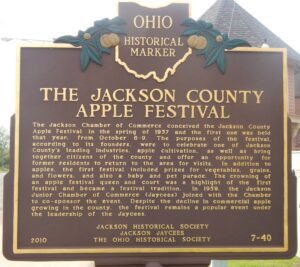
The Jackson Chamber of Commerce conceived the Jackson County Apple Festival in the spring of 1937 and the first one was held that year, from October 6-9. The purposes of the festival, according to its founders, were to celebrate one of Jackson County’s leading industries, apple cultivation, as well as bring together citizens of the county and offer an opportunity for former residents to return to the area for visits. In addition to apples, the first festival included prizes for vegetables, grains, and flowers, and also a baby and pet parade. The crowning of an apple festival queen and court was a highlight of the first festival and became a festival tradition. In 1959, the Jackson Junior Chamber of Commerce (Jaycees) joined with the Chamber to co-sponsor the event. Despite the decline in commercial apple growing in the county, the festival remains a popular event under the leadership of the Jaycees.
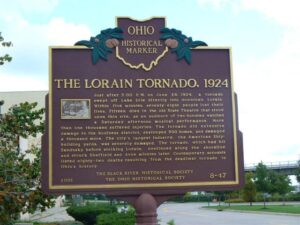
Just after 5:00 P.M on June 28, 1924, a tornado swept off Lake Erie directly into downtown Lorain. Within five minutes, seventy-eight people lost their lives. Fifteen died in the old State Theatre that stood upon this site, as an audience of two hundred watched a Saturday afternoon musical performance. More than one thousand suffered injuries. The tornado did extensive damage to the business district, destroyed 500 homes, and damaged a thousand more. The city’s largest industry, the American Shipbuilding yards, was severely damaged. The tornado, which had hit Sandusky before striking Lorain, continued along the shoreline and struck Sheffield and Avon minutes later. Contemporary accounts listed eighty-two deaths resulting from the deadliest tornado in Ohio’s history.
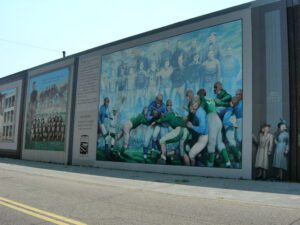
The Ohio River floodwaters account for Portsmouth’s settlement. Alexandria, the county’s first town, was laid out in 1799 on the west bank of the Scioto at its confluence with the Ohio. Early settlers in Alexandria were forced to higher ground across the river in Portsmouth because of frequent flooding. As a result, Portsmouth, platted in 1803, became Scioto County’s seat and business center by 1814. Prominent local industries included brick, stone, steel, wood products, and shoe manufacturing. As of 2003, the Ohio River is the cornerstone of Portsmouth’s transportation system, providing a means for materials to reach destinations throughout the region. It also serves as a recreation hub. The three-mile long levy, first built in 1908, failed in the 1937 flood and was subsequently improved.