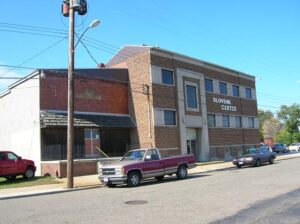
In 1918, early Slovene immigrants organized the Slovenian Independent Society Home and later constructed this hall, which became the center for Barberton Slovene cultural, social, and recreational activities. They formed dramatic and singing clubs, conducting performances in their native language. In the early twentieth century, prior to employers providing insurance or health care for their workers, the society acted to ensure sick and death benefits for its members. It also prepared members for citizenship in their newly chosen country. First generation Slovenes provided the labor that helped spur the growth of local industries while succeeding generations have continued to contribute to the community in various business, industrial, professional, and governmental capacities.
Ohio’s oldest surviving municipal market house, Findlay Market was designed under the direction of City Civil Engineer Alfred West Gilbert (1816-1900). It was listed on the National Register of Historic Places in 1972. The structure was among the first market houses in the United States to use iron frame construction technology. Originally an open pavilion, much of the market was erected in 1852, but disputes with contractors delayed its opening until 1855. The center masonry tower was built in 1902. Soon after, public health concerns prompted enclosure of the market stalls and the addition of plumbing and refrigeration. Until then, vendors found cool storage in deep cellars beneath nearby breweries. The tower bell was brought from Cincinnati’s Pearl Street Market in 1934. Findlay Market was renovated in 1973-74 and again in 2002-03.
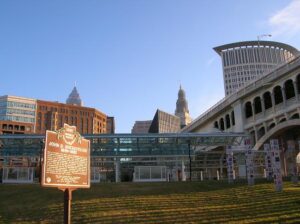
Born at Richford, New York, John D. Rockefeller moved to the Cleveland area with his family at age 14. He began his business career as a bookkeeper in 1855. From modest beginnings he became one of the richest men of his era by developing the world’s largest oil corporation, the Standard Oil Company, which was founded here in the Flats of Cleveland. Rockefeller moved to New York City in 1884 but maintained two homes in Cleveland, returning often with his wife Laura (1839-1915). Although he was a controversial businessman, Rockefeller donated millions of dollars to Cleveland charities and institutions, and land for Rockefeller and Forest Hills parks. John and Laura Rockefeller are interred in Lake View Cemetery.
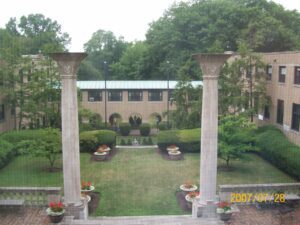
Elm Court, designed by Howard Van Doren Shaw of Illinois, was built in 1912 for Arthur Hudson Marks. The original mansion exemplifies the Italian Renaissance Revival style. Elm Court included the mansion, barn, stables, carriage house, pond, and a variety of trees, especially elms, on 33 acres. Arthur Marks was the inventive genius in chemistry and business who revolutionized the rubber industry in Akron. He was best known for inventing the alkaline-recovery vulcanization process in 1899, the cord tire, the chemical research laboratory system, and placing rubber research on a scientific basis. In World War I he served as director of chemical warfare services. Marks served as vice-president of B.F. Goodrich Company and Curtis Airplane and Engine Company and president of other rubber companies and the Aeolian Skinner Organ Company.
On this site in 1882, Gustave H. Grimm (1850-1914), a German immigrant tinsmith, established the G.H. Grimm Manufacturing Company. His device, the Champion Evaporator revolutionized maple syrup production with the use of a corrugated pan which increased the efficiency of evaporating liquids such as saps. Grimm’s business became the world’s leading manufacturer of maple supplies. His contributions as an inventor, researcher, and manufacturer established him as a leader in the maple sugar industry.
Poland Township Historical Society, 4515 Center Road
Lowellville
, OH
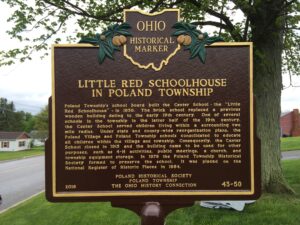
Poland Township’s school board built the Center School- the “Little Red Schoolhouse”- in 1858. The brick school replaced a previous wooden building dating to the early 19th century. One of several schools in the township in the latter half of the 19th century, the Center School served children living within a surrounding two mile radius. Under state and county-wide reorganization plans, the Poland Village and Poland Township schools consolidated to educate all children within the village and township. Consequently, the Center School closed in 1915 and the building came to be used for other purposes, such as 4-H activities, public meetings, a church, and township equipment storage. In 1979 the Poland Township Historical Society formed to preserve the school. It was placed on the National Register of Historic Places in 1984.
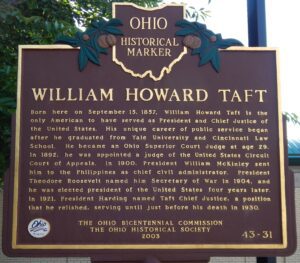
Born here on September 15, 1857, William Howard Taft is the only American to have served as President and Chief Justice of the United States. His unique career of public service began after he graduated from Yale University and Cincinnati Law School. He became an Ohio Superior Court Judge at age 29. In 1892, he was appointed a judge of the United States Circuit Court of Appeals. In 1900, President William McKinley sent him to the Philippines as chief civil administrator. President Theodore Roosevelt named him Secretary of War in 1904, and he was elected president of the United States four years later. In 1921, President Harding named Taft Chief Justice, a position that he relished, serving until just before his death in 1930.
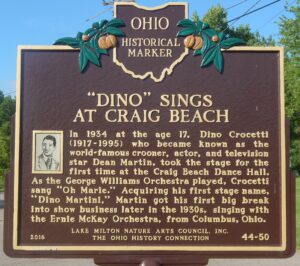
In 1934 at the age 17, Dino Crocetti (1917-1995) who became known as the world-famous crooner, actor, and television star Dean Martin, took the stage for the first time at the Craig Beach Dance Hall. As the George Williams Orchestra played, Crocetti sang “Oh Marie.” Acquiring his first stage name, “Dino Martini,” Martin got his first big break into show business later in the 1930s, singing with the Ernie McKay Orchestra, from Columbus, Ohio.