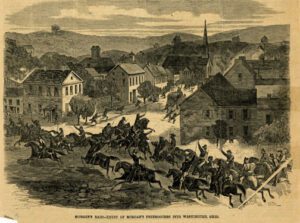
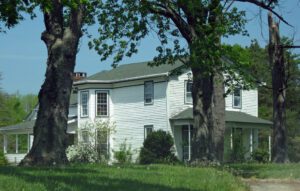
General John Hunt Morgan of Kentucky led a force of Confederate calvarymen into Meigs County during a forty-six day raid north of the Ohio River. The advance forces burned Benjamin Knight’s carding mill and sawmill, the Shade River Bridge, and pillaged local businesses in Chester on July 18, 1863, while waiting for the rest of the column to catch up. This two-hour halt delayed General Morgan’s arrival at the ford at Buffington Island until after dark, allowing Union troops to arrive before he could make his escape. General Morgan surrendered eight days later near West Point in Columbiana County, the northernmost point ever reached by Confederate forces during the Civil War.
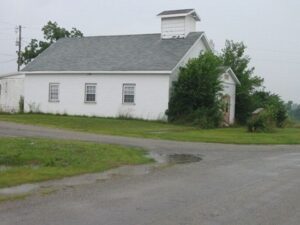
Through the terms of his will, British absentee landowner Samuel Gist (c.1723-1815) freed his 350 Virginia slaves and provided funds for their relocation, the purchase of land and homes, and the establishment of schools and churches. Gist’s executors acquired over 2,000 acres of land in Ohio, including two large tracts in Scott and Eagle townships in Brown County in 1819. In 1831 and 1835, an agent of the Gist estate purchased 207 acres in Fairfield Township (now Penn Township), Highland County, and divided the acreage into thirty-one lots. The Gist Settlement in Highland County was the last to be purchased and settled. In 1857, the Ohio Legislature granted the Highland County Court of Common Pleas control over the freedmen’s trust monies. In 2003 descendants of the freed Gist slaves still inhabited part of the original settlement.
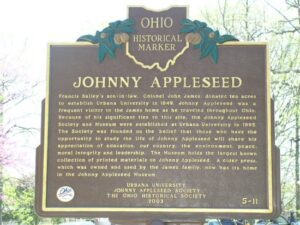
Urbana University was established by the Swedenborgian Church in 1850. Bailey Hall (1853), named after Francis Bailey (1735-1815), was designed by W. Russell West, architect of the Statehouse of Ohio. Bailey was an American Revolutionary War hero, official printer of the Continental Congress and printer of The Freeman’s Journal or the North American Intelligencer. He also printed The True Christian Religion papers. John (Johnny Appleseed) Chapman (1774-1845) distributed The True Christian Religion papers along with his famous apple trees throughout Ohio as a missionary for the Swedenborgian Church. Barclay Hall (1883) was named after Hester Barclay, a ward of Francis Bailey. It was Hester Barclay’s brother-in-law, John Young, who converted Chapman to the Swedenborg faith. Francis Bailey and Hester Barclay were the first male and female Swedenborgian converts in North America. Both Bailey and Barclay halls appear on the National Register of Historic Places.
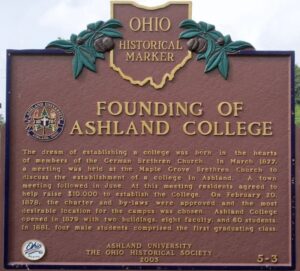
The dream of establishing a college was born in the hearts of members of the German Brethren Church. In March 1877, a meeting was held at the Maple Grove Brethren Church to discuss the establishment of a college in Ashland. A town meeting followed in June. At this meeting residents agreed to help raise $10,000 to establish the College. On February 20, 1878, the charter and by-laws were approved and the most desirable location for the campus was chosen. Ashland College opened in 1879 with two buildings, eight faculty, and 60 students. In 1881, four male students comprised the first graduating class.
Betsey Mix Cowles dedicated her life to fighting slavery and improving the status of women. Her desire for a formal education led her to Oberlin College, where she completed two years of study in 1840. An advocate of immediate abolition, Cowles lectured on the moral depravity of slavery, opened her home, at this site, to fugitive slaves. Opposed to expansion of slavery into the West, Cowles protested the Mexican War. Cowles served as president of Ohio’s first women’s rights convention (in Salem) in 1850, and the following year wrote a treatise on equal pay for working urban women. She served as the first dean of women at Grand River Institute, and later became one of the first women public school superintendents in Ohio.
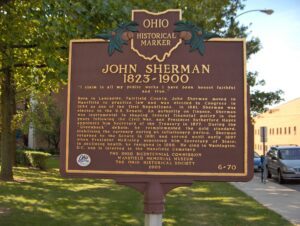
Born in Lancaster, Fairfield County, John Sherman moved to Mansfield to practice law and was elected to Congress in 1854 as one of the first Republicans. In 1861, Sherman was elected to the U.S. Senate. An authority on finance, Sherman was instrumental in shaping federal financial policy in the years following the Civil War, and President Rutherford Hayes appointed him Secretary of the Treasury in 1877. During the “Greenback” debate, he re-implemented the gold standard, stabilizing the currency during an inflationary period. Sherman returned to the Senate in 1881 and served until early 1897 when President McKinley appointed him Secretary of State; in declining health, he resigned in 1898. He died in Washington, D.C. and is interred in the Mansfield Cemetery.
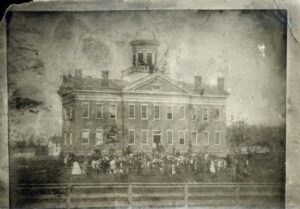
Founded in 1850 by the Disciples of Christ, or “Campbellites,” this institution of higher education was chartered as Hiram College in 1867. The College’s original charter provided for instruction for both men and women, and Hiram served as an early example of successful coeducation. From 1857 to 1861, James A. Garfield, 20th president of the United States, held the principalship of the institute. It continues today as one of Ohio’s successful liberal arts colleges.
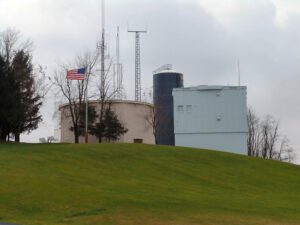
Campbell Hill is named for Charles D. Campbell of Bellefontaine, who owned this land from 1898 to 1937. A marble stone marker atop the hill, set in 1900 by the U.S. Coast and Geodetic Survey, marks it as the highest point in Ohio at an elevation of 1549.09 feet. In 1951, the federal government established the 664th Aircraft Control and Warning (AC&W) Squadron here as part of the North American Air Defense Command (NORAD). Its military and civilian operators used sophisticated radar and computer equipment to locate and identify aircraft as friendly or suspicious, and relayed information to a central site in Battle Creek, Michigan. This Cold War site operated until 1969. It was converted to civilian use as a vocational education center in 1974.