

, OH
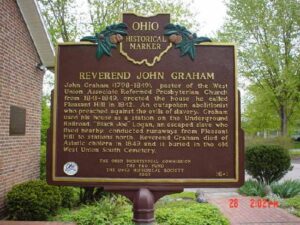
John Graham (1798-1849), pastor of the West Union Associate Reformed Presbyterian Church from 1841-1849, erected the house he called Pleasant Hill in 1842. An outspoken abolitionist who preached against the evils of slavery, Graham used his house as a station on the Underground Railroad. “Black Joe” Logan, an escaped slave who lived nearby, conducted runaways from Pleasant Hill to stations north. Reverend Graham died of Asiatic cholera in 1849 and is buried in the old West Union South Cemetery.
, OH
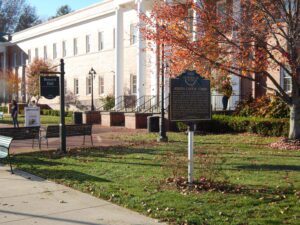
Joseph Carter Corbin’s work in the Reconstruction-era south after the Civil War created many educational opportunities for African Americans. Corbin (1833-1911) was a professor, administrator, journalist, linguist, and musician. Born in Chillicothe, Ohio to free African American parents, he earned his bachelor’s degree and two masters’ degrees from Ohio University, in 1853, 1856, and 1889, respectively. In 1872, Corbin and his wife Mary moved to Arkansas where he served as the state superintendent of public education. In 1875, Corbin was appointed principal of Branch Normal College, which became the University of Arkansas at Pine Bluff. In 1898, he co-founded and became president of the Arkansas Teachers Association. He was also a leader in the Prince Hall Masons, an African American Masonic order. He served as a secretary and Grand Master of the lodge’s Arkansas chapter.
, OH
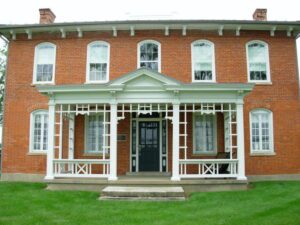
Known as the “Halfway House,” the Gooding House and Tavern was built by George B. Gooding halfway between the towns of Worthington and Delaware in 1827. Its location was influenced by construction of the Columbus and Sandusky Turnpike that was chartered by the State of Ohio the year before. Also known as the “Mud Pike,” the turnpike was slow and difficult for travelers and could take nearly a day to travel 10 miles. The Gooding House was the perfect place for stagecoach drivers to change teams of horses and for travelers to rest and have refreshments. George Gooding also prospered as a farmer with over 1,000 acres of land. This stately brick farmstead remained in the Gooding family for 175 years with each succeeding generation adding its imprint on the property. The Gooding House and Tavern was listed on the National Register of Historic Places in 2005 and restored in 2007.
, OH
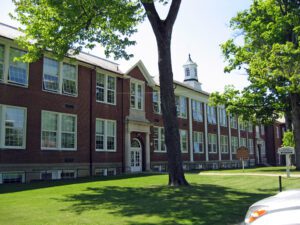
Poland Academy, an elite private school, was established on this site in 1830 and in 1859 graduated its most notable student William McKinley, who became the 25th president of the United States. In 1862, the school changed its name to Poland Seminary and was one of the first schools in northeast Ohio to admit girls on an equal basis. Ida Tarbell, who became a prominent national journalist and author was Preceptress of the Seminary from 1880-1882. William Calhoun graduated from the Seminary and became the U.S. Ambassador to China from 1910-1913. The school became a public institution in 1909 when it became the Poland Seminary High School. In 1972 it was the site of Poland Junior High School and Poland Middle School in 1985.
, OH
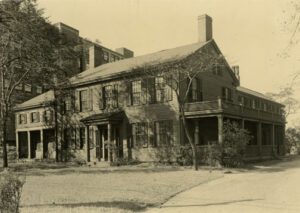
Dunham Tavern is the oldest building still standing on its original site in the City of Cleveland. Once a stagecoach stop on the old Buffalo-Cleveland-Detroit road (modern Euclid Avenue), the tavern dates from 1824. The structure was built by Rufus and Jane Pratt Dunham, who journeyed to the Western Reserve from Mansfield, Massachusetts. The Dunhams sold the tavern in 1853. However, it continued to serve the public until 1857, when it was converted to a private residence. It remained a home until the nineteen thirties, when commercial development threatened the former tavern’s existence. The historic structure was dedicated in 1936 as a museum depicting the life of an early Cleveland pioneer family. Dunham Tavern is listed in the National Register of Historic Places and is a designated Cleveland Landmark building.
, OH
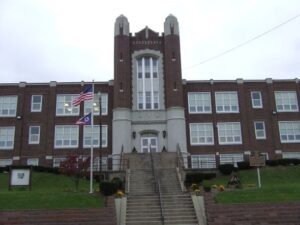
An October 23, 1927, ceremony was held for the laying of the cornerstone for the Dennison High School Building. It opened in the fall of 1928 and was called “Angel’s Castle” in honor of school superintendent William Hiram Angel. The building was designed by J.K. Griffin, an architect from Canton, Ohio, in a style that has the elements of Collegiate Gothic that was popular for school and college buildings during the early twentieth century. The distinguishing architectural features of the entrance towers enhance the school’s prominent location above the street level. Dennison High School is an important visual landmark in the community, as its towers are visible from the downtown area and surrounding neighborhoods. It has retained its integrity of location, materials, design, and association and conveys the early twentieth century ideals of education that the original design of the building was intended to inspire. (Continued on other side)
, OH
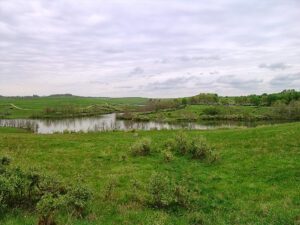
Near this location stood the settlement of African American families known as “The Lett Settlement.” The Lett Settlement was a self-sustaining community of mixed race families, including the Caliman, Guy, and Lett families. The families had formed ties through marriage and common background during the mid-1700s in Virginia and Maryland. These early African American pioneer families came to Ohio as “free people of color,” and began acquiring land in Meigs Township, Muskingum County, and surrounding townships in adjacent counties during the 1820s. They were soon joined by the Brown, Clifford, Earley, Simpson, Tate, and Pointer families. The families of the Lett Settlement were land owners and tax payers in Ohio before the Civil War and challenged the State of Ohio for the right to vote and for access to education during the 1840s, 1850s, and 1860s. (Continued on other side)
, OH
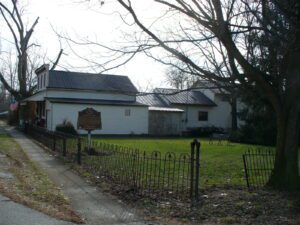
The foundation for the first Welsh settlement in Ohio was laid on June 29, 1801, when William and Morgan Gwilym purchased land in what is now Morgan Township at the Cincinnati Land Office. The Welsh, who settled in Pennsylvania beginning in the late eighteenth century, moved westward and settled here in 1802. This area was also the major terminus for the 1818 migration from Montgomeryshire and Cardiganshire in Wales. In 1803 a Congregational Church was organized and services were held in members’ homes or outdoors. A brick Meetinghouse, complete with a Welsh death door leading to the cemetery, was constructed in 1824. The building now serves as the Community House. The present brick church was built in 1854. For many years, the library, formed in 1852, was housed in the New London Special School District building that stood on this site. (Continued on other side)