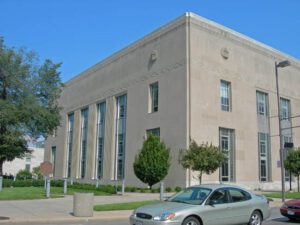
Toledo High School opened in 1854 on the site of the city’s first log schoolhouse. After an 1895 fire, it was rebuilt and named Central High School. The facility closed in 1914 with the opening of Scott and Waite high schools. It reopened as Woodward Technical School and later became Vocational High. The building was razed in 1938 for construction of the Toledo Public Library.
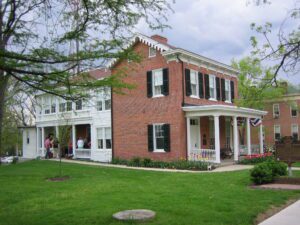
William Holmes McGuffey (1800-1873) was a Miami University faculty member in 1836 when he compiled the first edition of the McGuffey Eclectic Reader in this house. His Reader taught lessons in reading, spelling, and civic education by using memorable stories of honesty, hard work, thrift, personal respect, and moral and ethical standards alongside illustrative selections from literary works. The six-edition series increased in difficulty and was developed with the help of his brother Alexander Hamilton McGuffey. After the Civil War the Readers were the basic schoolbooks in thirty-seven states and by 1920 sold an estimated 122 million copies, reshaping American public school curriculum and becoming one of the nation’s most influential publications. (Continued on other side)
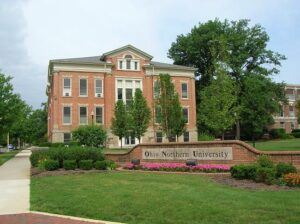
Henry Solomon Lehr founded Ohio Northern University in 1871 as the Northwestern Ohio Normal School. Its purpose was to train teachers and to provide higher education to the people in Northwest Ohio. In 1885, the school became Ohio Normal University. The new name recognized that the institution drew students from all over Ohio and the nation, and offered courses in many disciplines, including literature, music, business, telegraphy, and law, as well as teacher training. Beginning with 131 students, the institution’s enrollment grew rapidly during its first thirty years of existence. Buildings on the early campus included Dukes Memorial (left), built in 1905; the Normal School Building, built in 1871 and demolished in 1915 to make way for Lehr Memorial (center); and Hill building (right) finished in 1879. The Methodist Episcopal Church (predecessor to the United Methodist Church) assumed control in 1899. Ohio Normal University became Ohio Northern University in 1903. On June 3, 1910, President William Howard Taft delivered that year’s commencement address near this spot.
801 E. Pete Rose Way, Bicentennial Commons at Sawyer Point
Cincinnati
, OH
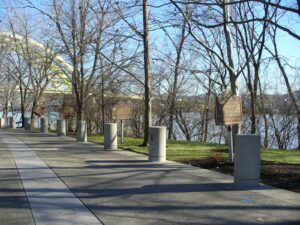
In memory of the Irish people who left a country where only their rivers run free. The Irish came to Cincinnati where they contributed to housing, education, employment, religious freedom, medical care and recreation, and embraced all aspects of life in the city. The descendants of Irish immigrants hope that our hands will ever be extended in friendship and never in want.
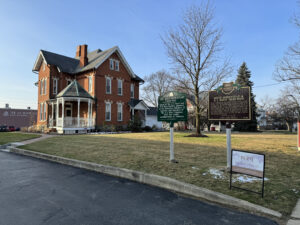
The Root Homestead was built in 1879 by Amos Ives Root, founder of the A. I. Root Company, shortly after he moved his business from the town square. The homestead housed several generations of the Root family until 1953 and was listed on the National Register of Historic Places in 1975. A pioneer of the beekeeping industry, Root helped to standardize such beekeeping equipment and tools as the Langstroth removable frame hive and the centrifugal honey extractor. As a result, beekeepers were able to harvest more honey every season without harming the bees. A prolific author and publisher, Root educated beekeepers across the globe and built a sense of community within the profession. (Continued on other side)
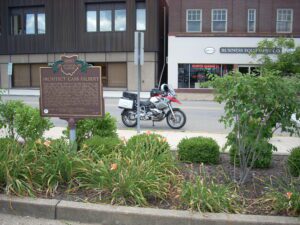
One of America’s leading architects of the early 20th century, Cass Gilbert (1859-1934), was born in a home that stood at this site. After studying at the Massachusetts Institute of Technology, Gilbert apprenticed with prominent architectural firm McKim, Mead, and White. The critical success of his first major public building, the design of the 1895 Minnesota State Capitol, established his national reputation. His influential 1912 Woolworth building, at 792 feet, was then the world’s tallest building, earning Gilbert’s nickname of “Father of the Modern Skyscraper.” Combining classical designs with modern technology, Gilbert also created the United State Supreme Court building (1932) in Washington, D.C., an enduring icon of American justice and democracy. His other achievements include the Arkansas and West Virginia capitols, the U.S. Custom House in New York, and several buildings at Oberlin College. Gilbert served as the president of the American Institute of Architects and the National Academy of Design.
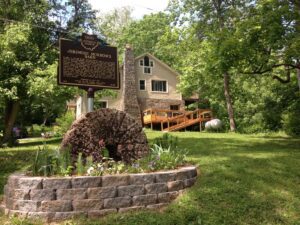
In 1795, at the age of 23, Jeremiah Morrow came to the Northwest Territory from Pennsylvania. He purchased land along the Little Miami River in Deerfield Township and in 1799 married Mary Parkhill of Pennsylvania. Around 1800 he built this barn which is one of Warren County’s oldest standing structures. In 1801, Morrow was sent to the Second Territorial Assembly and to the first Ohio Constitutional Convention in 1802. In 1803, he was elected the new state’s first U. S. Congressman and was Ohio’s only congressman for ten years. In 1813 the Ohio legislature elevated him to U.S. Senate. In 1822 he became Ohio’s ninth governor. He went on to serve in both the Ohio House and Senate and at age 69 returned to Congress. An extraordinary man, Jeremiah Morrow gave his country 43 years of public service.
“I thought of the great bandits of the old West [like] the James Brothers…They knocked over trains, and I was going to pull the same stunt,” exclaimed notorious gangster Alvin “Creepy” Karpis. On November 7, 1935, Karpis and his bandits held up Erie Train #626 at this former location of the Garrettsville Train Depot, escaping with over $46,000 in cash and securities. Because of this last great train heist in American history, FBI Director J. Edgar Hoover and his Government Men (G-Men) improved their surveillance methods to capture Karpis. Once labeled “Public Enemy Number One,” Alvin Karpis became Hoover’s first arrest on May 1, 1936. Local legend holds that FBI agents flooded this town searching for Karpis and his accomplices, and this led the James A. Garfield School District to adopt the G-Men as the mascot for its athletic teams.