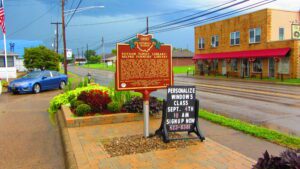
As a shareholder of the United Library Association in Pomfret, Connecticut, General Israel Putnam amassed a large collection of books, which was called the Putnam Family Library. The collection was divided among his heirs after his death in 1790. His son, Colonel Israel Putnam brought part of that collection with him to Washington County, Ohio, in 1795. Education was a foremost concern to settlers in the Ohio Country and was reinforced in article three of the Northwest Ordinance of 1787. Accordingly, the Putnam family’s collection circulated among neighbors and provided the means of education for the people of Belpre and surrounding communities. By 1796, a group of subscribers, paying ten dollars a share, fully organized a public library. Later known as the Belpre Farmers’ Library, it was the first library established in the Northwest Territory. The library operated under the management of the shareholders until 1815.
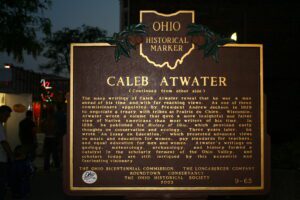
Born in North Adams, Massachusetts on December 23, 1778, Caleb Atwater graduated from Williams College in 1804. He moved to Circleville in about 1814 where he organized the city’s first school board and served as postmaster and prosecuting attorney. His life and work as a teacher, minister, lawyer, legislator, and scholar greatly influenced early 19th-century Ohio. Upon arriving in Circleville, he became interested in local history and the nearby earthworks and in 1820 published his book Descriptions of the Antiquities Discovered in the State of Ohio and Other Western States, the first compilation of prehistoric remains in the Ohio and Mississippi valleys. Elected to the Ohio State Legislature in 1821, Atwater fervently supported canal construction. He also chaired Ohio’s first board of school commissioners and was instrumental in passage of Ohio’s Public School Law. For this, he has been called the “Father of Ohio’s Common Schools.” (continued on other side)
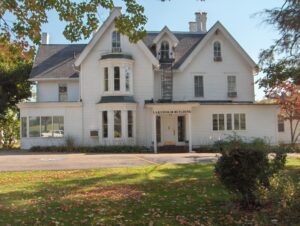
Lakeholm was built as the home of Columbus Delano while serving as Secretary of the Interior under President Ulysses S. Grant from 1870 to 1875. Delano (1809-1896) came to Mount Vernon in 1817, attended public schools, studied law, and was admitted to the bar in 1831. In addition to practicing law in Mount Vernon and serving as the Prosecuting Attorney of Knox County, Delano was a farmer, mill owner, and politician. Lakeholm, originally part of a 300-acre farm, contains many of its original rooms and Italianate features. In 1966, 209 acres of the farm were acquired for the establishment of the Mount Vernon Nazarene College. The house served as offices, meeting rooms, and classrooms. In 2002, the college became a university and continues to use Lakeholm for administrative offices. Historic Lakeholm is a focal point on the Mount Vernon Nazarene University campus and a symbol of the institution’s ties with the Mount Vernon community.
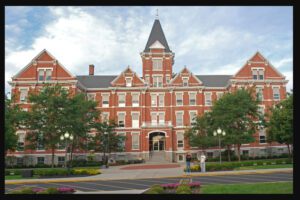
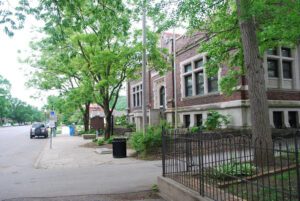
Findlay College was a joint venture of the Churches of God, General Conference, and the Village of Findlay. It was chartered on January 28, 1882, to provide a liberal arts education within a Christian context for all–regardless of race or sex. Old Main was constructed between 1883 and 1886 at a cost of $51,662.95. It was 171 by 107 feet, one of the largest college buildings in the state, and the only one heated by natural gas. The cornerstone was laid on May 25, 1884.
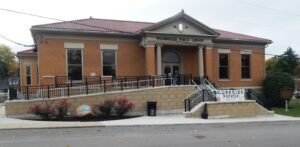
The Wilmington Public Library of Clinton County, one of 111 Carnegie libraries in Ohio, opened its doors to readers on June 30, 1904. A $12,500 gift from steel magnate and philanthropist Andrew Carnegie financed construction of the original 3,360-square-foot building. The community provided the building site, formerly known as Martin Field, and pledged tax funds for the library’s ongoing operation and maintenance. Expansions and modernizations have incorporated the original building and preserved its historic architectural style. “A Library outranks any other thing a community can do to benefit its people.” – Andrew Carnegie
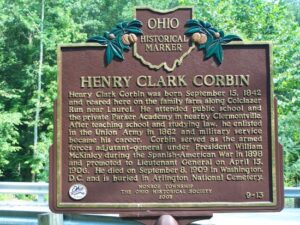
Henry Clark Corbin was born September 15, 1842 and reared here on the family farm along Colclazer Run near Laurel. He attended public school and the private Parker Academy in nearby Clermontville. After teaching school and studying law, he enlisted in the Union Army in 1862 and military service became his career. Corbin served as the armed forces adjutant-general under President William McKinley during the Spanish-American War in 1898 and promoted to Lieutenant General on April 15, 1906. He died on September 8, 1909 in Washington, D.C. and is buried in Arlington National Cemetery.
Born in Chillicothe in 1872, Burton Stevenson’s life was devoted to the written word as a prolific author and anthologist, and as a librarian. Following stints as a journalist while a student at Princeton University and then at newspapers in Chillicothe, Stevenson became the librarian of the city’s public library in 1899. He held the post for 58 years. Stevenson helped secure a Carnegie Library for Chillicothe, completed in 1906, and became prominent for his service during World War I. He founded a library at Camp Sherman (an army training camp north of the city), which became a model for others nationally.
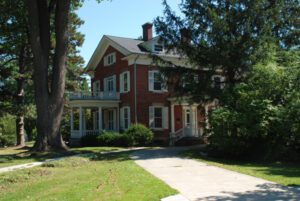
Jabez Lyman Burrell (1806-1900), originally from Massachusetts, built this house in 1852. Burrell made his living as a cattleman and farmer, but devoted much of his time serving the cause of abolitionism, helping slaves, who had escaped the South, get to Sheffield and from there to Lorain and across Lake Erie to Canada. He was also devoted to equal education for all, providing funding to a freedmen’s school in Selma, Alabama, and serving as a trustee of the Oberlin Collegiate Institute, well known for educating African Americans and women. From 1884 to 1934, this was the home of Henry Churchill King (1858-1934), who was the president of Oberlin College from 1902-1927. The Kings added the porches and rear wing and made their home a social center for the college and community. The house is listed on the National Register of Historic Places and is a City of Oberlin Historic Landmark.