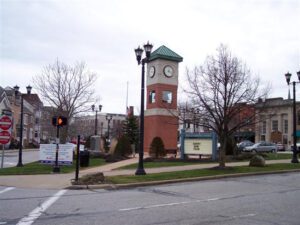
The Triangle, one of the most historic places in Berea, has been the center of the city’s civic life since the mid-19th century. Just beneath lie the solid layers of the famous Berea Sandstone that brought prosperity to Berea during its early years. Quarry owner and Berea Seminary founder John Baldwin obtained much of what is now Berea from Gideon Granger, Postmaster General under President Thomas Jefferson and original owner of Township 6, Range 14 (later Middleburg Township) of the Western Reserve. When the seminary trustees transferred the Triangle tract to the people of Berea in 1847, they designated it by deed as a public promenade. This farsighted stipulation preserved it from commercial development during the 20th century. (continued on other side)
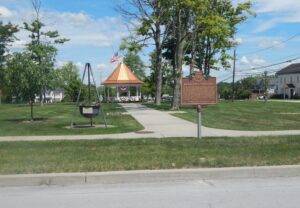
In 1798, Judge Samuel Hinckley of Northampton, Massachusetts, drew the 72nd draft in the land lottery held by the Connecticut Land Company and received 15,305 acres in Township 4, Range 1, for which he paid $12,903.23, less than one dollar per acre. The area had been inhabited for many years by trappers, missionaries, and Native Americans. One of the earliest settlers was James McMullen, who acquired the first 160-acre parcel from Hinckley in 1801. Brookfield Township became the crown jewel of Hinckley’s holdings. Hinckley named Brookfield after a city in England and set aside land for the village green and the cemetery stating that they were for public use forever. During the mid-1820s the Overland Stage Line had a run through Brookfield, linking it to Salem, Warren, and Youngstown in Ohio and Erie, Pennsylvania and Dunkirk, New York. (Continued on other side)
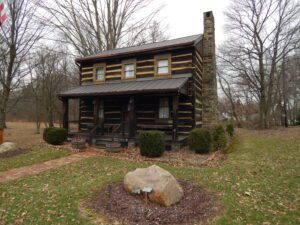
This circa 1840s log house, which now serves as a museum and home to the East Palestine Historical Society, was originally located at the corner of West Main and Walnut Streets. Some of its most notable and earliest residents were Dr. Robert Chamberlin (1798-1876), the town’s first resident physician, and his wife Rebecca (1810-1895). Chamberlin practiced medicine for 30 years, serving the town as a township trustee in 1834, the first postmaster in 1836, and township clerk in 1839. (Continued on other side)
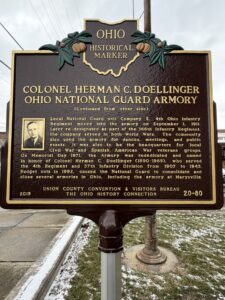
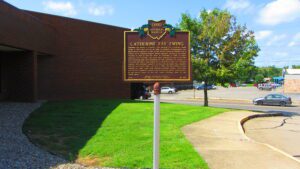
The Marysville Ohio National Guard Armory was the first such armory constructed in the state after the recognition of the Guard in 1909. The new armory and others like it were built in response to federalization of National Guard units after the passage of the Militia Act of 1903. Armory buildings served as the headquarters for local companies and provided drill rooms and arsenals for the storage of military equipment and supplies. Architect Charles Insco Williams designed Marysville’s armory and it was built by James Laughlin, both of Dayton, Ohio. Marysville contractor George W. Fox provided the brickwork for the structure. Construction began in 1910 and was completed in 1911 at a cost of $19,886. (Continued on other side)
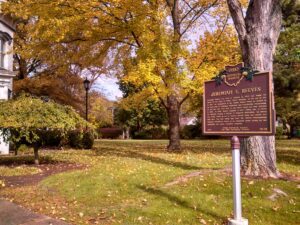
Jeremiah Reeves was born in England in 1845 and began his career in the mills of Wales, United Kingdom, at the age of ten. In 1867, he immigrated to the United States where he worked in the steel mills of Cleveland, Pittsburgh, and Connellsville, Pennsylvania. He met his wife Jane Rees in the latter place and they married in 1869. In 1883, Reeves acquired a steel rolling mill in Dover for $14,000. Despite a history of financial difficulties, the Reeves Iron Works would go on to expand several times and employ over 800 men. The iron works and later the Reeves Manufacturing Company established Dover as an industrial center during the late nineteenth and early twentieth centuries.
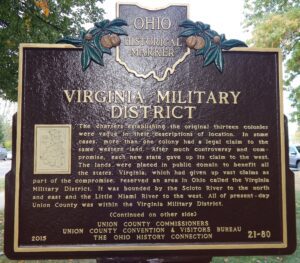
The charter establishing the original thirteen colonies were vague in their descriptions of location. In some cases, more than one colony had a legal claim to the same western land, After much controversy and compromise, each new state gave up its claim to the west. The lands were placed in public domain to benefit all the states. Virginia, which had given up vast claims as part of the compromise, reserved an area in Ohio called the Virginia Military District. It was bounded by the Scioto River to the north and east and by the Little Miami River to the west. All of present-day Union County was within the Virginia Military District. (Continued on other side)
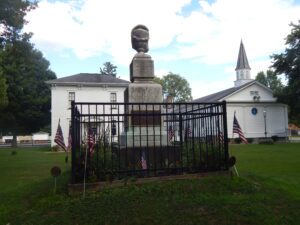
With the outbreak of the Civil War in 1861, many young men of Bristol Township enlisted in the army when President Abraham Lincoln issued his call to defend the Union cause. The death toll of some of these men at the Battle of Shiloh in Tennessee in April 1862 touched the local community as did the loss of Bristol Township lives at the Battle of Perryville in Kentucky, the Battle of Cedar Mountain in Virginia, and other theaters of war later in the year. The local citizenry responded to a plan for a lasting public memorial at the Town Park through a fund raising campaign. In 1863 the town square was transformed with a marble monument placed on an elevated mound at its center. The monument was designed by local artist Frank J. Hammond and manufactured by Myers, Uhl & Company of Cleveland at a cost of $500. [continued on other side]
Frances Dana (Barker) Gage was born on October 12, 1808, in Marietta. She married James L. Gage in 1829 and they raised eight children, including four sons who served with Union forces during the Civil War. Throughout much of her life, Frances was deeply involved with the Temperance and Anti-Slavery movements and Women’s Rights issues. Presiding over the Women’s Rights Convention in Akron in 1851, she invited Sojourner Truth to give her famous “Ain’t I a Woman” speech. The Gage family moved in 1853 to St. Louis, the western extension of the Mason-Dixon Line, where her life was threatened whenever she spoke out against slavery. During the Civil War, she traveled south to aid Union soldiers and teach freed slaves. Though crippled and permanently disabled by a stroke, she continued to lecture on social issues until 1867. Frances Dana Gage died on November 10, 1884, in Greenwich, Connecticut.