

, OH
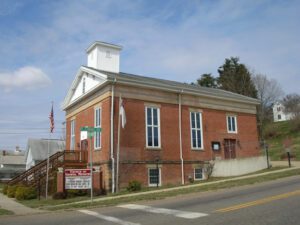
This former Universalist Church, which held a strong conviction for education and the pursuit of knowledge, was built in 1852 at a cost of $3,500. In 1865, its members decorated the first Christmas tree to be placed in a church in McConnelsville. Two years later they installed a pipe organ at a cost of $1,000, the first such organ in the community. The first Sunday School Library was also added, allowing members to borrow books and return them a week later. A number of prominent local families attended the church, including the Manly, Whitiker, Beckett, Arrick, and Murray families from the 1850s through the early twentieth century. Richard Bilbe, a former slave who had been freed, served as an early trustee of the church and attended with his family. The church was restored and reopened as a non-denominational church in 1997.
, OH
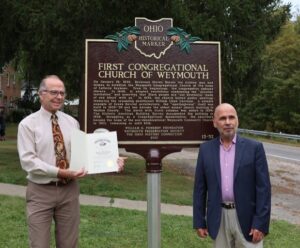
On January 19, 1835, Reverend Steven Barnes led sixteen men and women to establish the Weymouth Congregational Church at the home of Lathrop Seymour. From its beginnings, the congregation opposed slavery. In 1848, it adopted resolutions condemning the “peculiar institution” and asserting that Black people are “our brother[s] ‘made one blood’ with us.” In 1853, the church hosted public meetings featuring the crusading abolitionist William Lloyd Garrison. A notable example of Greek Revival architecture, the “meetinghouse” itself was built in 1835-’36 and has become the oldest extant church building in Medina County. The porch with Doric columns was added in 1854. The Historical American Building Survey documented the building in 1936. Struggling as a Congregational denomination, the sactuary became the home of the non-denominational Weymouth Community Church in 1920, remaining so until 2018.
, OH
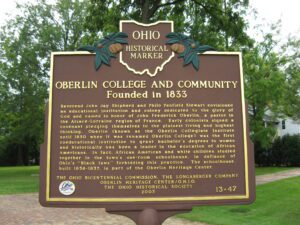
Reverend John Jay Shipherd and Philo Penfield Stewart envisioned an educational institution and colony dedicated to the glory of God and named in honor of John Frederick Oberlin, a pastor in the Alsace-Lorraine region of France. Early colonists signed a covenant pledging themselves to the plainest living and highest thinking. Oberlin (known as the Oberlin Collegiate Institute until 1850 when it was renamed Oberlin College) was the first coeducational institution to grant bachelor’s degrees to women and historically has been a leader in the education of African Americans. In fact, African American and white children studied together in the town’s one-room schoolhouse, in defiance of Ohio’s “Black laws” forbidding this practice. The schoolhouse, built 1836-1837, is part of the Oberlin Heritage Center.
, OH
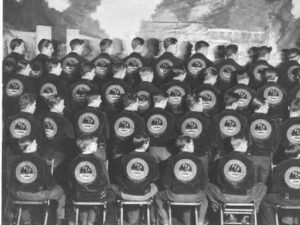
The blue corduroy jacket worn by members is a widely recognized symbol of the National FFA Organization, formerly Future Farmers of America. In 1933, Dr. J.H. “Gus” Lintner, a Fredericktown teacher and advisor to the local FFA chapter, commissioned a jacket for its members to wear to FFA’s national convention in Kansas City, Missouri. Impressed by the design, the organization adopted the jacket as part of FFA’s Official Dress. Millions of members have worn it since. Founded in 1928 to promote agricultural education, FFA continues its mission in 2018 in all 50 U.S. states and two territories.
, OH
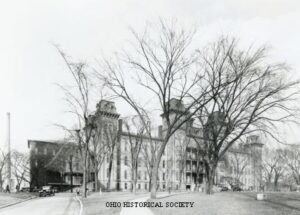
This ten acre site was purchased in 1829 for the Ohio School for the Education of the Deaf. The first school building opened here in 1834; the school was enlarged in 1845. In 1868 the original school was replaced. Another school building was added in 1899 and a hospital in 1908. The Deaf School was relocated on Morse Road in 1953.
, OH
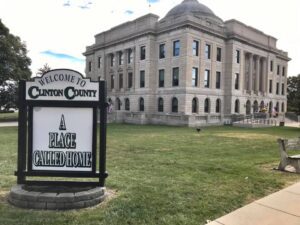
The Clinton County Courthouse was dedicated October 22, 1919. The Cincinnati firm of Weber, Werner and Adkins designed the edifice and it is a local masterpiece that fuses the Beaux-Arts and Neo-Classical architectural styles. A grand marble staircase rises from the basement to the second floor. At the center of the cruciform plan is a dome 32 feet in diameter with a stained-glass window. The murals of four women beneath the dome represent Agriculture, Education, Medicine, and Industry, and are known as the Guardians of the Courthouse. The county built courthouse and former jail for a combined cost of nearly $370,000.
, OH
In 1834, ministers gathered at Providence Church in Berlin Crossroads and organized the Providence Anti-Slavery Baptist Association; believed to be both the first African American Baptist Association in Ohio and among the earliest in the country. The Association’s name boldly reflected its stance: opposition to slavery and a commitment to freedom. Several affiliated churches and their members were known Underground Railroad safe houses and conductors. Providence Association grew to include member churches across Ohio—including Athens, Bidwell, Beaver, Blackfork, Burlington, Gallipolis, Glouster, Ironton, Middleport, Nelsonville, Rutland—as well as congregations in West Virginia, Kentucky, and Michigan.
, OH
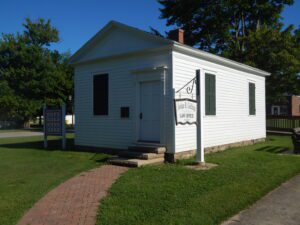
This building served as the law office to Joshua Reed Giddings, a Whig congressman who advocated for the abolition of slavery and an end to the domestic slave trade. Born in 1795, much of Giddings’ young life was occupied by working on his father’s farm. After serving in the War of 1812, he began to study law, gaining admittance to the bar in 1821. A successful lawyer, Giddings was elected to the Ohio House of Representatives in 1826. In 1837, he was elected as a Whig to the U.S. House of Representatives, where he quickly established himself as a staunch opponent of slavery. In 1854, he joined the Republican Party, contributing greatly to the platform during the party’s conventions of 1856 and 1860. As reward for his dedication, President Abraham Lincoln appointed him as consul- general to Canada, where he served until his death in 1864.