

, OH
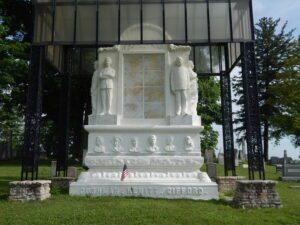
Warren Cushman was a respected painter, sculptor, photographer, musician, and inventor. He created the towering Cushman monument in Woodstock’s Rush Township cemetery and is believed to have shown his painting “Spanish Dancing Girls” at the 1893 World’s Columbian Exposition in Chicago. Warren was born to Franklin and Susan (Gifford) Cushman on January 17, 1845 in Woodstock and had three siblings, Julius, Charles and Lucy. (Continued on other side)
, OH
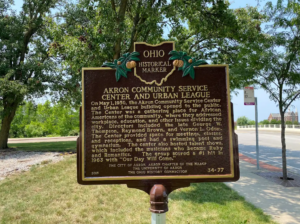
On May 1, 1950, the Akron Community Service Center and Urban League building opened to the public. The Center was a gathering place for African Americans of the community, where they addressed workplace, education, and other issues dividing the city. Directors included the late George W. Thompson, Raymond Brown, and Vernon L. Odom. The Center provided space for meetings, classes and receptions and had a swimming pool and gymnasium. The Center also hosted talent shows, which included the musicians who became Ruby and the Romantics. The group scored a #1 hit in 1963 with “Our Day Will Come.”
, OH
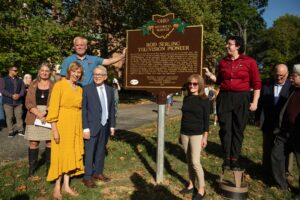
Rodman Edward Serling (1924-1975) enrolled at Antioch College in 1946 following military service in World War II. He began college as a physical education major, but soon discovered writing as a way of working through his war experiences. As a student, he contributed short fiction to The Antiochian literary magazine, managed the student-run Antioch Broadcasting System, and wrote and produced award-winning radio dramas. In July 1948, Serling married classmate Carolyn “Carol” Kramer. Shortly after earning his degree in 1950, he took a copy writer job at Cincinnati’s WLW radio. Serling quickly focused on selling scripts to national television networks. After eight years in Ohio, he and his wife moved to Connecticut. He returned to Antioch after the third season of The Twilight Zone to teach writing, drama, and media during the 1962-1963 academic year.
, OH
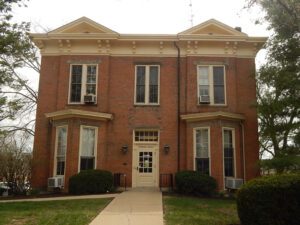
Built by “Old Miami” University President Robert L. Stanton, D.D. (1810-1885) as his private home and president’s office, Stanton’s 1868 Italianate house faced University Square, and welcomed students and guests. The house retains its original symmetrical façade, enclosed portal, grand staircase, double parlors, parlor doors, marbleized slate mantels, and triangular bay windows. Stanton served as president from 1866-1871. Stanton’s son, Robert Brewster Stanton, MU ’71, famed civil engineer, lived here as an undergraduate. His Miami mentor, mathematics professor Robert W. McFarland (1825-1910), purchased the house in 1873. McFarland rented it while distinguishing himself at Ohio State University during Miami’s twelve-year closure, and then resided here while first president of “New Miami” (1885-1888) and until his death. McFarland’s daughter Frances and her husband Llewellyn Bonham sold the home to Miami in 1940.
, OH
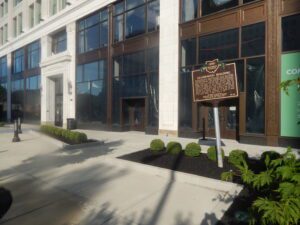
Steel-frame skyscrapers and retail buildings replaced wood-frame residences as the downtown evolved into a commercial district. A small public library branch occupied the north side of the square from 1923 to 1954. The Keith-Albee Theater (later the Palace) in the northeast corner of the square from 1926 to 1964, featured vaudeville performances and movies. Streetcar tracks around the square were removed for scrap during World War II. With expansion of suburban shopping malls, downtown theaters and department stores gradually closed. In 1973-74 Central Square was converted to a pedestrian Federal Plaza by closing off traffic on Federal Street one block east and west of Market Street. Central Square reopened in 2004 with a new traffic pattern, planting beds, and street furniture. Marker for “Central Square (1798-1899)” across the street.
, OH
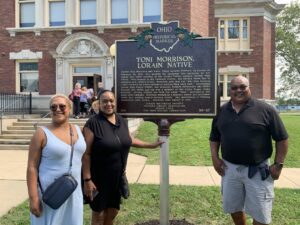
Author Toni Morrison was born, Chloe Ardelia Wofford, in Lorain on February 18, 1931. Her passion for language was nurtured by her family and while working at the Lorain Public Library during high school. Then housed in the Carnegie Center, the library hired her to reshelve and catalog books. Morrison said that she “was slow because I kept reading the books instead of putting them back fast.” Graduating Lorain High School (1949), she attended Howard University (BA 1953), Cornell (MA 1955), and she was a member of the Alpha Kappa Alpha sorority. During college she took the name “Toni,” shortening her saint name Anthony. Morrison worked as a literary editor and professor while also writing award-winning novels. She maintained a lifelong connection with Lorain. Morrison died August 5, 2019.
, OH
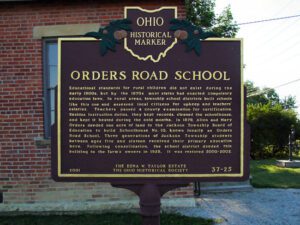
Educational standards for rural children did not exist during the early 1800s, but by the 1870s most states had enacted compulsory education laws. In rural areas, township school districts built schools like this one and assessed local citizens for upkeep and teacher’s salaries. Teachers passed a county examination for certification. Besides instruction duties, they kept records, cleaned the schoolhouse, and kept it heated during the cold months. In 1879, Allen and Mary Orders deeded one acre of land to the Jackson Township Board of Education to build Schoolhouse No. 10, known locally as Orders Road School. Three generations of Jackson Township students between ages five and sixteen received their primary education here. Following consolidation, the school district deeded this building to the farm’s owners in 1928. It was restored in 2000-2002.
, OH
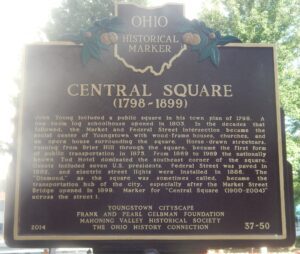
John Young included a public square in his town plan of 1798. A one-room log schoolhouse opened in 1803. In the decades that followed, the Market and Federal Street intersection became the social center of Youngstown with wood-frame houses, churches, and an opera house surrounding the square. Horse-drawn streetcars, running from Brier Hill through the square, became the first form of public transportation in 1875. From 1869 to 1969 the nationally known Tod Hotel dominated the southeast corner of the square. Guests included seven U.S. presidents. Federal Street was paved in 1882, and electric street lights were installed in 1886. The “Diamond,” as the square was sometimes called, became the transportation hub of the city, especially after the Market Street Bridge opened in 1899. Marker for “Central Square (1900-2004)” across the street.