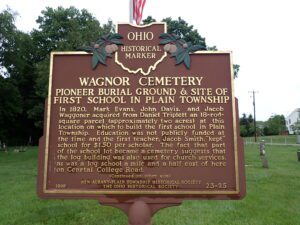
In 1820, Mark Evans, John Davis, and Jacob Waggoner acquired from Daniel Triplett an 18-rod-square parcel (approximately two acres) at this location on which to build the first school in Plain Township. Education was not publicly funded at the time and the first teacher, Jacob Smith, “kept” school for $1.50 per scholar. The fact that part of the school lot became a cemetery suggests that the log building was also used for church services, as was a log school a mile and a half east of here on Central College Road. (continued on other side)
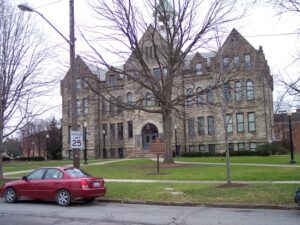
On this site the Lyceum Village and the Berea Seminary were established in 1837 by John Baldwin, James Gilruth, Henry O. Sheldon, and Josiah Holbrook. Their vision was to create the first in a connected series of Lyceum Villages. The Villages were designed especially to assist in the education of teachers, promote “scientific” exchanges over the world and thus encourage the study of the works and word of God, and cultivate the spirit of “peace on earth and good will to men.” The community, however, declined and in 1842, John Baldwin assumed the indebtedness of $15,000. James Wallace acquired the area. It was owned by the Methodist Children’s Home in the 1860s and then sold to German Wallace College in 1866, becoming the original German Wallace College campus.
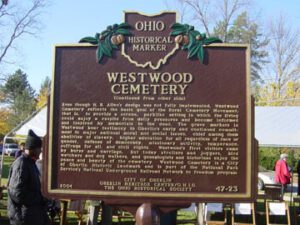
Shortly after Oberlin Colony was established in 1833, a two-acre burying ground was set aside south of Plum Creek in the area bounded by Main, Morgan, and Professor streets. By 1861, however, with the town and Oberlin College growing and the Civil War escalating, the need for a larger cemetery became clear. After an extensive search, 27.5 acres of land belonging to Henry Safford were acquired one mile west of the center of Oberlin. H.B. Allen was hired to create a design in the style of the Rural Cemetery Movement, and in July 1864 Westwood Cemetery was formally dedicated. Burials in Westwood had actually begun in August 1863, and over the next few years hundreds of remains were reinterred from Oberlin’s “Old Cemetery” and from burying grounds in surrounding communities. In the mid-1860s the cemetery was enlarged to its present 47 acres, and in 2004 burials and memorials were estimated to number almost ten thousand. (Continued on other side)
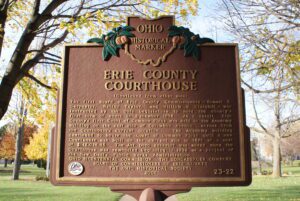
Jury of Erie County Women, First to be Impaneled Under Federal Suffrage proclaimed the headline of the Sandusky Register on August 28, 1920. One of the first female Court of Common Pleas juries in the nation was impaneled in Erie County on August 26, 1920, moments after the 19th amendment to the Constitution of the United States was declared ratified. On that date, Judge Roy Williams was to conduct a trial and jurors were needed. Out of the ten men he contacted, only one could serve. Frustrated, Judge Williams later told the women, “When I learned shortly after 10:30 this morning that suffrage had been proclaimed, I decided to impanel a woman jury. Twelve women were summoned. Twelve women served.” (continued on other side)
Marysville, Ohio. On August 10, 1819, Samuel W. Culbertson (1780-1840), a Zanesville lawyer, established Marysville at the convergence of Mill Creek and the road connecting Delaware to Urbana. Culbertson purchased 450 acres of land on July 10, 1817 and authorized Charles Roberts to survey the village, which originally contained 96 lots. Culbertson named the village in honor of his daughter, Mary Ellen (1810-1853), who later married US Congressman, Joshua Mathiot (1800-1849). The village was originally in Delaware County, located in part of the Virginia Military District. It was land given as bounties to soldiers from Virginia after the Revolutionary War. Union County, which included Marysville, was created in 1820, and Marysville became the county seat in 1822. (Continued on other side)
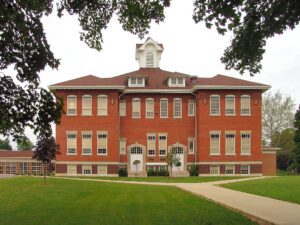
The first school in what is now Pataskala was a “subscription school” operated by Amariah Cubberly on the nearby banks of the South Fork of the Licking River in the 1820s. Subscription schools, which charged fees, were the forerunners of rural public schools in many parts of Ohio. By the 1830s several one-room public schools served the children of the area, but in 1870 the civic minded citizens of Pataskala provided a centralized building for grades one through twelve on Main Street, where the old Town Hall now stands. This school was moved to the new building on this site in 1908. When the Southwest Licking Local School District was established in 1953, Pataskala Elementary School continued in the building. Additions in 1968 and 2000 enhanced its educational capabilities. This 1908 Queen Anne architectural style building was listed on the National Register of Historical Places in 1983.
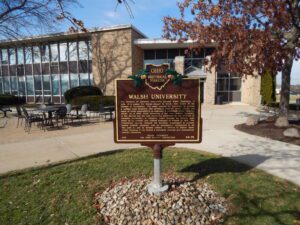
The Brothers of Christian Instruction founded Walsh University in 1958. It is named for Bishop Emmett M. Walsh, then leader of the Diocese of Youngstown. The order created the institution to provide a college-level education that developed students’ moral virtues and sense of social responsibility as embodied in traditional Judeo-Christian values. As of 2015, Walsh University is the only Catholic university in the diocese and the only university sponsored by the Brothers of Christian Instruction, a religious order founded by the Fathers Jean Marie de la Mennais and Gabriel Deshayes in France in 1819. The University’s mission reflects the Brothers’ commitment to provide quality Catholic education with an international perspective to all who seek it, and to develop leaders in service to others. Since Walsh’s founding, it has become a successful regional and international Catholic university.
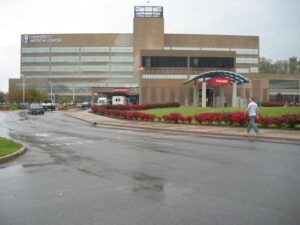
State interest in medical education for northwest Ohio became a reality when the Medical College of Ohio at Toledo was established in December, 1964. Located initially at South Detroit and Arlington on Lucas County property, MCO moved to the present 350-acre campus starting in 1972. It is the area’s first medical school since the closing of the Toledo Medical College (1882-1914).