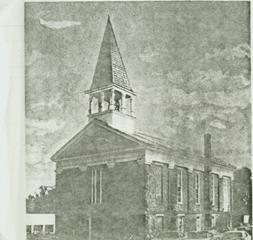
This site has long served the religious, education, and public interests of the residents of Mechanicsburg. A local Methodist congregation built its first church here in 1820, and the townspeople also used the structure as its village school. The Methodists replaced their original structure in 1837, using brick as the main building material. As the Methodist congregation grew, however, it was determined that a larger, more permanent structure was needed. As a result, the Mechanicsburg First Methodist Church was built here in 1858, and it served the congregation until 1894 when an African American based Second Baptist congregation purchased the building at a cost of $2,850. Besides religion and education, the site was also used as Mechanicsburg’s first cemetery. That cemetery lasted until the Maple Grove Cemetery was established and burials at this site were relocated there. [continued on other side]
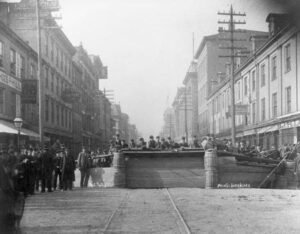
In March 1884, public confidence of Cincinnati law enforcement was extremely low. The public believed that murderers and other serious offenders were not brought to justice promptly or received little punishment. Civil unrest was brought to a boil when a seventeen-year-old was sentenced to only twenty years for manslaughter after brutally murdering his employer. On March 28, thousands of citizens stormed the county jail and courthouse. The riots lasted three days requiring forces from the Sheriff’s Office, city police, and local and state militia to restore order. Fifty-four people were killed and more than 200 wounded. The courthouse and jail suffered enormous damage, and valuable records were destroyed from the assault and fire. The riot gained international notoriety and helped pave the way for removal of political favoritism and a larger police force.
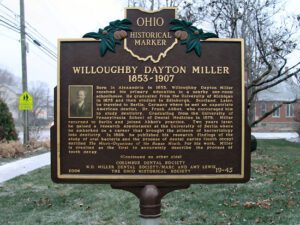
Born in Alexandria in 1853, Willoughby Dayton Miller received his primary education in a nearby one-room schoolhouse. He graduated from the University of Michigan in 1875 and then studied in Edinburgh, Scotland. Later, he traveled to Berlin, Germany where he met an expatriate American dentist, Dr. Frank Abbot, who encouraged him to study dentistry. Graduating from the University of Pennsylvania School of Dental Medicine in 1879, Miller returned to Berlin and joined Abbot’s practice. Two years later, he gained a research appointment at the University of Berlin where he embarked on a career that brought the science of bacteriology into dentistry. In 1889, he published his research findings of the study of oral bacteria and the process of dental caries (tooth decay) entitled The Micro-Organisms of the Human Mouth. For his work, Miller is credited as the first to accurately describe the process of tooth decay. (Continued on other side)
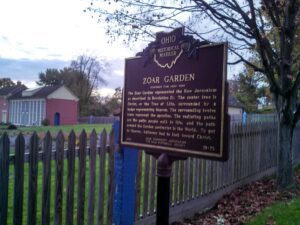
The Zoar Garden was the Separatist’s most public manifestation of their faith, its religious symbolism masked by its lush beauty. It provided both residents and visitors with a place to relax and reflect. This “lustgarden,” or pleasure garden and the accompanying greenhouse were mentioned by travelers as early as 1829. Although some vegetables and fruits were grown here, the garden was filled mainly with flowers. [continued on other side]
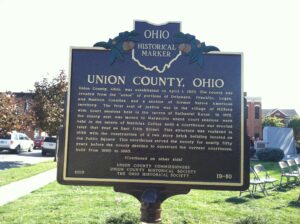
Union County, Ohio, was established on April 1, 1820. The county was created from the “union” of portions of Delaware, Franklin, Logan, and Madison Counties, and a section of former Native American territory. The first seat of justice was in the village of Milford with court sessions held in the tavern of Nathaniel Kazar. In 1822, the county seat was moved to Marysville where court sessions were held in the tavern of Matthias Collins until a courthouse was erected later that year on East Fifth Street. This structure was replaced in 1838 with the construction of a two story brick building located on the Public Square. This courthouse served the county for nearly fifty years before the county decided to construct the current courthouse, built from 1880 to 1883.
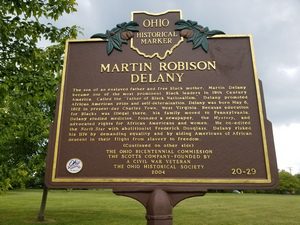
The son of an enslaved father and free Black mother, Martin Delany became one of the most prominent Black leaders in 19th Century America. Called the “Father of Black Nationalism,” Delany promoted African American pride and self-determination. Delany was born May 6, 1812 in present-day Charles Town, West Virginia. Because education for Blacks was illegal there, his family moved to Pennsylvania. Delany studied medicine, founded a newspaper, the “Mystery,” and advocated rights for African Americans and women. He co-edited the “North Star” with abolitionist Frederick Douglass. Delany risked his life by demanding equality and by aiding Americans of African descent in their fight from slavery to freedom. (Continued on other side)
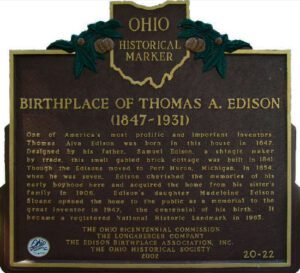
One of America’s most prolific and important inventors, Thomas Alva Edison was born in this house in 1847. Designed by his father, Samuel Edison, a shingle maker by trade, this small gabled brick cottage was built in 1841. Though the Edisons moved to Port Huron, Michigan, in 1854, when he was seven, Edison cherished the memories of his early boyhood here and acquired the home from his sister’s family in 1906. Edison’s daughter Madeleine Edison Sloane opened the home to the public as a memorial to the great inventor in 1947, the centennial of his birth. It became a registered National Historic Landmark in 1965.
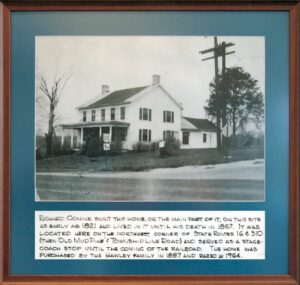
Born in New Jersey, Richard and Sarah Conine, the founders of the village of Pataskala, moved to Lima Township and lived on this site as early as 1821 when Richard established a grist mill nearby. Their homestead also served as a stagecoach stop on the mud pike between Columbus and Newark prior to the coming of the railroad. Richard platted “Conine Town” south and west of here in 1851, and the town was renamed Pataskala soon after. The public-spirited Conines contributed to the building of several area schools and churches and donated land for the Pataskala Cemetery. After their deaths, Sarah’s nephew Jacob Van Dorn inherited the property. John Hawley purchased the home in 1887 and for many years it was known as “The Hawley House.” It was demolished in 1964 to make way for commercial development.