

, OH
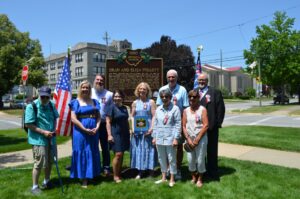
Oran Follett constructed his Sandusky house between 1835 and 1837. The golden sandstone mansion was home to Follett and his family until his death in 1894. Sold to James Flynn and then the Krupp family, the house remained a private residence until rented to the Works Progress Administration in 1935. The Sandusky Board of Education purchased the house in 1939 and used it as the adjacent high school’s Home Economics annex, meeting space, offices, and occasionally as art gallery or dance venue. From 1958 to 1968, it housed the Sandusky School of Practical Nursing. The Sandusky Library took over management of the house in 1973, opening it as museum in 1976. Considered one of the finest Greek Revival mansions in Ohio, the Follett House was listed on the National Register of Historic Places in 1974.
, OH
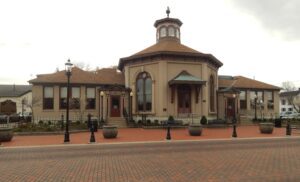
Clark Lane (1823-1907), industrialist and philanthropist, was a son of John Lane (1793-1880) and Rosanah Crum (1795-1877). John came with his family to the Ohio Country when it was still part of the Northwest Territory. As a young man, Clark worked in his family’s blacksmith shop, and eventually helped found Owens, Lane & Dyer Machine Company in 1854. It built agricultural machinery, sawmills, papermaking machines, and other products, initiating Hamilton’s prominence in metals manufacturing. Lane funded the Butler County Children’s Home, an orphanage for over a century, and constructed an octagon house as his residence on Third Street. He built this library in 1866, also as an octagon, and donated it to the people of Hamilton. A 19th century admirer wrote, “The name and generous deeds of Clark Lane will never fade from the memories of a grateful people who have been recipients of his favor.”
, OH
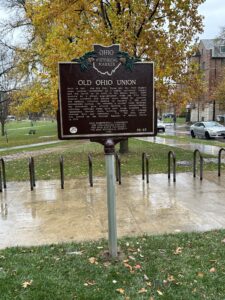
Built in 1910, the old Ohio Union was the first student union building constructed on a public university campus and the fourth to be built in the United States. Made possible by a direct appropriation from the 77th Ohio General Assembly and private funds raised by students, the building officially opened on January 11, 1911 with considerable fanfare. By erecting a student union building, the university gave official sanction to extracurricular activities. Although there have been seven additions, this Jacobethan Revival style building retains its original exterior form and character. The “Old Ohio Union” was placed on the National Register of Historic Places in 1979.
, OH
Marcellus F. Cowdery, Sandusky’s first Public School superintendent, encouraged William D. Curtis to formulate a chalk that did not break easily or scratch chalkboards. Curtis conducted experiments in his kitchen and, using gypsum and limestone deposits from Sandusky Bay, created sticks of pure white, processed chalk. In the late 1860s, he and his brothers-in-law, Marcellus and John S. Cowdery, began producing the chalk from their family home. In 1890, John Whitworth, Curtis’s son-in-law, helped finance the incorporation of The American Crayon Company. The company pioneered high quality art supplies, including wax color crayons and Prang watercolors, used in schoolrooms around the globe. Sandusky’s American Crayon factory that stood at 1706 Hayes Avenue for more than a century, closed production in 2002 and was later demolished.
, OH
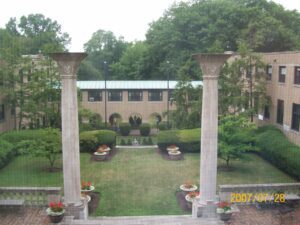
Elm Court, designed by Howard Van Doren Shaw of Illinois, was built in 1912 for Arthur Hudson Marks. The original mansion exemplifies the Italian Renaissance Revival style. Elm Court included the mansion, barn, stables, carriage house, pond, and a variety of trees, especially elms, on 33 acres. Arthur Marks was the inventive genius in chemistry and business who revolutionized the rubber industry in Akron. He was best known for inventing the alkaline-recovery vulcanization process in 1899, the cord tire, the chemical research laboratory system, and placing rubber research on a scientific basis. In World War I he served as director of chemical warfare services. Marks served as vice-president of B.F. Goodrich Company and Curtis Airplane and Engine Company and president of other rubber companies and the Aeolian Skinner Organ Company.
, OH
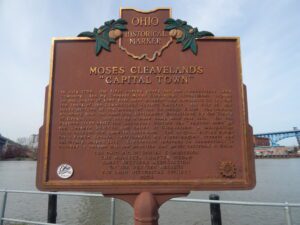
In July 1796, the first survey party for the Connecticut Land Company, led by General Moses Cleaveland (1754-1806), landed on the shore of Lake Erie near present-day Ashtabula to lay out the lands of the Connecticut Western Reserve. On July 22, the party arrived at the mouth of the Cuyahoga River, the western boundary line for American settlement established by the Treaty of Greenville, and set up a base camp near this site. On the eastern river bluff the surveyors platted the “capital town” of the Western Reserve and called it Cleaveland; a misspelling later changed the name to Cleveland. The original survey called for a Public Square, surrounded by right-angled streets and uniformly-shaped lots. Cleaveland returned to Connecticut in October to resume his law practice and never returned to Ohio.
, OH
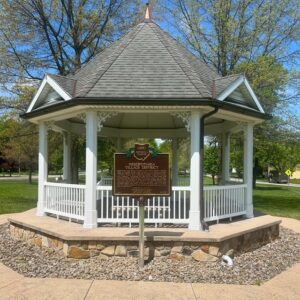
Mesopotamia Village District was listed in the National Register of Historic Places on December 24, 1974. Many consider it to be “the most unspoiled nineteenth century central green type of village in northeastern Ohio.” The district includes houses, commercial buildings, a town hall, churches, and a cemetery. Surrounding the 1600-foot-long public green these structures represent Greek Revival, Gothic Revival, Queen Anne, Italianate, and vernacular architectural styles constructed between 1820 and 1902. One of the oldest buildings in the district is the colonnaded Greek Revival commercial building at the southwest end of the green. Built in the 1820s for early resident Isaac Clark, it was operated as a store by F.C. Peck. Over the ensuing centuries it has served as a barber shop, post office, and an undertakers. (Continued on other side)
, OH
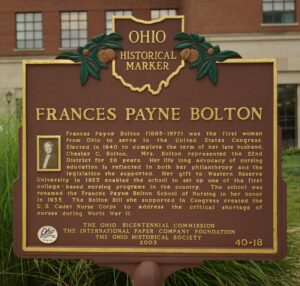
Frances Payne Bolton (1885-1977) was the first woman from Ohio to serve in the United States Congress. Elected in 1940 to complete the term of her late husband, Chester C. Bolton, Mrs. Bolton represented the 22nd District for 28 years. Her life long advocacy of nursing education is reflected in both her philanthropy and the legislation she supported. Her gift to Western Reserve University in 1923 enabled the school to set up one of the first college-based nursing programs in the country. The school was renamed the Frances Payne Bolton School of Nursing in her honor in 1935. The Bolton Bill she supported in Congress created the U.S. Cadet Nurse Corps to address the critical shortage of nurses during World War II.