


, OH
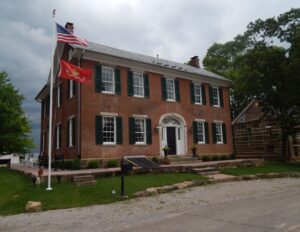
Unserheim, meaning “Our Home” in German, is the name of this ante-bellum Queen Anne style home, which was placed on the National Register of Historic Places in 1998. From 1857-1878, it was home to Daniel Howell Hise, a Quaker and ardent abolitionist. On April 8, 1849, Hise wrote, “Welcome! Welcome to the protection I can give, with or without the law.” A major stop on the Underground Railroad, Unserheim’s secret rooms and tunnel provided shelter to slaves on their flight to freedom. Hise’s belief in abolitionism was so strong that following John Brown’s Raid at Harper’s Ferry, he was instrumental in erecting the Edwin Coppock Monument at Hope Cemetery. Coppock had been executed for his participation in the raid. Hise also supported the Women’s Rights Movement and opened Unserheim to such notable guests as famed suffragists Susan B. Anthony and Sojourner Truth.
, OH
Erected in 1828, the Randolph Mitchell House is a five-bay, Federal-style “I” house. Its facade features a doorway with an Adam-style fan and sidelights. The interior boasts a grand stairway in the foyer and fine woodwork throughout. Randolph Mitchell (1796-1847) was born in Rockingham County, Virginia. In 1819, Mitchell and his mother Sarah (1765-1844), settled in New Reading and he married Lydia Witmer (1798-1872). They had four children. A merchant, Mitchell kept an ample smokehouse and owned a tannery and real estate. He served as a justice of the peace for Reading Township. After Mitchell’s death, his son-in-law, Dr. W.W. Arnold (1818-1872) maintained his practice in the home, where he and Caroline Mitchell Arnold (1825-1888) lived. Their son William Arnold (1858-1948) acquired the house, which remained in the family until 1951. The property was listed on the National Register of Historic Places in 1978.
, OH
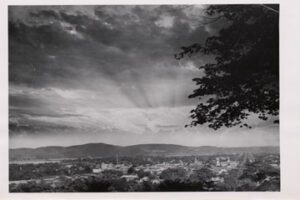
The hills before you were inspiration for the design of The Great Seal of the State of Ohio. The seal, first depicted in 1803, was often reconfigured until the present image was sanctioned by the Ohio General Assembly in 1967 and modified in 1996. In 1803 the law prescribed the sheaf of wheat to represent Ohio’s agricultural roots and the bundle of seventeen arrows to symbolize Ohio’s place as the seventeenth state in the Union. In the background is a range of hills, including Mount Logan, as viewed from Thomas Worthington’s estate, Adena, now a state memorial. (continued from other side)
, OH
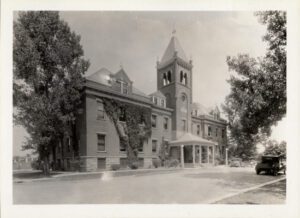
Central State University originated on March 19, 1887, when the Ohio General Assembly passed an act establishing a Combined Normal and Industrial (CN&I) Department at Wilberforce University. Through various transitional changes, it emerged as an independent, state university. In 1941, the General Assembly expanded the CN&I, which offered two-year courses, into the College of Education and Industrial Arts, with four-year programs. In 1947, it separated from Wilberforce University. The history of Central State University tells the history of higher education and advancement for African Americans in Ohio. It is within the walls of these structures, and others unfortunately demolished or destroyed by the 1974 tornado, that thousands of African Americans received valuable training for successful and rewarding careers. Thus, many of the contributions of African Americans to the promotion and betterment of education, medicine, law, social justice, technology, and the arts in Ohio have their roots here on the campus of Central State University.
, OH
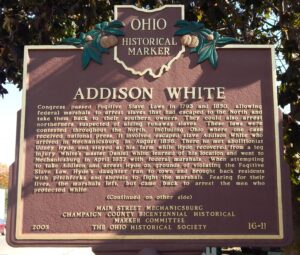
Congress passed Fugitive Slave Laws in 1793 and 1850, allowing federal marshals to arrest slaves that had escaped to the North and take them back to their southern owners. They could also arrest northerners suspected of aiding runaway slaves. These laws were contested throughout the North, including Ohio where one case received national press. It involved escaped slave Addison White who arrived in Mechanicsburg in August 1856. There he met abolitionist Udney Hyde and stayed at his farm while Hyde recovered from a leg injury. White’s master Daniel White learned of his location and went to Mechanicsburg in April 1857 with federal marshals. When attempting to take Addison and arrest Hyde on grounds of violating the Fugitive Slave Law, Hyde’s daughter ran to town and brought back residents with pitchforks and shovels to fight the marshals. Fearing for their lives, the marshals left, but came back to arrest the men who protected White. [continued on other side]
, OH
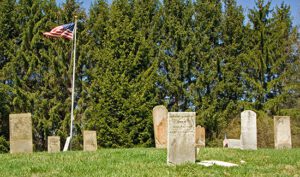
Smith’s Burying Ground was established in 1814 when John Smith (born 1742), Revolutionary War Veteran, died and was buried here. John Smith and four of his sons and their families made the six week, six-hundred-mile journey from New Jersey with ox teams the previous year. John Clouse (1758-1822), Dutch immigrant and Revolutionary War veteran, is also buried here. (Continued on other side)
, OH
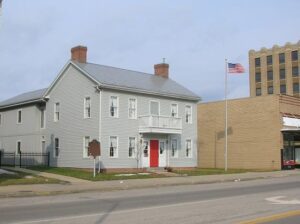
One of seven native Ohioans to serve as president of the United States, William McKinley (1843-1901) was born at this site. The original house was moved from this site and ultimately destroyed by fire. The McKinleys lived here until 1852 when they moved to Poland, Ohio, where William attended the Poland Seminary. He briefly attended Allegheny College in Pennsylvania, but poor health and family financial strain forced him to return to Ohio. As an enlistee in the 23rd Ohio Volunteer Infantry during the Civil War, McKinley rose to the rank of major. After the war, he settled in Canton and practiced law. Elected to Congress in 1876, McKinley favored high protective tariffs, a policy he continued to support as President.(Continued on other side)
, OH
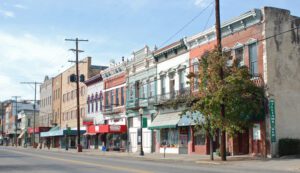
Since it was formed in 1819, Meigs County was fostered by its location on 57 miles of the Ohio River, named by the Indians”Oyo,” meaning beautiful river. Pomeroy, the county seat, was named for Samuel Wyllys Pomeroy, an early landholder. His company, Pomeroy, Sons & Company, and his son-in-law, Valentine B. Horton (1802-1888), were influential in developing the coal, salt, and iron industries of the region. Horton pioneered the transportation of coal by river, building the world’s first coal barges and, in 1835, the first coal-fueled towboat, the Condor. Coal, salt, and iron, in addition to other local products, were shipped from Pomeroy’s 125′ x 40′ wharf to ports from Pittsburgh to Cincinnati. Excursion, passenger, shanty and showboats also visited Pomeroy’s port. Today, the Ohio River continues to be a busy waterway carrying commodities such as coal, petroleum, chemicals, steel, sand, and gravel. It is also a busy haven for recreational crafts as well as stern wheel boats.