

, OH
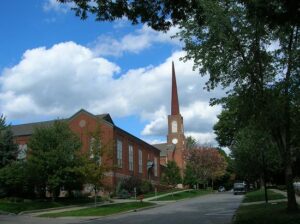
On this site, the first meetinghouse owned by the Hudson Congregational Church was dedicated March 1, 1820, twenty-one years after David Hudson first came to the Hudson area. Its members met here until they completed their sanctuary on Aurora Street in 1865. In August 1835, church members unanimously adopted a resolution declaring that slavery is”a direct violation of the law of Almighty God.” At a November 1837 prayer meeting, church member and anti-slavery leader John Brown made his first public vow to destroy slavery.
, OH
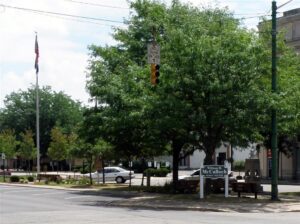
William McCulloch was born in Holmes County where he was educated in a one-room schoolhouse before moving to Wooster to attend high school and the College of Wooster. He attained prominence as Ohio’s Speaker of the House from 1939-1943 and House member from the Fourth Ohio Congressional District from 1948-1973. During his time in Washington, McCulloch was best known as a co-sponsor and staunch advocate of the Civil Rights Act of 1964. He was recognized by President Lyndon Johnson as the prime mover for passage of this landmark legislation. As a conservative Republican voice in the House, he was instrumental in championing other civil rights legislation, including fair housing and public accommodations. McCulloch was a founding partner in 1928 of the Piqua law firm that bears his name.
, OH
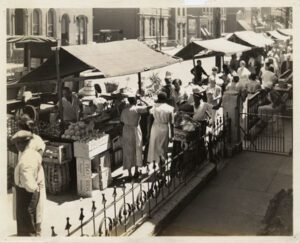
Public markets housing butchers, fish merchants, and produce vendors were once the primary source of perishable foods for residents of America’s cities. Cincinnati operated nine in 1859. Only Findlay Market, built here in 1852, survives. Cincinnati’s lost indoor markets include: Fifth Street Market: 1829 to 1870, Fifth between Vine and Walnut Wade Street Market: 1848 to 1898, corner of Wade and Bauer Avenue Canal Market: 1829 to 1864, Court between Vine and Walnut Court Street Market: 1864 to 1914, replaced Canal Market Jabez Elliott Flower Market: 1890 to 1950, Sixth between Elm and Plum Sixth Street Market: 1895 to 1960, Sixth between Plum and Western Row Pearl Street Market: 1901 to 1934, Market between Sycamore and Broadway
, OH
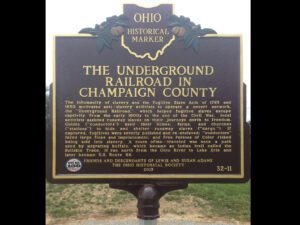
The inhumanity of slavery and the Fugitive Slave Acts of 1793 and 1850 motivated anti-slavery activists to operate a covert network, the “Underground Railroad,” which helped fugitive slaves escape captivity. From the early 1800s to the end of the Civil War, local activists assisted runaway slaves on their journeys north to freedom. Guides (“conductors”) used their homes, farms, and churches (“stations”) to hide and shelter runaway slaves (“cargo.”) If captured, fugitives were severely punished and re-enslaved; “conductors” faced large fines and imprisonment, and Free Persons of Color risked being sold into slavery. A route often-traveled was once a path used by migrating buffalo, which became an Indian trail called the Bullskin Trace. It ran north from the Ohio River to Lake Erie and later became U.S. Route 68.
, OH
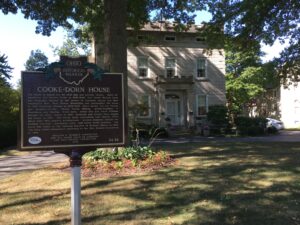
Eleutheros Cooke. The Cooke-Dorn house was the last home of attorney Eleutheros Cooke (1787-1864) who served four years in the Ohio legislature and one term in the 22nd Congress of the United States. An early proponent of railroads, Cooke received one of the first charters granted to a railroad west of the Alleghany Mountains, for the Mad River & Lake Erie line. He and wife Martha had six children, four of whom lived to adulthood. Two rose to prominence in the Civil War era. Jay was a successful banker and became known as the “financier of the Civil War” for his efforts to secure loans from Northern banks to support the Union’s war effort. Henry was appointed as the first governor of the short-lived Territory of the District of Columbia in 1871 (which was replaced in 1874).
, OH
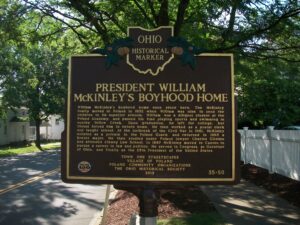
William McKinley’s boyhood home once stood here. The McKinley family moved to Poland in 1852 when William was nine to send the children to its superior schools. William was a diligent student at the Poland Academy, and passed his time playing sports and swimming in nearby Yellow Creek. Upon graduation, he left for college, but illness forced him to return home. He then worked as a postal clerk and taught school. At the outbreak of the Civil War in 1861, McKinley enlisted as a private in the Poland Guard, and returned in 1865 a brevet major. He then studied under Poland lawyer Charles Glidden and attended Albany Law School. In 1867 McKinley moved to Canton to pursue a career in law and politics. He served in Congress, as Governor of Ohio, and finally as the 25th President of the United States.
, OH
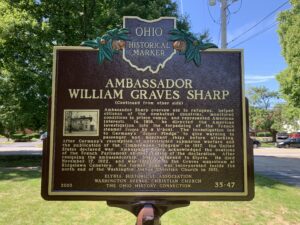
William Graves Sharp lived at this location before and after his tenure as Ambassador to France during World War I. He was born to George Sharp and Mahala Graves Sharp in Mount Gilead, Ohio, on March 14, 1859. As children, Sharp and his twin brother George moved to Elyria with their mother and grandparents, William and Ephra Graves. An Elyria High School graduate, Sharp earned a law degree from the University of Michigan in 1881. He was a journalist, lawyer, industrialist, and Lorain County Prosecutor. Serving three terms in the U.S. House of Representatives, Sharp introduced the first legislation providing for airmail service. Shortly before the outbreak of World War I, President Woodrow Wilson named Sharp as ambassador to France. He served from December 4, 1914, to April 14, 1919. (Continued on other side)
, OH
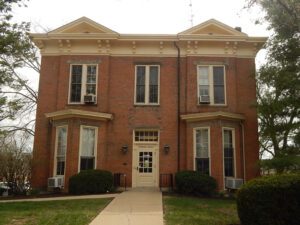
Built by “Old Miami” University President Robert L. Stanton, D.D. (1810-1885) as his private home and president’s office, Stanton’s 1868 Italianate house faced University Square, and welcomed students and guests. The house retains its original symmetrical façade, enclosed portal, grand staircase, double parlors, parlor doors, marbleized slate mantels, and triangular bay windows. Stanton served as president from 1866-1871. Stanton’s son, Robert Brewster Stanton, MU ’71, famed civil engineer, lived here as an undergraduate. His Miami mentor, mathematics professor Robert W. McFarland (1825-1910), purchased the house in 1873. McFarland rented it while distinguishing himself at Ohio State University during Miami’s twelve-year closure, and then resided here while first president of “New Miami” (1885-1888) and until his death. McFarland’s daughter Frances and her husband Llewellyn Bonham sold the home to Miami in 1940.