

, OH
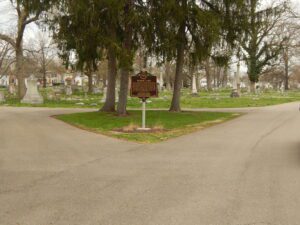
Warren Gard (1873-1929), son of Samuel Z. Gard and Mary Duke, was born in Hamilton, Ohio. He established his practice in Hamilton after graduating from Cincinnati Law School and being admitted to the Ohio Bar in 1894. Gard served as Butler County Prosecuting Attorney from 1898-1903, and as a judge on the Court of Common Pleas from 1907-1912. In 1910, he married Pearl Zuver Woods (1875-1946). In 1912, he was elected as a Democrat to the U.S. House of Representatives, serving from 1913-1921. Gard delivered a eulogy for his friend, Warren G. Harding, on August 8, 1923, the national day of mourning for the deceased president. Gard had been a 35-year member of the bar when he died. He is buried next to his wife in the Gard plot in Greenwood Cemetery. (Continued on other side)
, OH
Marcellus F. Cowdery, Sandusky’s first Public School superintendent, encouraged William D. Curtis to formulate a chalk that did not break easily or scratch chalkboards. Curtis conducted experiments in his kitchen and, using gypsum and limestone deposits from Sandusky Bay, created sticks of pure white, processed chalk. In the late 1860s, he and his brothers-in-law, Marcellus and John S. Cowdery, began producing the chalk from their family home. In 1890, John Whitworth, Curtis’s son-in-law, helped finance the incorporation of The American Crayon Company. The company pioneered high quality art supplies, including wax color crayons and Prang watercolors, used in schoolrooms around the globe. Sandusky’s American Crayon factory that stood at 1706 Hayes Avenue for more than a century, closed production in 2002 and was later demolished.
, OH
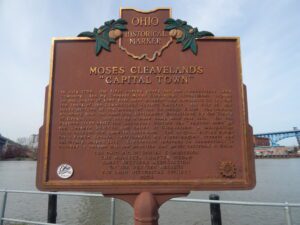
In July 1796, the first survey party for the Connecticut Land Company, led by General Moses Cleaveland (1754-1806), landed on the shore of Lake Erie near present-day Ashtabula to lay out the lands of the Connecticut Western Reserve. On July 22, the party arrived at the mouth of the Cuyahoga River, the western boundary line for American settlement established by the Treaty of Greenville, and set up a base camp near this site. On the eastern river bluff the surveyors platted the “capital town” of the Western Reserve and called it Cleaveland; a misspelling later changed the name to Cleveland. The original survey called for a Public Square, surrounded by right-angled streets and uniformly-shaped lots. Cleaveland returned to Connecticut in October to resume his law practice and never returned to Ohio.
, OH
Fout Hall was one of three original buildings on the Bonebrake Theological Seminary campus. Constructed 1920-1923, it was named for Dr. J. E. Fout, who managed campus construction. Bonebrake Seminary was founded in 1871 by Dayton’s United Brethren in Christ Church and became co-educational in 1873. Generous cash and land gifts (1909-1911) enabled the construction of a new campus. Fout Hall, the administration building, and a powerhouse were designed by Dayton architect Frederick J. Hughes in the Jacobethan Revival style. The three-story buff-brick dormitory was the largest of the buildings and cost $250,000. As well as dining hall, laundry, and storage facilities, it featured 12 single rooms, 54 two-room suites, and 6 three-room suites. Fout Hall was an integral part of the National Register listing of the Dayton View Triangle Historic District in 2022.
, OH
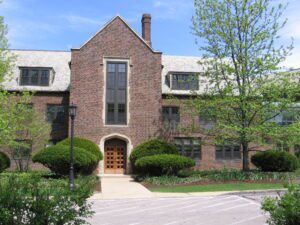
Florence E. Allen (1884-1966) was nicknamed “first lady of the law” for her many firsts as a woman in the legal profession. After graduating from Western Reserve College for Women, she taught at Laurel School from 1906 to 1909. She then became a crusader for women’s rights, and in 1913 received a law degree from New York University. Allen was appointed as an assistant Cuyahoga County prosecutor in 1919, the first woman in the country to hold such a position. In 1920, she was elected to Cleveland’s Court of Common Pleas, advancing, in 1922, to the Ohio Supreme Court, where she served two terms. In 1934, President Franklin D. Roosevelt appointed Allen to the nation’s second highest tribunal, the United States Sixth Circuit Court of Appeals, where she became its first female member. In 1958, she was elevated to Chief Justice of that body and retired in 1965.
, OH
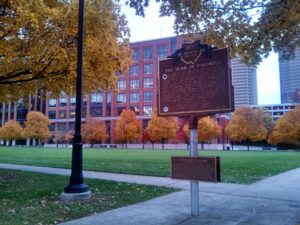
Thousands of Irish immigrants came to Columbus to seek personal and religious freedom. With the “Great Hunger” in Ireland and the completion of the Ohio and Erie Canal and the National Road, immigration to Columbus increased in the mid nineteenth century. They initially settled in the north side of the city in the swamp flats, where inexpensive land was available and work could be had on the railroads. Settlement spread to Franklinton, on Naghten Street, later known as “Irish Broadway”- part of which is now Nationwide Boulevard, and to nearby Flytown. The immigrants became domestic workers, civil servants, entrepreneurs, and served the city in police and fire departments. Others were leaders in government, law, medicine, and education. Their legacy continues today in the Irish-American population of Columbus, Ohio.
, OH
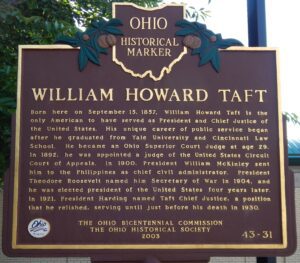
Born here on September 15, 1857, William Howard Taft is the only American to have served as President and Chief Justice of the United States. His unique career of public service began after he graduated from Yale University and Cincinnati Law School. He became an Ohio Superior Court Judge at age 29. In 1892, he was appointed a judge of the United States Circuit Court of Appeals. In 1900, President William McKinley sent him to the Philippines as chief civil administrator. President Theodore Roosevelt named him Secretary of War in 1904, and he was elected president of the United States four years later. In 1921, President Harding named Taft Chief Justice, a position that he relished, serving until just before his death in 1930.
, OH
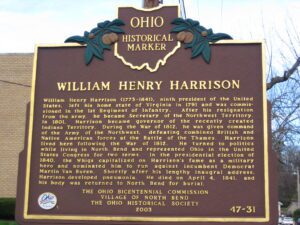
William Henry Harrison (1773-1841), ninth president of the United States, left his home state of Virginia in 1791 and was commissioned in the 1st Regiment of Infantry. After his resignation from the army, he became Secretary of the Northwest Territory. In 1801, Harrison became governor of the recently created Indiana Territory. During the War of 1812, he was given command of the Army of the Northwest, defeating combined British and Native American forces at the Battle of the Thames. Harrison lived here following the War of 1812. He turned to politics while living in North Bend and represented Ohio in the United States Congress for two terms. In the presidential election of 1840, the Whigs capitalized on Harrison’s fame as a military hero and nominated him to run against incumbent Democrat Martin Van Buren. Shortly after his lengthy inaugural address, Harrison developed pneumonia. He died on April 4, 1841, and his body was returned to North Bend for burial.