

, OH
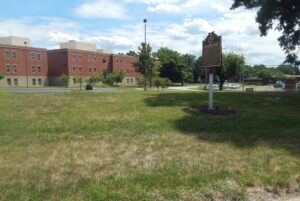
After the outbreak of the Civil War in the spring of 1861, the U.S. War Department commissioned Ohio Senator B.F. Wade of Jefferson and local Congressman John Hutchins of Warren to supervise the Union Army’s recruiting service in Northeastern Ohio. Recruitment rolls were to be filled in summer so training could be conducted during the fall. The Oak Grove Fairgrounds in Warren, home of the Trumbull County Agricultural Society, was one of the sites selected for the training. This camp was named Camp Hutchins in Congressman Hutchins’ honor. John Hutchins, an attorney by profession, had served as Trumbull County Clerk of Courts and had been assocaited with future Ohio governors David Tod (1862-1864) and Jacob Cox (1866-1868), in their law firms. An ardent anti-slavery man and Underground Railroad agent, Hutchins served in the U.S. Congress from 1859 to 1863.
, OH
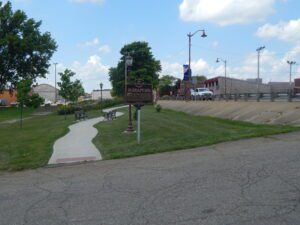
Christian Deardorff (1781-1851) with his brother-in-law Jesse Slingluff (1775-1836) platted and founded Dover and built the area’s first gristmill on Sugar Creek. With the coming of the Ohio and Erie Canal to Dover, Deardorff lobbied successfully to make Dover a toll stop for the canal and the be afforded a source of water power for his mill. A dam built on Sugar Creek obstructed for the mill there. Deardorff received access to the canal near Tuscarawas Avenue, and there erected a mill, later named the Cascade Mill by the Hardesty brothers when they purchased it in 1872. The Hardestys, from Carroll County, came to Dover in the 1860s and began operating a large mill on the Calico Ditch, near the foot of 2nd Street. The Dover Milling Company bought the last Hardesty-owned mill in 1951.
, OH
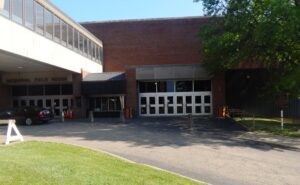
“All life is interrelated in today’s world. I can’t be what I ought to be until you are what you ought to be; and you can’t be what you ought to be ’till I am what I ought to be.” Dr. Martin Luther King Jr. spoke these words before 3,500 people while addressing a Freedom Rally here on March 20, 1964. His speech addressed issues of racial equality and unity, and urged passage of the Civil Rights Act. On July 2, 1964, President Lyndon B. Johnson signed the act into law, prohibiting discrimination based on a person’s race, color, religion, sex, or nationality.
, OH
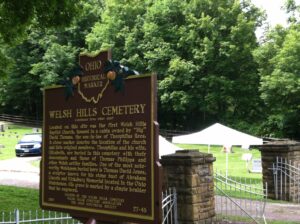
Welsh Hills Cemetery was once part of the United States Military Tract given to veterans of the Revolutionary War. The land was owned by a Philadelphia Welshman named Samson Davis. On September 4, 1801, a portion of his land was purchased by the co-founders of the Welsh Hills community, Theophilus Rees and Thomas Philipps, who came from Carmarthenshire, Wales. On February 6, 1808, Theophilus Rees donated a portion of his land for the establishment of this cemetery. On that same day, Rees Thomas, the 8-year-old grandson of Theophilus Rees, became the first person interred. (Continued on other side)
, OH
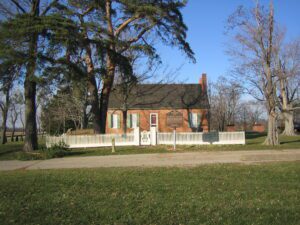
As Oxford Township was developing in the mid-1800s, a cluster of farmsteads near its northern border developed and was designated the “Doty Settlement.” As was the custom, the community took its name from a prominent family in the area. In or near the settlement were a church and cemetery, a school, a blacksmith shop, a sawmill, a distillery, a furniture shop, and a fulling mill for cleansing, shrinking, and thickening cloth. With the frontier spirit of self-reliance, it was seldom necessary to travel several miles into Oxford village for additional goods or services. Working together, the community farmed local fields and bartered for other items. Men, women, and children worked long, hard hours in the fields harvesting corn and wheat. It is evident that these families, living in an agricultural society, possessed many useful skills for surviving in the Ohio country.
, OH
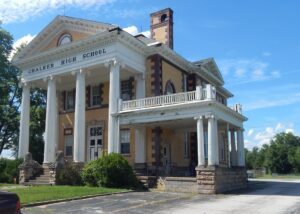
Southington native Newton Chalker built, furnished, and donated Chalker High School to his community in 1907. Chalker was born in 1842 in Southington Township and lived there until adulthood. He later built a prosperous law and real estate practice in Akron. Chalker’s dedication to improve educational opportunities in the township likely originated with his personal struggle to complete high school, which was repeatedly interrupted by financial concerns and family obligations. The Chalker High School building was designed in the Neo-Classical Revival architectural style which was favored for public buildings, churches and schools early in the twentieth century. The building exhibits Classical influences through the use of fluted columns that support a pedimented gable, resembling a Greek temple. Chalker High School and the Civil War Monument were listed in the National Register of Historic Places in 2010. (Continued on other side)
, OH
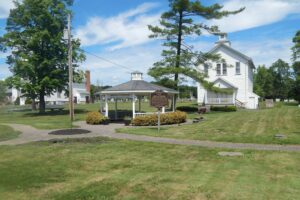
The Connecticut Land Company surveyed Vienna Township as Township 4, Range 2, in 1798. The Township’s proprietors were Ephraim Root, Uriel Holmes, Jr., and Timothy Burr. Survey members Dennis Clark Palmer, Isaac Flower, and Samuel Hutchins and their families were the first to settle here in 1799. Between 1810 and 1840, Vienna was a center for the wooden works clock industry in Trumbull County and the Connecticut Western Reserve, with six factories located amid farms, sawmills, and quarries. After coal was discovered in 1866, over twenty mines were opened, bringing boom times for two decades. Vienna’s miners helped to bring about Ohio’s first mining safety law in 1874. Vienna was the birthplace of abolitionist and attorney John Hutchins (1812-1891), who represented Trumbull and Ashtabula counties in the United States Congress (1859-1863) and raised troops during the Civil War.
, OH
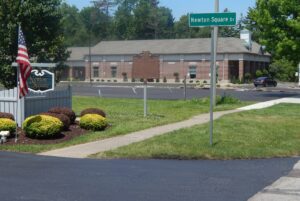
On this site stood the home of Elisha and Polly Mygatt Whittlesey and their ten children. Also here was his law office and a records office that was moved in 1965 to Pioneer Village at the Canfield Fairgrounds. Already an attorney in his home state, Elisha (1783-1863) with Polly (1787-1855) emigrated from Danbury, Connecticut in June 1806 to Canfield in the Western Reserve where he was admitted to the Ohio bar and was prosecuting attorney from 1807 to 1823. During the War of 1812, Whittlesey was adjutant to Maj. Gen. Elijah Wadsworth and later a secretary to Gen. William Henry Harrison. Whittlesey opened a law office in Canfield in 1813, specialized in land cases, and was one of the founders of Norwalk, Ohio in 1815. In 1820, he was elected to the first of two terms in the Ohio General Assembly. (Continued on other side)