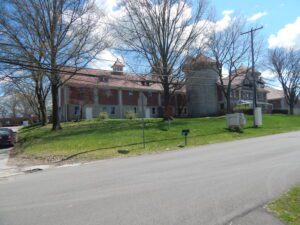
Ohio Columbus Barber began construction of his farm complex in 1909; Barn No. 1 was the first structure. The farm, named for his daughter and son-in-law, ultimately encompassed 3500 acres and 102 structures. It was famous for both the design of its buildings and its scientific agriculture. Listed on the National Register of Historic Places, Barn No. 1 was renovated in 1985 by Yoder Brothers, Inc., for their world headquarters.
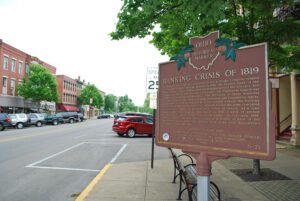
To provide direction and stability to the economy, Congress created the nation’s largest lending agency in 1816, the Second Bank of the United States. Branch banks were established around the country, two of them in Ohio-Chillicothe and Cincinnati. The Chillicothe branch was located in a building on this site. The presence of these branches adversely affected the ability of state chartered and independent banks, which had long printed and lent their own money without the backing of species. When the Secretary of Treasury forced the state chartered and independent banks to redeem their notes in specie, at a time when a sharp recession hit the nation in 1819, a wave of protest arose from those connected with those banks. In February 1819, Ohio’s General Assembly levied a tax of $50,000 on each of the two branch banks, and bank officers were given until September 1 to comply with the law. (continued on other side)
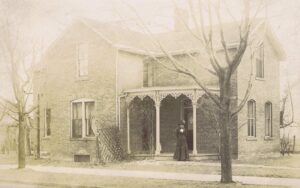
Generations of the Barker family lived in the house that stood at 89 Wood Street from 1875 to 1973. George W. Barker (1836-1913) was born enslaved in Virginia, emancipated age 13, and settled in Mansfield by 1870. He worked as a well-known chef in downtown hotels. In December 1873, Barker married Dayton-native Harriet J. Hurley (1840-1925). The next April, he purchased a corner plot in Snyder’s Subdivision for $450. Completed by 1875, his original brick house sheltered Barker, his wife, and his mother-in-law, Eliza Hurley (1815-1885). The Barker’s children — Sumner (1875-1890) and Sarah Daisy (1877-1973) — were born there. The Barker family were one of Mansfield’s historic Black families and members of the First Congregational Church. Their house once included a decorative wooden porch, numerous outbuildings, and served as an important community gathering place.
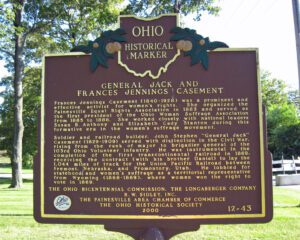
Western Reserve agriculturalist Charles Clement Jennings built the Casement House, also known as the “Jennings Place,” for his daughter Frances Jennings Casement in 1870. Designed by Charles W. Heard, son-in-law and student of Western Reserve master builder Jonathan Goldsmith, it is an excellent example of the Italianate style, featuring ornate black walnut woodwork, elaborate ceiling frescoes, and an innovative ventilation system. It remained in the Casement family until 1953. It was added to the National Register of Historic Places in 1979.
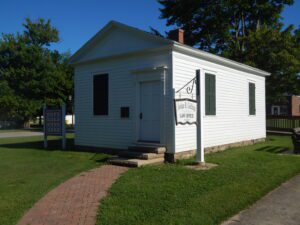
This building served as the law office to Joshua Reed Giddings, a Whig congressman who advocated for the abolition of slavery and an end to the domestic slave trade. Born in 1795, much of Giddings’ young life was occupied by working on his father’s farm. After serving in the War of 1812, he began to study law, gaining admittance to the bar in 1821. A successful lawyer, Giddings was elected to the Ohio House of Representatives in 1826. In 1837, he was elected as a Whig to the U.S. House of Representatives, where he quickly established himself as a staunch opponent of slavery. In 1854, he joined the Republican Party, contributing greatly to the platform during the party’s conventions of 1856 and 1860. As reward for his dedication, President Abraham Lincoln appointed him as consul- general to Canada, where he served until his death in 1864.
On July 3, 1872, 16 men and a 9-year old boy descended the 170 foot shaft in the Atwater Coal Company Mine located in Atwater Township south of Route 224 and East of Route 225. The mine was situated on the property known as the S.G. Shaffer Farm. By mid-day, 7 miners survived the brutal fire in the mine. Richard Roberts, Robert Roberts, William Roberts, Thomas Maines, Joseph Otey, John Williams, John Howells, John Jones and 9-year old George Hufford gave their lives to the first Mining Disaster in Ohio and the 19th mining disaster in the United States since 1839 with more than 5 fatalities. In 1873, Ohio was the second State to pass a law for the safety of Miners.
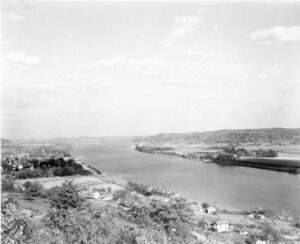
On April 1, 1818, six families from the Cilcennin area of Mid-Wales sailed from Aberaeron, Wales to Baltimore. The group of 36 people was led by John Jones Tirbach. From Baltimore they traveled to Pittsburgh and then by flatboats down the Ohio River toward their destination-Paddy’s Run in Butler County in the southwest corner of Ohio. They stopped in Gallipolis for provisions where their boats were cut loose by either travel-weary women or citizens of Gallipolis who wanted them to stay. The men found work on the Gallipolis to Chillicothe road that was under construction. The terrain reminded them of Mid-Wales, so they purchased land near Centerville and remained. These Welsh prospered and wrote home to Wales with news of their success, prompting others to come. (continued on other side)
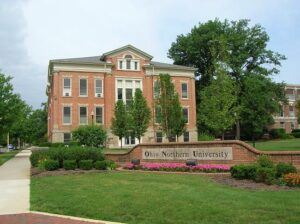
Henry Solomon Lehr founded Ohio Northern University in 1871 as the Northwestern Ohio Normal School. Its purpose was to train teachers and to provide higher education to the people in Northwest Ohio. In 1885, the school became Ohio Normal University. The new name recognized that the institution drew students from all over Ohio and the nation, and offered courses in many disciplines, including literature, music, business, telegraphy, and law, as well as teacher training. Beginning with 131 students, the institution’s enrollment grew rapidly during its first thirty years of existence. Buildings on the early campus included Dukes Memorial (left), built in 1905; the Normal School Building, built in 1871 and demolished in 1915 to make way for Lehr Memorial (center); and Hill building (right) finished in 1879. The Methodist Episcopal Church (predecessor to the United Methodist Church) assumed control in 1899. Ohio Normal University became Ohio Northern University in 1903. On June 3, 1910, President William Howard Taft delivered that year’s commencement address near this spot.