

, OH
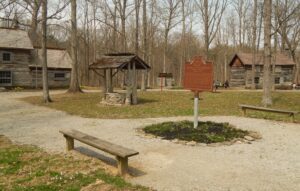
Edward Bebb, father of William Bebb and first Welshman to settle in Paddy’s Run, Morgan Township, Butler County purchased this cabin in 1801. Originally the cabin stood four miles southeast of this site on the Dry Fork of the Whitewater River. It was here that William Bebb was born on December 8, 1802, the first white child born in Butler County west of the Great Miami River. At the age of twenty, after attending district schools, William Bebb became a teacher. In 1826 he became the first teacher at Paddy’s Run School. Two years later Bebb and his wife opened a boarding school on his father’s farm. While teaching school he began the study of law and in 1831 passed the state bar examination. A year later he began to practice law in Hamilton, where he soon became an active politician. In 1840 he stumped the state for Harrison and Tyler and in 1846 he was nominated for Governor by the Whig party. He was elected on the slogan “Wm. Bebb and a Home Currency against David Tod and Pot Metal.” After his term as governor, Bebb served in a number of government positions until his retirement to his farm near Rockford, Illinois. He died on October 23, 1873.
, OH
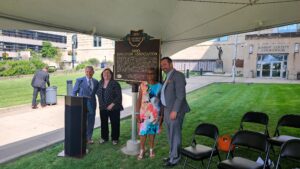
On December 30, 1847, six educators met at the Summit County Courthouse to organize the first convention of the Ohio State Teachers’ Association, now known as the Ohio Education Association (OEA). The organizers Josiah Hurty (Richland County), Thomas W. Harvey (Geauga County), M.D. Leggett (Summit County), Lorin Andrews (Ashland County), William Bowen (Stark County), and Marcellus F. Cowdery (Lake County) hoped “to elevate the profession of teaching” and “to promote the interests of schools in Ohio.” In 1853, the General Assembly enacted the new association’s entire slate of proposals into law, thus ensuring free, universal, public education in Ohio. For 176 years, the Ohio Education Association has advocated for fair terms and conditions of employment for Ohio educators and for the betterment and improvement of public education for all students.
, OH
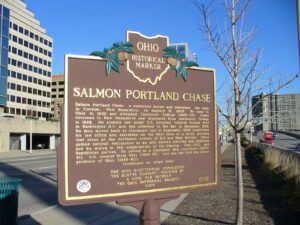
Salmon Portland Chase, a renowned lawyer and statesman, was born in Cornish, New Hampshire, on January 13, 1808. He came to Ohio in 1820 and attended Cincinnati College (1822-23). Chase returned to New Hampshire and graduated from Dartmouth College in 1826. He studied law under U.S. Attorney General William Wirt in Washington D.C. and was admitted to the bar in December 1829. He then moved back to Cincinnati and in September 1830 established his law office and residence on the first floor of a brick building that stood at the northeast corner of 3rd and Main Streets. Chase gained national recognition as an anti-slavery attorney and politician and by aiding in the organization of the Liberty, Free-Soil, and Republican parties. He served as a Cincinnati city councilman (1840-41), U.S. senator from Ohio (1849-55), and was the first Republican governor of Ohio (1856-60). (continued on other side)
, OH
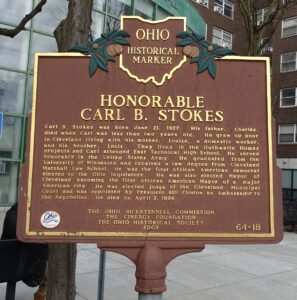
Carl B. Stokes was born June 21, 1927. His father, Charles, died when Carl was less than two years old. He grew up poor in Cleveland living with his mother, Louise, a domestic worker, and his brother, Louis. He served honorably in the United States Army. He graduated from the University of Minnesota and received a law degree from Cleveland Marshall Law School. He was the first African American democrat elected to the Ohio legislature. He was also elected Mayor of Cleveland, becoming the first African American Mayor of a major American city. He was elected judge of the Cleveland Municipal Court and was appointed by President Bill Clinton as ambassador to the Seychelles. He died on April 3, 1996.
, OH
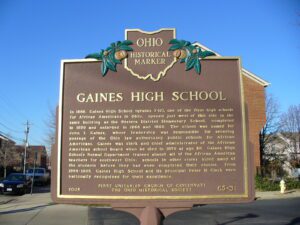
In 1866, Gaines High School (grades 7-12), one of the first high schools for African Americans in Ohio, opened just west of this site in the same building as the Western District Elementary School, completed in 1859 and enlarged in 1866 and 1868. The school was named for John I. Gaines, whose leadership was responsible for securing passage of the Ohio law authorizing public schools for African Americans. Gaines was clerk and chief administrator of the African American school board when he died in 1859 at age 38. Gaines High School’s Normal Department trained almost all of the African American teachers for southwest Ohio; schools in other states hired many of the students before they had even completed their studies. From 1866-1886, Gaines High School and its principal Peter H. Clark were nationally recognized for their excellence.
, OH
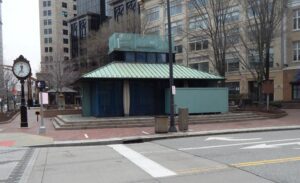
On October 31, 1963, the actions of Cleveland Police Detective Martin J. McFadden led to a new legal standard allowing police officers in the United States to stop and frisk suspicious persons prior to committing a crime. On that day McFadden had spotted three men loitering outside a jewelry store at 1276 Euclid Avenue. Believing a robbery was about to take place, the 38-year veteran stopped the men and checked them for weapons. Two of them had guns and were charged with, and convicted of, carrying concealed weapons. The law at the time allowed officers to stop a suspect only after a crime was committed. They appealed their case all the way to the United States Supreme Court. In a landmark decision on June 10, 1968, Chief Justice Earl Warren delivered the court’s opinion that McFadden’s action, called a “Terry Stop” after one of the suspects, was justifiable.
, OH
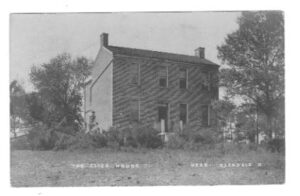
Three hundred yards east of this location on Oak Road, overlooking the Miami & Erie Canal, was the house of abolitionist John Van Zandt (1791-1847). For years this house was known as one of the most active “stations” on the Underground Railroad. In 1842, two bounty hunters from Sharonville caught Van Zandt helping eight runaway slaves who had escaped from owner Wharton Jones of Kentucky. Defended in court by Salmon P. Chase, who became Chief Justice of the Supreme Court of the United States from 1864-1873, Van Zandt was convicted and fined. Chase appealed the case to the U.S. Supreme Court, where he tested the constitutionality of the 1793 Fugitive Slave Law. When writing her novel Uncle Tom’s Cabin, Harriet Beecher Stowe used Van Zandt as the abolitionist character John Van Trompe. Van Zandt’s house became associated with the book and was known as “The Eliza House,” named for one of the novel’s main characters.
, OH
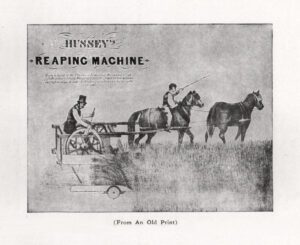
Mechanical reapers enabled farmers to harvest much more grain than they could by sickle or scythe. In June 1835, in a field 800 feet southeast of Mill Creek, inventor Obed Hussey (1791-1860) tested what he upheld as the first successful reaper. Blacksmith John Lane, miller Jediah Hill, Hill’s son-in-law Henry Rogers, brothers Algernon and Thomas Foster, and others observed the test, the culmination of Hussey’s experiments with prototypes since the early 1830s. Hussey’s patent for a reaper in 1833 predated that of his competitor Cyrus McCormick (1809-1884) applied for in 1834. Initially, some preferred Hussey’s reaper to McCormick’s, although McCormick’s machines eventually dominated the field. In the late 1850s, Hussey and others sued McCormick for patent infringement and won, compelling the payment of damages by McCormick.