

, OH
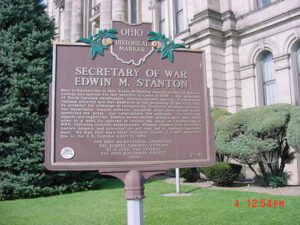
Born in Steubenville in 1814, Edwin McMasters Stanton studied at Kenyon College and opened his law practice in Cadiz in 1836. The grandson of North Carolina slaveholders, Stanton opposed slavery. A successful railroad attorney and War Democrat at the beginning of the Civil War, he accepted the challenge of reorganizing President Abraham Lincoln’s War Department. Stanton enforced unpopular draft laws, fought draft, restricted the press, and nationalized the railroads. An effective planner and logistician, Stanton moved 20,000 soldiers more than 1,200 miles in a week by railroad to relieve the siege of Chattanooga in 1863. Following Lincoln’s assassination, Stanton clashed with President Andrew Johnson and provoked the act that led to Johnson’s impeachment. He died four days after President Ulysses S. Grant appointed him to the U.S. Supreme Court in 1869.
, OH
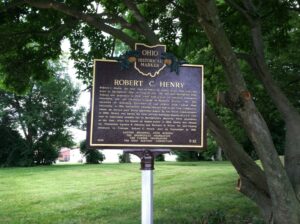
Robert C. Henry, the first African-American mayor of an Ohio city, was born in Springfield, Ohio, on July 16, 1921. He attended Springfield High School and graduated in 1939. After high school, he attended Wittenberg University and the Cleveland College of Mortuary Science. He also received an honorary Doctorate of Law degree from Central State University. In 1961, Springfield citizens elected him to the City Commission, where he served until being appointed mayor by his fellow commissioners in 1966. Henry was among the first African-American mayors of a U.S. city, and is especially notable due to Springfield’s majority white population at the time. After his tenure as mayor ended in 1968, Henry was chosen by presidents Lyndon B. Johnson and Richard M. Nixon for fact- finding missions in Vietnam. Robert C. Henry died on September 8, 1981.
, OH
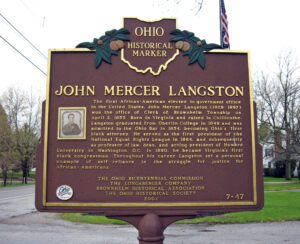
The first African-American elected to government office in the United States, John Mercer Langston (1829-1897) won the office of Clerk of Brownhelm Township on April 2, 1855. Born in Virginia and raised in Chillicothe, Langston graduated from Oberlin College in 1849 and was admitted to the Ohio Bar in 1854, becoming Ohio’s first black attorney. He served as the first president of the National Equal Rights League in 1864, and subsequently as professor of law, dean, and acting president of Howard University in Washington, D.C. In 1890, he became Virginia’s first black congressman. Throughout his career Langston set a personal example of self-reliance in the struggle for justice for African-Americans.
, OH
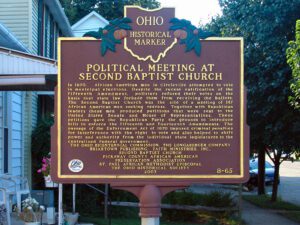
In 1870, African American men in Circleville attempted to vote in municipal elections. Despite the recent ratification of the Fifteenth Amendment, pollsters refused their votes on the basis that state law forbade them from receiving the ballots. The Second Baptist Church was the site of a meeting of 147 African American men seeking redress. Together with Republican leaders these men produced petitions that were sent to the United States Senate and House of Representatives. These petitions gave the Republican Party the grounds to introduce bills to enforce the Fifteenth and Fourteenth Amendments. The passage of the Enforcement Act of 1870 imposed criminal penalties for interference with the right to vote and also helped to shift power and authority from the individual state legislatures to the centralized Federal government.
, OH
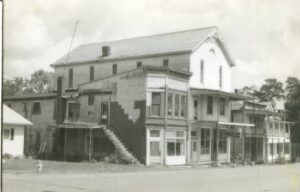
The commercial building that stood at 305 Main Street for over a century was built by Justus S. Law in 1897. On April 1, 1897, Law leased the Odd Fellows and Knights of Pythias joint-use of the third floor, rent-free, for 99 years after they completed its construction and added a slate roof to the building. Although the Pythians purchased the remainder of the building in 1921, they continued to share their “Castle Hall” with the Odd Fellows until 1965. In July 1974, the Pythians assigned their Pleasant City property to the Ohio Knights of Pythias Home in Springfield. From 1974 to 2012 the property exchanged private ownership multiple times until forfeited to the state in 2020. After the dilapidated Victorian building was demolished in 2021 the land was donated to the Village of Pleasant City.
, OH
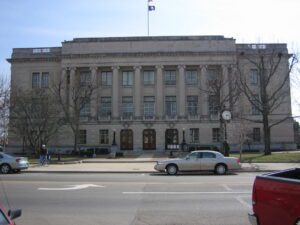
The current Preble County Courthouse, the third courthouse erected on this site, was designed by noted architect and Preble County native Harvey Heistand. Its cornerstone was laid on March 17, 1917, with a copper box containing a bible, historic papers, and other memorabilia placed under the stone. Upon completion, the building was dedicated on September 10, 1918, with three thousand people attending the ceremony. Designed in the Neo-Classical style, the exterior was constructed of Indiana Bedford limestone with ten immense columns that extend upward from the second floor. Above the colonnade, a dentiled entablature is inscribed, Salus Populi Suprema Lex, meaning “The health of the people is the supreme law.” The façade is enhanced with a bricked courtyard flanked by balustraded terraces. [continued on other side]
, OH
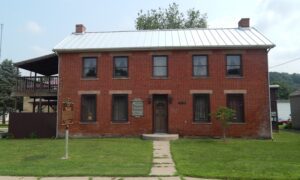
Named for General Zebulon Pike, killed in the War of 1812, Pike County was organized in February 1815. Commissioners were charged with establishing a county seat and on May 12, 1815 accepted a conveyance of 40 acres from Elisha Fitch. The new seat was named “Piketon.” In 1816, the commissioners let a contract for the construction of a courthouse and jail. A fine two story courthouse with brick laid in Flemish bond was finished in 1819. A fire destroyed some country courthouse offices on October 9, 1844. The repaired courthouse was the seat of county government until 1861 and is part of the Piketon Historic District, which was listed on the National Register of Historic Places in 1974. Limestone headers above the windows have the names of the county government offices.
, OH
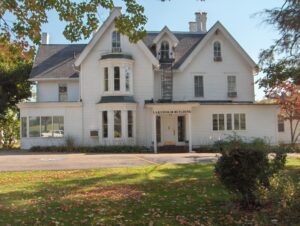
Lakeholm was built as the home of Columbus Delano while serving as Secretary of the Interior under President Ulysses S. Grant from 1870 to 1875. Delano (1809-1896) came to Mount Vernon in 1817, attended public schools, studied law, and was admitted to the bar in 1831. In addition to practicing law in Mount Vernon and serving as the Prosecuting Attorney of Knox County, Delano was a farmer, mill owner, and politician. Lakeholm, originally part of a 300-acre farm, contains many of its original rooms and Italianate features. In 1966, 209 acres of the farm were acquired for the establishment of the Mount Vernon Nazarene College. The house served as offices, meeting rooms, and classrooms. In 2002, the college became a university and continues to use Lakeholm for administrative offices. Historic Lakeholm is a focal point on the Mount Vernon Nazarene University campus and a symbol of the institution’s ties with the Mount Vernon community.