Trenton’s founder, Michael Pearce, came to the area in 1801. The original village of 33 lots was named Bloomfield. When the post office was established in 1820, it was named Trenton to honor the founder’s home state of New Jersey. Pearce’s son-in-law, Squier Littell, was the first resident doctor in Butler County. Originally settled by the English, Trenton saw a migration of Germans by 1840. By 1851, the farming community became a grain center with the introduction of the Cincinnati, Hamilton, and Dayton Railroad. Further development occurred when a franchise was granted to operate interurban electric traction cars through the village in 1896. Early commercial endeavors were Dietz, Good & Company grain elevator, Trenton Foundry, and Magnode Corporation. By 1991, the largest industries were Miller Brewing Company and Cinergy/Cincinnati Gas & Electric.
Ottawa Park, the largest city park, was developed in the early 1890s on the 280-acre farm of John B. Ketcham. Based on a design by the famous landscape architect, Frederick Law Olmsted, Ottawa Park was intended to be central to a vast park and boulevard system. By 1920 the Toledo Park movement had provided fifteen parks totaling nearly 1400 acres.
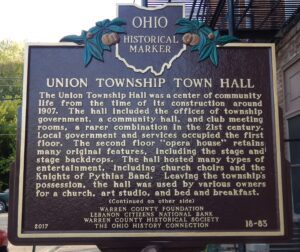
The Union Township Hall was a center of community life from the time of its construction around 1907. The hall included the offices of township government, a community hall, and club meeting rooms, a rarer combination in the 21st century. Local government and services occupied the first floor. The second floor “opera house” retains many original features, including the stage and stage backdrops. The hall hosted many types of entertainment, including church choirs and the Knights of Pythias Band. Leaving the township’s possession, the hall was used by various owners for a church, art studio, and bed and breakfast.(Continued on other side)
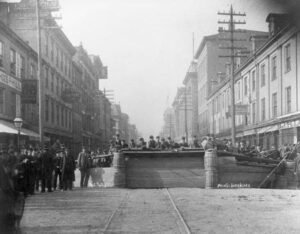
In March 1884, public confidence of Cincinnati law enforcement was extremely low. The public believed that murderers and other serious offenders were not brought to justice promptly or received little punishment. Civil unrest was brought to a boil when a seventeen-year-old was sentenced to only twenty years for manslaughter after brutally murdering his employer. On March 28, thousands of citizens stormed the county jail and courthouse. The riots lasted three days requiring forces from the Sheriff’s Office, city police, and local and state militia to restore order. Fifty-four people were killed and more than 200 wounded. The courthouse and jail suffered enormous damage, and valuable records were destroyed from the assault and fire. The riot gained international notoriety and helped pave the way for removal of political favoritism and a larger police force.
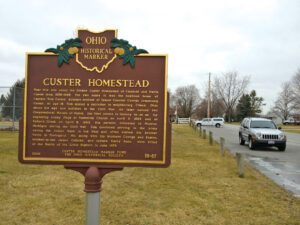
Near this site stood the former Custer Homestead of Emanuel and Maria Custer from 1856-1865. For two years it was the boyhood home of Captain Tom Custer, younger brother of famed General George Armstrong Custer. At age 16, Tom misled a recruiter in neighboring Gilead, Ohio about his age and enlisted in the Civil War. He later earned two Congressional Medals of Honor, the first person in history to do so, for capturing enemy flags at Namozine Church on April 3, 1865 and at Sailor’s Creek on April 6, 1865. His parents relocated to Monroe, Michigan during the Civil War. Tom continued serving in the Army during the Indian Wars in the West and often visited his brother Nevin in Tontogany. He, along with his brothers George and Boston, brother-in-law James Calhoun, and nephew Harry Reed, were killed at the Battle of the Little Bighorn in June 1876.
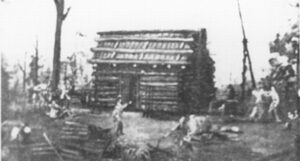
In the late 1790s General Benjamin Whiteman built near this site one of the first log cabins in Alpha, the first settlement in what would become Beavercreek Township of Greene County. The cabin, later owned by Whiteman’s father-in-law, Owen Davis, and leased for use as a tavern to Peter Borders, became the first courthouse of Greene County. Twenty-five feet square, it had one room below and a chamber above, serving as the family sleeping quarters. A small ladder through a hole in the ceiling reached the upper level. The building was constructed of burr oak logs with a roof made of clapboards held in place by long poles laid across them. Considered to be one of the finest houses in that part of the county, the cabin had one door, one window, and a huge fireplace with an outside chimney built of sticks, stones, and clay. (Continued on other side)
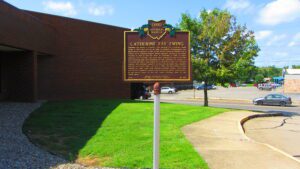
Frances Dana (Barker) Gage was born on October 12, 1808, in Marietta. She married James L. Gage in 1829 and they raised eight children, including four sons who served with Union forces during the Civil War. Throughout much of her life, Frances was deeply involved with the Temperance and Anti-Slavery movements and Women’s Rights issues. Presiding over the Women’s Rights Convention in Akron in 1851, she invited Sojourner Truth to give her famous “Ain’t I a Woman” speech. The Gage family moved in 1853 to St. Louis, the western extension of the Mason-Dixon Line, where her life was threatened whenever she spoke out against slavery. During the Civil War, she traveled south to aid Union soldiers and teach freed slaves. Though crippled and permanently disabled by a stroke, she continued to lecture on social issues until 1867. Frances Dana Gage died on November 10, 1884, in Greenwich, Connecticut.
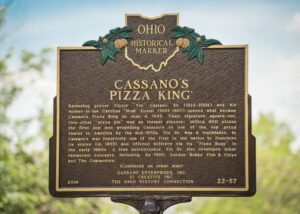
Kettering grocer Victor “Vic” Cassano, Sr. (1922-2002) and his mother-in-law Caroline “Mom” Donisi (1893-1987) opened what became Cassano’s Pizza King on June 4, 1953. Their signature square-cut, thin-crust “pizza pie” was an instant success; selling 400 pizzas the first day and propelling Cassano’s to one of the top pizza chains in America by the mid-1970s. Vic Sr. was a trailblazer, as Cassano’s was reportedly one of the first in the nation to franchise its stores (in 1955) and offered delivery via its “Pizza Bugs” in the early 1960s. A true entrepreneur, Vic Sr. also developed other restaurant concepts, including, by 1980, London Bobby Fish & Chips and The Commodore. (Continued on other side)