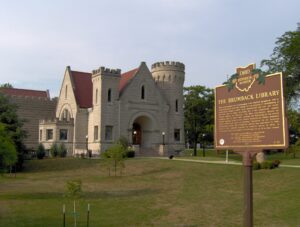
When local banker and businessman John Sanford Brumback left a large bequest to Van Wert County for the purpose of establishing a countywide library in 1897, such institutions did not yet exist, and Ohio had no legal provision for a tax-supported county library system. In response, the Ohio Legislature passed an enabling law in April 1898, marking the beginning of the county library system in the United States. Designed by Toledo architect David L. Stine and built of Bedford limestone in an eclectic Romanesque style, the Brumback Library was dedicated in 1901. Added to the National Register of Historic Places in 1979, it continues to serve as a center of knowledge for all of Van Wert County.
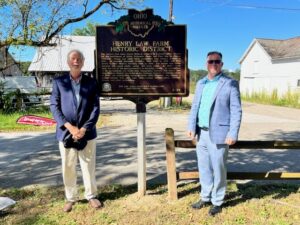
The historic Law Farm (circa 1846) is situated in a broad valley formed by the confluence of Little Stillwater Creek and Plum Run in Monroe Township. Henry Law (1812-1869) immigrated from Ireland to Ohio in 1830. He married Elizabeth McMillan (1818-1892) in 1839, and they moved to their Monroe Township farm by 1846. The couple had eleven children and raised cattle, sheep, and other crops. By 1860, their farm was one of the most productive in Harrison County. In recognition of its agricultural and Scots-Irish immigration history, the Henry Law Farm Historic District was listed on the National Register of Historic Places in 2002. Its contributing buildings (1846-1920) included: two houses; a summer kitchen; tool, milk, coal, smoke houses; multiple barns; carriage houses; and other outbuildings.
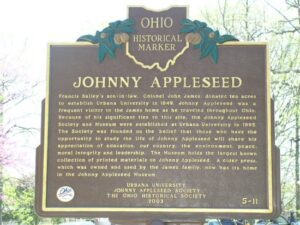
Urbana University was established by the Swedenborgian Church in 1850. Bailey Hall (1853), named after Francis Bailey (1735-1815), was designed by W. Russell West, architect of the Statehouse of Ohio. Bailey was an American Revolutionary War hero, official printer of the Continental Congress and printer of The Freeman’s Journal or the North American Intelligencer. He also printed The True Christian Religion papers. John (Johnny Appleseed) Chapman (1774-1845) distributed The True Christian Religion papers along with his famous apple trees throughout Ohio as a missionary for the Swedenborgian Church. Barclay Hall (1883) was named after Hester Barclay, a ward of Francis Bailey. It was Hester Barclay’s brother-in-law, John Young, who converted Chapman to the Swedenborg faith. Francis Bailey and Hester Barclay were the first male and female Swedenborgian converts in North America. Both Bailey and Barclay halls appear on the National Register of Historic Places.
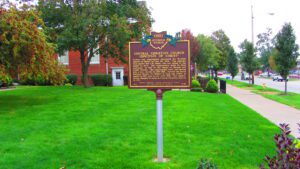
Harvey Howard, a local druggist, built the house at 407 North Market Street around 1860. After many owners, Captain James B. Taylor bought the home in 1893. Taylor commanded Company H of the 120th Ohio Volunteer Infantry during the Civil War. He studied law after the war and moved his practice to Wooster in 1882. Taylor’s wife Emelie died in 1905 and in 1906 Taylor sold the property to become Wooster’s first city hospital. Many of the town’s noted physicians practiced here and the facility was eventually enlarged to accommodate 30 beds. The house was a hospital until 1943, when Central Christian Church purchased it. The church used the building for education programs and restored much of its decor, including four fireplaces, inlaid floors, and bronze door hardware.
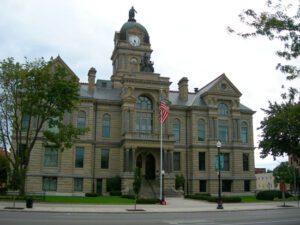
Hancock County was organized March, 1828, court being held in a log schoolhouse. In 1833, a frame courthouse was built. It served until 1840, when a brick structure went up on this site. During the oil and gas boom of the 1880’s, the present courthouse was erected at a cost of $305,272, and dedicated Oct. 27, 1888.
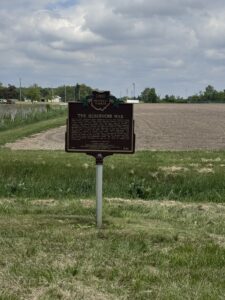
Here in 1887, frustrated locals destroyed the Six Mile Reservoir when legal efforts to close it failed. Years after any boat ran on the Wabash & Erie Canal, its water source, the 2,000-acre reservoir, became a stagnant, uncultivable breeding ground for disease-carrying mosquitos. Legislative attempts to abandon the canal and reservoir failed because manufacturers in Defiance used the waterway to float logs downstream. On the night of April 25, 1887, 200 men calling themselves “The Dynamiters” carried a banner that read, “No Compromise! The Reservoir Must Go!” and converged here, overpowered citizen guards, gouged the banks of the reservoir, dynamited the bulkhead and lock, and burned down the lockkeeper’s house. The next day, Governor Joseph B. Foraker denounced the acts of the “mob of lawless and rioting men.” (Continued on other side)
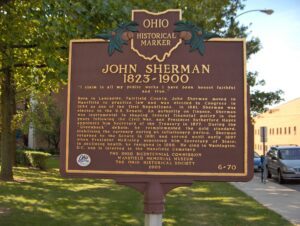
Born in Lancaster, Fairfield County, John Sherman moved to Mansfield to practice law and was elected to Congress in 1854 as one of the first Republicans. In 1861, Sherman was elected to the U.S. Senate. An authority on finance, Sherman was instrumental in shaping federal financial policy in the years following the Civil War, and President Rutherford Hayes appointed him Secretary of the Treasury in 1877. During the “Greenback” debate, he re-implemented the gold standard, stabilizing the currency during an inflationary period. Sherman returned to the Senate in 1881 and served until early 1897 when President McKinley appointed him Secretary of State; in declining health, he resigned in 1898. He died in Washington, D.C. and is interred in the Mansfield Cemetery.
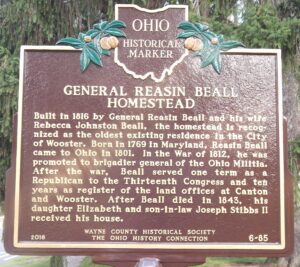
Built in 1816 by General Reasin Beall and his wife Rebecca Johnston Beall, the homestead is recognized as the oldest existing residence in the City of Wooster. Born in 1769 in Maryland, Reasin Beall came to Ohio in 1801. In the War of 1812, he was promoted to brigadier general of the Ohio militia. After the war, Beall served one term as a Republican to the Thirteenth Congress and ten years as a register of the land offices at Canton and Wooster. After Beall died in 1843, his daughter Elizabeth and son-in-law Joseph Stibbs II received his house.